
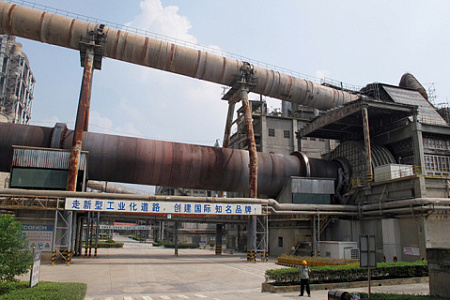
In China, authorities can curb output at cement plants during periods of weak demand.
Russia’s cement industry is grappling with a deepening slump in demand. Two factors are driving the downturn: slowing construction activity and seasonality, with consumption of building materials traditionally hitting its lowest point in winter. Against this backdrop, analysts at consultancy SMPro have pointed to China’s experience, where the government steps in during seasonal demand slumps and orders cement kilns to be temporarily shut down. While players in the construction sector warn that such a policy could carry risks if applied in Russia, cement producers themselves have shown interest in the idea.
How China Manages the Market
In some Chinese provinces, mainly in the country’s north, part of the cement industry’s production capacity must be taken offline during periods of weak demand under regional government directives. The shutdowns are typically scheduled for specific periods and durations. For example, authorities in the Ningxia Hui Autonomous Region announced that cement kilns would be shut down for a total of 136 days during the 2025–2026 season, according to SMPro.
Formally, the policy is justified on environmental grounds: reducing emissions during the heating season, when heavy smog becomes a particularly acute problem. But experts say there is also a clear economic logic behind the official explanation.
Outside the heating season, the industry can add further shutdown days under a regime described as ‘self-discipline’. In Liaoning province, official documents explicitly outline a centralised shutdown between January and March, followed by up to two additional months of stoppages. The exact timing is decided by local authorities together with industry associations and plant operators, taking into account both air quality and market conditions.
Under normal market logic, each plant would be expected to scale back production when demand weakens. In reality, however, that rarely happens when there is excess capacity, analysts note. No one voluntarily cuts output; instead, producers compete by slashing prices, ultimately damaging the industry itself. To prevent this, the Chinese state steps in and takes control of the situation.
‘In market terms, this means that when demand weakens, China, meaning the government, does not wait for the industry to destroy itself through dumping. Excess supply is systematically taken off the market during the most difficult period, winter and early spring. Under the banner of environmental protection, the policy effectively acts as an anti-dumping mechanism: it is tough for everyone, but equally so, and prices are prevented from turning into a rollercoaster,’ analysts at SMPro say.
The measures deliver both environmental and economic benefits. ‘On average, the market manages to hold prices steady during the off-season, creating a clear anti-dumping effect. This does not solve the underlying problem of excess capacity, and profitability in China’s cement industry continues to decline. But it is the most effective form of support the state can offer,’ said Vladimir Guz, managing partner at consultancy SMPro.
Double Blow for Russia’s Cement Market
In Russia, winter has long been the industry’s low season. When temperatures drop below –25°C, concrete work is banned, and strong winds can make the use of tower cranes impossible. With harsh weather halting most ‘wet’ construction work, demand can fall sharply. According to estimates by SMPro, winter consumption typically runs two to three times lower than in summer. In 2025, cement demand peaked in July at 6.6 million tonnes, while in January it amounted to just 2.68 million tonnes.
Seasonal demand largely shapes how cement plants operate. In theory, production capacity should be used evenly throughout the year. In practice, however, output inevitably slows from November through April, with production hitting its lowest point in December and January, when demand for cement is weakest.
The winter slump cannot simply be offset during the summer months. Plants face limits on daily output as well as logistical bottlenecks. During the peak construction season freight volumes surge, requiring additional rail wagons and driving up both transport costs and rolling stock rental rates. Railway priorities further complicate the situation. Extra passenger services are added to the network, and cement deliveries that would normally take a few days can end up stretching into weeks.
‘Seasonal swings in demand are typical across all regions of Russia, but the sharpest fluctuations occur in Siberia and the Far East because of the climate. Long winters and cold shoulder seasons affect production schedules, maintenance cycles and overall capacity utilisation,’ the industry association Soyuzcement says.
This winter the seasonal downturn has been amplified by severe frosts and record snowfall. Yet structural factors are weighing even more heavily on the market. Construction activity has been declining since 2024 amid the Central Bank’s high key interest rate, tighter mortgage conditions and falling housing sales. Cement demand is also weakening in infrastructure and road construction. According to Soyuzcement, orders from producers of ready-mix concrete, reinforced concrete products and aerated concrete, as well as from construction contractors, are declining. Overall cement consumption fell by 9% over the past year.
As a result of this combination of adverse factors, demand for cement plunged by 28% in January 2026 compared with January 2025. Shipments dropped to their lowest level in more than 15 years. The steepest declines were recorded in the North Caucasus Federal District (–43.9%), the Southern Federal District (–39.4%) and the Siberian Federal District (–35.8%).
What Producers Are Missing
Could China’s model of administratively regulating cement plant utilisation be applied in Russia? Analysts at SMPro believe it could.
‘There are two possible approaches. One is through environmental regulation, limiting emissions during the winter months, when overall pressure on the environment is higher. The other is through restrictions on electricity or gas consumption. Both would require a much greater degree of state involvement in managing the economy. That is a far more complex and systemic task than simply distributing subsidies or loans to individual producers,’ said Vladimir Guz.
He added that if companies, following the Chinese example, were to balance supply through ‘self-discipline’, antitrust risks would likely be minimal. ‘If each company independently cuts output in winter to avoid building up inventories, that is generally not considered a violation. Antitrust law does not prohibit reasonable kiln utilisation or inventory management, provided the decision is taken unilaterally and without coordination with competitors. One sign of this would be the absence of sharp price spikes,’ he explained.
Such measures would not create shortages, Guz argues. ‘The aim is simply to balance production, inventories and consumption during the winter months, when demand is two to three times lower than in summer. In effect, the industry has almost a fourfold reserve of capacity.’
CEMROS has also responded positively to the Chinese model. ‘China’s approach to managing excess production capacity and seasonal demand slumps shows a well-structured system of coordination at the provincial level. In essence, it is a systematic tool for balancing supply during periods of weak demand, which helps stabilise prices and reduces the risk of dumping,’ said Denis Usoltsev, director of marketing and strategic analysis at CEMROS. ‘China’s experience demonstrates that centralised coordination of capacity utilisation is a tool Russian producers currently lack.’
The company also highlights another structural constraint on the Russian market. ‘There is still no established government practice of producing medium- and long-term forecasts for cement demand,’ Denis Usoltsev said. ‘Without a clear planning horizon, it becomes much harder for producers to plan production programmes and logistics.’
As a result, companies are forced to rely mainly on current construction activity and short-term operational data, effectively operating in the dark. ‘Against the backdrop of a structural slowdown in housing construction, this increases the risk of overproduction and inefficient capacity utilisation,’ he said. With the cement market shrinking, the lack of an integrated forecast that takes into account housing construction plans as well as investment and infrastructure projects makes it more difficult for the industry to adapt to shifting market conditions, Usoltsev added.
‘The idea itself makes sense, but there are doubts about how feasible it is,’ said Vladimir Guz. ‘Planning is a systemic process that would require the involvement of a wide range of players, from federal ministries and the state construction review body Glavgosexpertiza to major corporations, developers and construction firms. We understand the methodology and have some experience, but without the participation of all these actors it is impossible to produce an accurate forecast. For now, we can only operate within a broad range of projected demand.’
Can Construction Go Year-Round?
The National Association of Builders (NOSTROY) believes adopting the Chinese approach would carry significant risks. ‘China’s experience of mandating cuts in cement production is certainly worth examining, but in my view it is not suitable for the Russian market,’ said NOSTROY president Anton Glushkov. ‘Such a policy would not promote balanced development in the industry and could create new supply–demand imbalances.’
Forced reductions in cement output would also have a knock-on effect on related industries, including producers of concrete, crushed stone, steel and other construction materials, he said. Lower cement consumption would ultimately translate into reduced construction volumes and require additional spending on heating systems and other technologies needed for winter concrete work.
‘It is also important to note that China’s experience in regulating the cement market is limited to certain provinces,’ Anton Glushkov added. ‘In major cities such as Beijing, Guangzhou, Shanghai and Shenzhen there are no such legislative restrictions. China’s strategy is aimed more at promoting exports of construction services than at cutting domestic production.’
Instead of imposing strict output limits, NOSTROY advocates expanding the use of modern construction technologies, particularly prefabrication, where buildings are assembled from factory-made components and only the installation takes place on site. The key advantage, Glushkov said, is independence from weather conditions: prefabricated elements can be produced year-round, regardless of the season, helping stabilise the supply of construction materials and reducing price volatility.
In Russia, construction continues through the winter thanks to special additives and heating systems, but these solutions drive up project costs, Glushkov said. ‘Expanding the use of prefabrication technologies would reduce dependence on seasonal factors and help maintain more even resource consumption throughout the year.’
Soyuzcement, for its part, says the Chinese experience merits close attention. ‘China’s approach to managing seasonal fluctuations and excess production capacity highlights the importance of balancing supply during periods of weak, and in Russia’s case also declining, demand. This makes it possible to mitigate negative effects not only for the construction materials industry but for the economy as a whole,’ the association said.
A return to year-round construction could help resolve the problem of seasonal demand, Soyuzcement says, stressing that there are no technological barriers to such a shift. While the necessary technologies would increase construction costs to some extent, more even utilisation of infrastructure would ultimately benefit developers, building materials producers and the broader economy, the association argues.
The industry also needs regional forecasts of cement demand for three, five and seven years ahead, aligned with projections for housing construction volumes, Soyuzcement added. ‘The cement industry is a capital-intensive, energy-intensive sector with large-scale output and long investment cycles. Maintaining additional capacity without guaranteed utilisation is economically inefficient. Expanding production can only happen gradually and requires major repair programmes and substantial investment,’ the association said.
In short, seasonality and the slowdown in construction have once again exposed a structural weakness in Russia’s cement market, one that will require a comprehensive response. Year-round construction technologies could help smooth the winter slump in demand, long-term consumption forecasts would give producers a clearer planning horizon, and a Chinese-style system of managed seasonal limits on capacity utilisation could remove excess supply from the market and reduce the risk of price dumping.