Most Russians are bracing for a prolonged conflict in Ukraine and the continuation of what authorities describe as a ‘special military operation’. More than half of the population now believe that ‘the most difficult times still lie ahead’, a share that continues to grow, according to surveys by the Institute of Psychology of the Russian Academy of Sciences.Levels of anxiety and depression are also on the rise, although they remain below the peaks recorded in 2022. No improvement is expected in the first half of the year, analysts said in a new forecast by the Institute of Economic Forecasting of the Russian Academy of Sciences, citing the lingering effects of economic slowdown.
After a year and a half under tight financial conditions, the Russian economy has seen a decline in capacity utilisation and a slowdown in demand, particularly for durable goods, machinery and equipment. The accumulated inertia of this economic ‘cooling’ leaves little room for expectations of any meaningful improvement in the first half of the year, according to a new quarterly forecast by the Institute of Economic Forecasting of the Russian Academy of Sciences. Even in the second half of 2026, any recovery remains largely theoretical.
A faster pace of economic growth in the second half of the year would only be possible through sustained stimulus of demand for domestic products, higher capacity utilisation and the subsequent launch of a new investment cycle. However, implementing such a sequence of measures under tightening budget constraints will be extremely challenging, economists at the Institute of Economic Forecasting of the Russian Academy of Sciences warn.
The inertial scenario assumes a gradual exit from the phase of economic ‘cooling’, with Russia’s GDP growth exceeding 2% only by 2028. At the same time, fiscal policy remains one of the key risks to economic development. Excessive budget consolidation could prolong the period of stagnation in economic activity, economists warn. GDP growth is forecast at 1.1% in 2026, only slightly above the officially reported figure for 2025. One potential driver of economic activity could be a reduction in the Central Bank’s key rate, which, among other effects, would lower household savings rates. However, expectations of stronger consumption are not borne out by public sentiment. Surveys by the Institute of Sociology of the Russian Academy of Sciences suggest that Russians remain cautious in their outlook.
An economic and psychological assessment of Russian society suggests that a savings-oriented model of behaviour will persist throughout 2026, according to a report by the Institute of Sociology of the Russian Academy of Sciences (IS RAS). Consumption is expected to remain largely situational, with households prioritising day-to-day spending over planning major purchases.
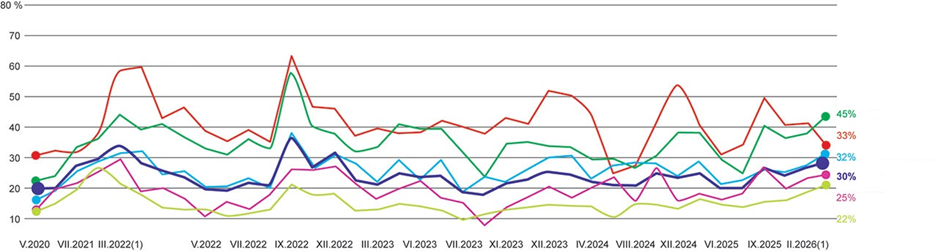
Anxiety levels across age groups and the overall population of the Russian Federation.
Source: Institute of Economic Forecasting of the Russian Academy of Sciences (RAS)
‘A high level of anxiety and depressive symptoms is observed in 31% of Russians. This is driven by pessimistic economic expectations, as well as mounting fatigue from the ‘special military operation’, alongside a marked decline in hopes for its swift conclusion,’ psychologists said.
Symptoms of depression are more common among residents of large cities, while anxiety is more prevalent in rural areas, the report notes. The lowest levels of psychological well-being are currently observed among people aged 25 to 34, low-income Russians and employees of commercial organisations. Among higher-income groups, defined as those able to afford a car, an apartment or a country house, the share of respondents reporting high levels of anxiety and depression is six times lower than in the lowest-income group, at 11% and 64% respectively. However, in February 2026, an increase in psychological distress and financial anxiety was recorded across all socio-economic groups. Notably, the most vulnerable respondents were those who placed themselves either at the very bottom or at the very top of a perceived social ladder.
In February 2026, psychological distress and financial anxiety increased across all socio-economic groups. The share of respondents reporting anxiety when thinking about their finances rose to 66% in February, according to a report by the Institute of Sociology of the Russian Academy of Sciences
The share of respondents expecting their family’s financial situation to deteriorate has risen to 47%. At the same time, 53% anticipate a worsening of the national economy over the next 12 months. Negative economic expectations are more pronounced among residents of major cities, where 64% believe the country’s economic situation will deteriorate over the coming year.
At present, around 60% of Russians view the continuation of a military confrontation between NATO countries and Russia on Ukrainian territory as the most likely scenario for 2026. The expectation of a prolonged conflict is ‘leading to a mobilisation of psychological resources to cope with a sustained crisis’. This is reflected in the growing share of respondents who believe that the most difficult times for Russians still lie ahead. That view is now held by 52% of the population, up 7 percentage points from December 2025. The main factor shaping economic expectations in 2026 is no longer the potential end of the ‘special military operation’, but rising prices and the impact of budget deficits at both the federal and regional levels.
The increase in the value added tax rate in 2026, from 20% to 22%, along with other measures aimed at tightening tax collection, is likely to push some small businesses into the shadow economy. Survey data from urban residents suggest this trend is already taking shape. In February 2026, 27% of respondents said they had more frequently encountered requests from sellers to pay in cash for goods and services over the previous six months
A worsening economic outlook and a gradual rise in taxes are expected to entrench shadow economic behaviour among lower-income groups and trigger it among higher-income households, sociologists say. A preference for cash payments has been linked to inflation expectations, concerns over potential restrictions, low levels of trust in federal authorities and a perceived increase in social inequality.
Original:NG/Россияне не верят в мирное соглашение по Украине