By 2030, one in ten of the students in our country will be internationals
Olga Solovieva
The number of students from CIS member states studying in Russia is dwindling, while those from Asian countries is rising. The overall share of international students at Russian universities is growing so rapidly that, by 2030, every tenth student in Russia could be an international, according to forecasts by the Centre for Continuing Education Economics (CCEE) at the Presidential Academy. The Russian authorities intend for the number of international students to reach 500,000 by 2030. Experts estimate that by then, one in four of the international students will be enrolled in medical programmes
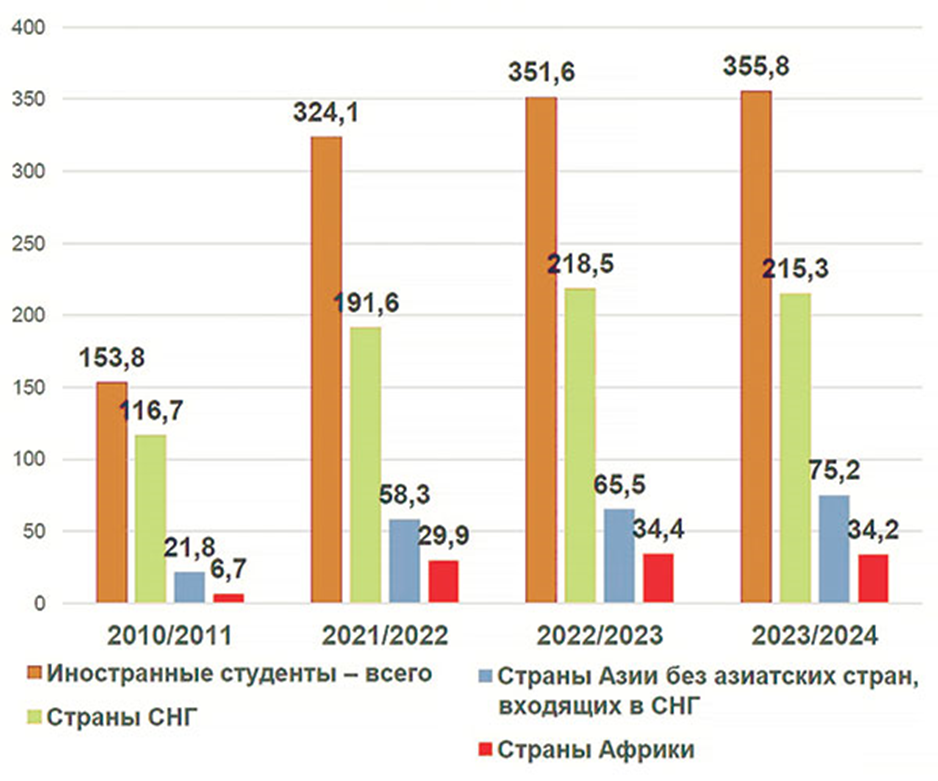
Russia is experiencing steady growth in its number of international students. From 2010 to 2024, they rose from 154,000 to 356,000. ‘Today, over 414,000 international students from 184 countries are studying in the Russian higher education system,’ Valery Falkov, head of the Russian Ministry of Education and Science, noted
The Russian authorities have set the goal of reaching 500,000 international students by 2030. These targets were set out in the presidential decree On National Development Goals of the Russian Federation for the Period up to 2030 and the Prospects for 2036
In just over 10 years, the share of international students at Russian universities has increased by more than 2.5 times, from 3% in 2013 to 7.2% in 2025, observes Inna Krakchieva, senior researcher at the Centre for Educational and Scientific Research of the Presidential Academy. If the current trend continues, experts expect that, by 2030, every 10th student and graduate of higher education institutions in Russia will be an international.
Russian education mainly attracts students from CIS member states and developing countries, including China, India, the Middle East and Africa. Meanwhile, the cross section of countries from which students come is changing. While in 2010 students from CIS member states accounted for 76% of all international students, by 2024, their share dropped to 60%, as shown in a study by the Presidential Academy. Over the same period, the proportion of students from Asian countries (excluding Asian CIS member states) increased from 14% to 21%. The proportion of students from African countries approached 10%, compared to 4% in 2010.
About 25,000 students from India are studying in Russia, according to data from the Presidential Academy. There are 56,000 Chinese citizens studying in basic educational programmes at Russian universities, noted Russian Ambassador to China Igor Morgulov late last year. This compares with the number of students from Kazakhstan (55,500), Turkmenistan (53,300), and Uzbekistan (47,500), as reported by the Russian International Affairs Council (RIAC).
The composition of the student flow into the Russian Federation has certain peculiarities, notes Tatyana Klyachko, Director of the Centre for Educational and Scientific Research of the Presidential Academy. According to her, the largest share is formed by applicants from Kazakhstan and Turkmenistan. ‘China is mainly represented by master’s students while Indians, Egyptians and Malaysians go for medical specialities, largely due to a shortage of doctors in their countries,’ she reports.
In addition, Klyachko highlights that medical education has been less affected by the structural changes brought along with the Bologna system. According to calculations by scientists at Sechenov University, by 2030, the number of international students in medical programmes at Russian universities may reach 117,000 people.
The revenues of Russian universities from the international students are also increasing. According to the Presidential Academy, in 2023, Russian universities’ revenues under educational contracts with international students increased by 27.7% over the year to 40.5 billion. The growth in educational exports continued for the fifth consecutive year, with revenues almost doubling from 2019, when the figure stood at 20.5 billion
Meanwhile, over half (55%) of all funds Russia receives from international students go to six regions: Moscow, St. Petersburg, Bashkortostan, Tatarstan, Primorye and Volgograd Region.
According to the experts, one current example of the successful development of exporting education is Tatarstan, which earned almost RUB 4 billion from international students in 2023. By comparison, universities in St Petersburg earned less than 3 billion over the same period
‘Today, approximately 370,000 international students are studying at Russian universities, out of a total student body of about 4.66 million. That is about 8.5%,’ Tatyana Klyachko points out. Comparatively speaking, this is not unlike the US, she continues. ‘However, in absolute numbers, the difference is significant: over 1 million international students are enrolled at American universities. In other words, in many ways, Russia’s statistics look more impressive because of the smaller overall basis for comparison,’ she says.
Tatyana Klyachko believes that Russia is mainly attractive for international applicants in the affordable, sufficiently high quality segment. ‘The country is more likely to attract those with a focus on finding a reasonable balance between cost and quality of training, rather than prestigious, elite academic trajectories. Meanwhile, more affluent and academically strong graduates from China and India tend to choose English-speaking destinations: the US, UK, Canada or Australia,’ she observes.
The experts see the uncertainty surrounding the future of bachelor’s and master’s degrees as a constraint on further growth. ‘For students focused on an international career, it is of fundamental importance to understand what kind of degree they will receive and how well it will be recognised abroad. When there is no such clarity, the inflow is primarily from those countries and categories of applicants for whom the reputation of Russian education is sufficient, regardless of the formal model followed,’ Klyachko points out.
Indeed, while the number of international students in Russia’s higher education system is generally growing, their share among undergraduate students is declining, from 70% of admissions in 2016 to 58% in 2025, and in terms of tuition, from 71% to 59% respectively. By contrast, there is a steady increase in the number of foreign nationals in specialist programmes from 2016 to 2025. Admissions actually rose from 12,900 to 25,900, and their share in admissions rose from 17% to 24%, according to the Presidential Academy.
The number of international students in undergraduate programmes exhibits the most rapid growth: from 1.3% in 2016 to 17.7% in 2025. ‘Thus, specialist programmes and master’s degrees are the drivers of growth. Their combined share in admissions has risen from 18% in 2016 to 42% in 2025,’ Inna Karakchieva reports.
Amid the growing number of international students in the Russian Federation, the flow of Russian students abroad is still rather weak. According to UNESCO data for 2023, an average of about 62,000 Russian students study abroad each year. Most of them study at universities in Germany, the Czech Republic, the USA, the UK, France and Finland. ‘So, the balance of the incoming and outgoing flows of students can be estimated at 6.5 to 1, which means that today, Russia serves as an exporter of education,’ Vasily Kutiin, director of analytics at Ingo Bank, points out.
The volume of the global higher education market is estimated to exceed USD 1 trillion by the end of 2025, and may rise to The volume of the global higher education market is estimated to exceed USD 1 trillion by the end of 2025, and may rise to USD 2.5 trillion by 2034, with an average annual growth rate of 11.62%.USD 2.5 trillion by 2034, with an average annual growth rate of 11.62%.