
The Russian government is embarking on sharp cuts to social spending. Federal funding for social policy is set to fall by more than 15% in nominal terms in 2027, with inflation making the real reduction even larger. Federal social spending will remain below this year’s level at least until 2030, according to the Finance Ministry. The government plans, among other measures, to reduce payments to large families and childbirth benefits. Subsidised housing programmes will also face cuts, according to an assessment by the Russian Academy of Sciences’ Institute of Economic Forecasting. This is the first time in modern Russian history that the authorities have made social spending cuts on such a scale.
The Finance Ministry’s plans to cut social policy spending are set out in a document titled Budget for Citizens. The ministry, headed by Anton Siluanov, says federal funding for social policy will fall from RUB 7,839 bln this year to RUB 6,651 bln in 2027. In nominal terms, this represents a 15.2% reduction in federal social spending
The cuts will be made partly by reducing monthly payments to large families and spending on childbirth benefits. Federal expenditure in these areas will be reduced by RUB 371 bln next year compared with this year, according to the Institute of Economic Forecasting (IEF) of the Russian Academy of Sciences in its assessment of the draft federal budget.
Child benefit cuts are also included in the draft budget of Russia’s off-budget Social Fund. ‘The Social Fund’s submitted budget already includes substantial cuts to the same unified benefit. Around RUB 1.6 tn is allocated for payments in 2027, compared with RUB 1.8 tn in 2026. Spending is being reduced even as the number of potential recipients rises. The cuts are being made ruthlessly. In 2027, the unified benefit will cover just 8 mln children, compared with 10 mln in 2025 and 2026. ‘One reason for this sharp reduction in coverage is the introduction of what is known as a residency requirement. The decision itself may not be unreasonable, but we must not allow 2 mln children to lose their right to state support simply because officials take months to process their documents,’ said Nina Ostanina, head of the State Duma Committee on Family Protection
The sharp reduction in social spending is part of the Finance Ministry’s new budget strategy. In brief, total government expenditure is to be held next year at roughly the 2026 level, while spending rises sharply in only two areas: defence and debt servicing. Spending on other items will be cut or kept broadly stable. To maintain government revenues at last year’s level in a stagnant economy, however, Siluanov’s ministry is increasing the overall tax burden on businesses and individuals.
The draft budget provides for several tax increases affecting non-oil and gas revenues. These include extending the progressive personal income tax scale to passive income, expected to generate an additional RUB 498 bln next year, and raising the tax rate on dividends paid into ‘C’ accounts, which is expected to bring in another RUB 130 bln. A tax on passive income from mutual investment funds will also be introduced, with projected annual revenues of RUB 100 bln.
The Finance Ministry also plans to introduce a windfall tax on certain segments of the mining and metals sector, expected to raise RUB 200 bln annually. A tax on cross-border e-commerce will bring in a further RUB 100 bln a year.
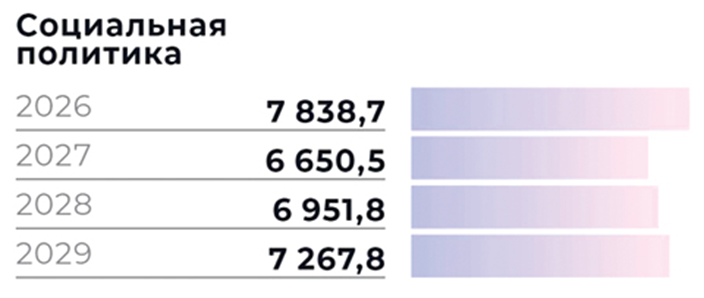
Finance Ministry plans for cuts to federal spending on social policy, RUB bln. Source: Russian Finance Ministry
The ministry also expects to raise additional revenue through excise duty increases above the rate of inflation and higher export duties on diamonds. In total, it plans to collect an additional RUB 1.5 tn next year through tax increases.
Alongside higher taxes, the government plans to increase domestic borrowing. The proposed volume of government borrowing is substantially higher than the level envisaged a year ago, when the 2026–2028 budget was adopted. Under the new draft, net domestic borrowing in 2027 will amount to RUB 6.1 tn, compared with RUB 3.8 tn in last year’s budget law. As a result, government debt is projected to exceed 24% of GDP within three years. The 2026–2028 budget had set a debt ceiling of 19.5% of GDP, notes Ksenia Savchishina, who authored the IEF’s assessment of the draft budget. She also points to a significant increase in government spending as a share of GDP. A year ago, the planned level of expenditure was 18–17.5% of GDP. Under the new draft, federal spending is projected to reach 19.6% of GDP in 2027.
Savchishina describes the increase in spending relative to GDP as a loosening of fiscal policy and a reduction in the scale of fiscal consolidation. In effect, the government has abandoned for the coming years the so-called budget rule, which is intended to limit the maximum level of public spending. ‘However, in our view, the easing of fiscal policy will not have a significant impact on overall economic dynamics, because the planned increase in government spending will be concentrated mainly in two areas: national defence and interest payments. In practice, this means that despite the increase in federal spending commitments compared with last year’s budget law, the period of broad-based fiscal stimulus has ended. Support for macroeconomic activity will be channelled solely through an increase in defence procurement,’ the economist concludes
The assumptions underpinning the draft budget also raise questions about its realism. The government expects annual inflation to remain exactly 4% over the next three years, while the baseline oil price is set at USD 50 per barrel.
Experts see the main budget risks in whether the Finance Ministry’s optimistic forecast for non-oil and gas revenues will materialise. Under this fiscal framework, a more conservative scenario would make it necessary either to revise spending plans or to increase government debt.
“The budget projections include a certain margin of safety in the form of a fairly conservative forecast for oil prices, making it highly likely that actual oil and gas revenues will exceed the planned level,’ the IEF’s assessment states
ORIGINAL: NG/Russian Government to Make Sharp Cuts to Social Spending for the First Time