A cluster of high-tech manufacturing and robotics is actively developing in the Moscow Region within the framework of the import substitution strategy. As stated by Regional Governor Andrey Vorobyov, the strategic goal is to make the Moscow Region a "home for smart machines" and a leader in robotization. To achieve this, the authorities are the first in Russia to introduce special subsidies for robot manufacturers: compensation of up to 20% of factory construction costs or up to 50% of rental costs in industrial parks. In total, 457 import substitution projects have been announced in the region, for which infrastructure is being created, including the "Light Industrial" ready-to-use facility format.
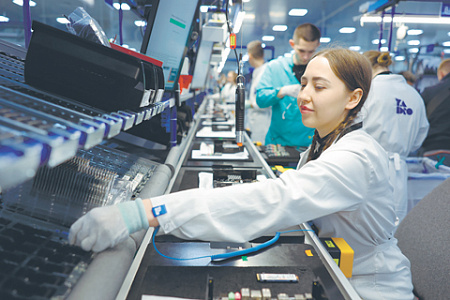
A major technological player, the company Yadro (part of ICS Holding), has invested over 14.4 billion rubles in a plant in the Dubna Special Economic Zone (SEZ), where about 700 people are employed. The company has launched sales of the Kvadra TAU mini-PC and is implementing a project to produce cellular base stations worth 30 billion rubles. The equipment is already undergoing testing in the networks of the operator Beeline, demonstrating LTE speeds of up to 75 Mbps. Yadro has signed forward contracts for the supply of 55,000 base stations to operators Beeline, Rostelecom, and MegaFon through 2030. Serial production of radio modules will begin by the end of 2025.
The Softline Group of companies is developing production facilities in the science city of Fryazino. Vendor Inferit produces up to 300,000 devices per year and has presented a new line of servers. The company Somers has begun production of the first fully Russian payment terminal (PIN pad), the P180, certified for the Mir national payment system. Production capacity stands at 150,000 terminals per year. Another unit, VPG LaserOne, has developed a robotic complex for laser welding that does not require high engineering qualifications from operators.
New domestic solutions are also represented in the logistics and office equipment sector. The company Comitas (Solnechnogorsk) is ready to produce up to 2,000 logistics robots per year; in 2025, 60 machines have already passed trials with customers. SEZ Dubna resident company Getmobit (investments of 1.3 billion rubles) has included a universal docking station for secure workplaces in the Ministry of Industry and Trade's registry, oriented toward the public sector and critical infrastructure.