The Trans-Arctic Transport Corridor is emerging as a strategic blueprint for the development of Russia’s Arctic over the next 15 years. President Vladimir Putin reviewed the government’s plans for the region at a meeting on Thursday. As risks to global transport routes mount, the authorities are placing growing emphasis on building a self-sufficient transport and economic backbone in the heart of Eurasia, spanning the Urals, Siberia and the Arctic.
In September last year, Vladimir Putin highlighted growing interest in the Trans-Arctic transport corridor linking St Petersburg and Vladivostok, both from Russian companies operating in the Arctic and from foreign shipping operators.
In November last year, President Vladimir Putin instructed the government, together with the Maritime Board, to draw up proposals to improve the efficiency of cargo flows from Siberia, the Far East and the Urals to the Trans-Arctic Transport Corridor.
Moscow aims to build the corridor into an international transport alternative in the Arctic, highlighting that the Northern Sea Route is about 30 % shorter than the Europe-Asia passage via the Suez Canal.
Under the President’s directive, the government is to submit proposals to develop domestic capabilities for building container ships, bulk carriers, LNG tankers, as well as supply vessels, dredging and towing vessels for the Trans-Arctic Transport Corridor.
Officials have also been tasked with expanding multimodal transport and logistics hubs in the Far Eastern Federal District and improving their efficiency, including at rail bridge crossings linking Nizhneleninskoye in the Jewish Autonomous Region with Tongjiang in China and Blagoveshchensk in the Amur region with Heihe in China. The programme also covers a bridge now under construction across the Tumannaya River towards North Korea, which is scheduled to open in 2026, alongside upgrades to access roads to bring them up to standard.
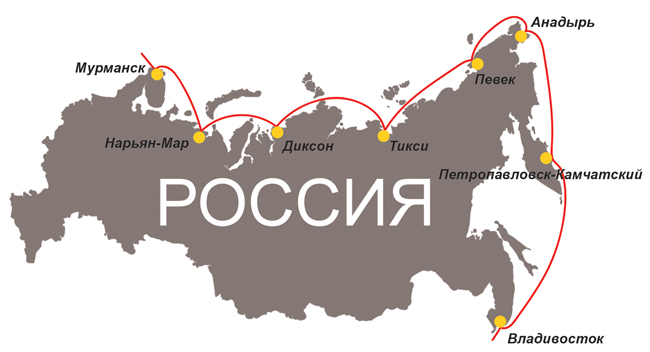
The Trans-Arctic Transport Corridor links the ports of St Petersburg, Murmansk, Arkhangelsk and Vladivostok. It incorporates the Northern Sea Route, whose boundaries are set out in the Merchant Shipping Code, running from the Novaya Zemlya archipelago in the west to Cape Dezhnev in Chukotka.
‘The Trans-Arctic Transport Corridor is a new concept. It expands the Northern Sea Route to include overland freight links, river logistics and rail infrastructure. This is a vast project that still requires rigorous planning. In effect, it is a business plan for the Arctic’s development over the next 15 years,’ said Alexei Chekunkov, Minister for the Development of the Far East and the Arctic.
The corridor represents an evolution of the Greater Northern Sea Route project, which is being developed under the national ‘Efficient Transport System’ programme.
Russia’s Arctic zone spans more than a quarter of the country’s territory and is home to nearly 2.5 million people. According to President Vladimir Putin, the region accounts for about 7 % of GDP and roughly 11 % of exports.
Key priorities include upgrading airfields and landing strips for civil aviation, as well as expanding major seaports such as Sabetta, Dikson, Dudinka, Khatanga, Tiksi and Pevek. Ensuring reliable ‘northern supply’ deliveries of essential goods to remote Arctic settlements is also gaining importance.
‘Historically, working in this region involved severe hardship, risks to life and a degree of heroism. Today, modern technology allows people to live and work effectively even at very high latitudes, with access to the full range of modern infrastructure and communications. The Arctic is becoming on-trend in a positive sense, and we are seeing strong interest among young people in taking part in these projects,’ Alexei Chekunkov said.
The case for building an alternative transport system has strengthened as geopolitical tensions escalate and attacks on commercial vessels and terminals become more frequent, in what officials describe as a growing use of state-backed piracy.
‘Russia has entered a prolonged phase of irreversible shift in its geopolitical and geoeconomic axis towards the East and the South. In this context, the old model that cast the country as a transit bridge between Europe and Asia has run its course. The new strategic logic calls for a reorientation of transport policy away from transit and towards strengthening domestic connectivity, spatial development and sovereignty,’ a new report says.
The document was prepared by several organisations, including the Higher School of Economics and the Council on Foreign and Defence Policy. In the current environment, it argues, the priority is to build a self-sufficient transport and economic backbone in the heart of Eurasia, spanning the Urals, Siberia and the Arctic (see Nezavisimaya Gazeta, April 13, 2026).
The Trans-Arctic Transport Corridor is set to provide the shortest maritime link between Europe and the Asia-Pacific, spanning 8,300 nautical miles, of which about 3,000 nautical miles run along the Northern Sea Route.
Its growing importance is underscored by rising cargo flows from Russia’s Arctic zone and the scope to optimise logistics by diverting freight from other routes to the corridor.
The network also includes river, rail, road, air and pipeline links, as well as port facilities and supporting infrastructure, officials at the Ministry of Transport said.
Inland waterways play a central role in supporting sustainable economic growth in Russia’s Arctic zone. The Ob, Yenisei and Lena rivers, with established navigational standards, provide substantial capacity for cargo flows towards the Northern Sea Route, with a combined length of nearly 22,000 km.
Maintaining these shipping channels and removing narrows requires extensive dredging, with around 10 million cubic metres carried out each year across Arctic waterways.
Around 40 Arc7 high ice-class vessels currently operate in Russia’s Arctic, and the fleet is expected to expand to 122 by 2030 as cargo volumes, including container traffic, increase.
At present, most of Russia’s seaborne foreign trade is carried on vessels sailing under foreign flags. In practice, however, foreign insurers are unable to settle claims within Russia’s financial system when insured events occur. The Ministry of Transport has therefore proposed legislation requiring foreign insurers to confirm their ability to make payouts within the Russian financial system.
At a meeting with the president on Thursday, Yury Trutnev, Deputy Prime Minister and Presidential Envoy to the Far Eastern Federal District urged Vladimir Putin to consider equipping the unified northern supply operator with its own fleet.
Trutnev said the average age of seagoing vessels exceeds 25 years, while river vessels average 45 years.
‘This year saw the launch of a unified maritime operator for northern supply deliveries, Rosatom Arctic, which is responsible for route planning, scheduling and cargo transport. At present, however, the operator relies on leased vessels and faces both shortages and a high degree of fleet wear,’ he said.
Timely northern supply deliveries are critical for residents of the region, Trutnev said.
‘These shipments amount to 4 million tonnes of cargo worth more than RUB 200 billion. Under federal law, they are given priority, and the number of containers delivered with delays has fallen more than 30-fold over the past two years,’ he added.