The financial position of Russian companies is deteriorating rapidly. This is reflected in growing wage arrears, as well as non-payments between companies, bond defaults and overdue debts to banks. The volume of unpaid products is increasing at an annual rate of more than 22% and has reached RUB 9 tn. The Central Bank, however, says the situation is under control.
Russian companies’ profits are currently at a good level, Central Bank Governor Elvira Nabiullina says. However, the profit statistics contain nuances that Central Bank officials prefer not to discuss: companies’ profits are falling while their losses are increasing. According to the latest Rosstat data, Russian companies recorded profits of RUB 17.1 tn in the first half of this year, significantly less than the RUB 18.4 tn recorded in the same period last year.
Not only profits have fallen, but also the share of profitable companies in the economy. While 69.6% of companies were considered profitable last year, the figure is now only 66.5%.
Other data also point to a deterioration in companies’ financial condition. Almost one in four Russian companies is now on the brink of default. By the beginning of August this year, 195,700 of the 709,600 corporate borrowers had overdue debt. That amounts to 27.6% of the total. Before 2022, by comparison, only 13.1% of corporate borrowers had overdue debt. The sharp increase began in the second half of 2024, when the economy entered a slowdown phase, and the share of troubled borrowers rose by almost a third in 18 months. The main cause of the collapse is the gap between borrowing costs and business profitability. According to the Centre for Macroeconomic Analysis and Short-Term Forecasting (CMASF), businesses are spending a record 36–37% of operating profit on debt servicing. At the same time, return on assets in the overwhelming majority of sectors is significantly below lending rates. According to estimates by the Stolypin Club, only one of 60 sectors, tobacco manufacturing, has a return on assets above the average lending rate. The academician of the Russian Academy of Sciences Sergei Glazyev’s channel publishes such assessments of the real picture behind the ‘good profits’.
Official statistics on unpaid wages in Russia also point to the nuances behind the ‘good profits’. Wage arrears are increasing at a rate of more than 18% a month and more than 47% a year, Rosstat reports. The share of employees owed overdue wages is still below 1%, but the pace of deterioration in companies’ financial condition suggests that this threshold will be breached despite the prospect of criminal cases against employers with outstanding wage debts
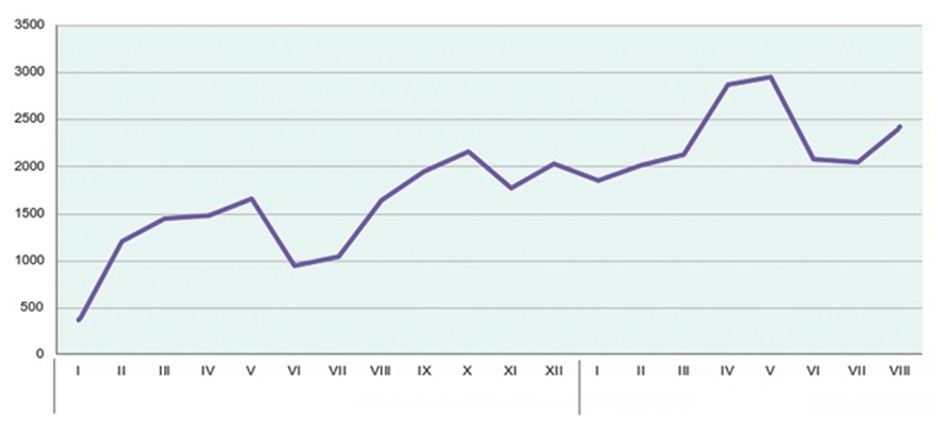
Dynamics of overdue wage arrears at the end of the month, RUB mln. Source: Rosstat
Non-payments are also increasing across the Russian economy, as shown by the rise in companies’ overdue accounts receivable. According to the latest Rosstat data, overdue accounts receivable increased by 22.5% year on year and reached RUB 8.8 tn in June this year. By September, overdue receivables for companies’ products had most likely already exceeded RUB 9 tn
The situation is aggravated by the structure of borrowing: two-thirds of corporate loans are issued at floating rates, while refinancing has become virtually inaccessible as banks have tightened their requirements. Total corporate debt has exceeded RUB 122 tn, with a significant share of borrowing used not for development but for refinancing and maintaining liquidity. The sectors at greatest risk are trade, with RUB 623 bln in overdue debt; real estate operations, with RUB 570 bln; and manufacturing, with RUB 498 bln. The system has entered a vicious circle: high rates are suffocating businesses, rising arrears are forcing banks to tighten lending conditions, which deprives companies of refinancing opportunities and sets off a chain reaction of bankruptcies. As long as the key rate remains at a level that makes borrowing inaccessible to the real sector, the share of troubled borrowers will continue to rise and the economy will stagnate, conclude the authors of the Razumnaya Rossiya 2.0 channel.
According to the Central Bank, however, the share of overdue corporate loans increased over the past year only from 3.1% to 3.5% of the total loan portfolio. By comparison, the share of overdue retail loans rose over the same period from 5.5% to 5.9% of banks’ total retail loan portfolio.
Given the almost prohibitive level of bank lending rates, many Russian companies have sought to raise funds by issuing bonds. That fundraising, however, has now turned into a wave of defaults. The number of defaults on the Russian debt market continues to increase. As of mid-August 2026, 48 bond defaults had been recorded, twice as many as during the same period last year. The Russian market is now recording more than two dozen corporate defaults a week.
ORIGINAL: NG/Companies’ Financial Indicators Deteriorate Rapidly