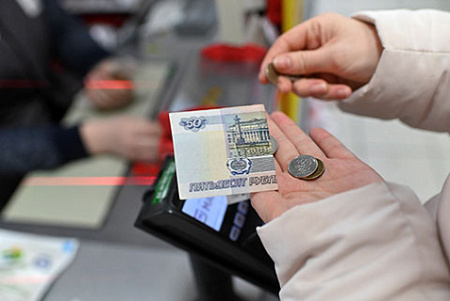

Since the beginning of the year, the volume of cash in circulation in Russia has risen sharply, increasing by more than RUB 1 tn to RUB 20.5 tn. Russians are seeking to keep more ‘real’ money on hand, money that will not disappear if the internet goes down. Until recently, falling deposit rates, which declined in tandem with the key rate, also encouraged people to withdraw their savings. Businesses, hit by rising tax costs, likewise hurried to move into cash. The banking sector, however, appears to have grown tired of this. In May and June, the country’s 20 largest banks suddenly reversed the trend and began raising deposit rates again. Experts describe this as an attempt to prevent funds from leaving accounts. Yet there are other motives as well.
In May and June, Russia’s banking sector reversed the downward movement in deposit rates. Previously, rates had been falling alongside the Central Bank’s key rate, in line with the logic of monetary policy. Now, however, deposit rates have edged upwards, albeit only slightly. This follows monitoring by the financial marketplace Finuslugi, which aggregates data on rouble deposits offered by the 20 largest Russian banks.
Between May 18 and June 15, the average maximum rate offered by the top 20 banks on three-month deposits rose from 13.27% to 13.44% per annum, an increase of 0.17 percentage points.
Average maximum rates on six-month deposits increased from 12.84% to 12.99% over the same period, while rates on one-year deposits rose from 12.17% to 12.32%, both up by 0.15 percentage points.
Commenting on these figures to RIA Novosti, Artem Perminov, Senior Analyst at BCS World of Investments, said that the increase in rates may be linked to stronger demand for cash among households in recent months. Banks may temporarily raise deposit rates in order to attract or retain clients.
Perminov later told Nezavisimaya Gazeta that higher rates make deposits more attractive and may therefore encourage customers not to withdraw their savings or to withdraw smaller amounts in cash.
‘If people increasingly prefer withdrawing money from their accounts and storing it in cash, banks lose part of their funding base, current liquidity deteriorates, and they are forced to seek replacement sources of funding,’ Maria Ermilova, Associate Professor at the Plekhanov Russian University of Economics, told Nezavisimaya Gazeta. ‘Growing demand for cash implies a potential outflow of funds from bank accounts.’
As a result, raising rates, especially on short-term deposits of one to three months, can be viewed as a tool for keeping money within the banking system. ‘For a bank, it is a form of operational defence,’ Ermilova said. ‘It allows banks to quickly attract or recover customers’ funds without locking in a high funding cost for a year or more
There are substantial grounds for such a reaction from the banking sector. Since the start of this year and as of June 1, the volume of cash in circulation, excluding holdings at the Central Bank and measured according to the monetary base, has risen sharply by more than RUB 1 tn to approximately RUB 20.5 tn. Most of the increase occurred in April and May.
An examination of Central Bank statistics for the corresponding months over the past seven and a half years, beginning in 2019, reveals only two comparable episodes of such a sharp increase in cash circulation. The first occurred in 2020, at the height of the pandemic, when the figure rose by RUB 1.4 tn in the first five months of the year. The second came in 2023, when cash circulation increased by almost RUB 1 tn over the same period.
Experts previously described 2023 as an exceptional year in terms of demand for cash and attributed it to several factors: the incorporation of the Donetsk and Luhansk People’s Republics and the Zaporizhzhia and Kherson regions into Russia, which objectively increased demand for banknotes; payments to participants in the Special Military Operation; and one-off events such as the attempted mutiny by the Wagner private military company.
‘In around 15 regions of the country, demand increased by approximately 30% on average. The strongest growth was observed in the southern regions, including the Voronezh, Rostov and Lipetsk regions, as well as in major cities. There, demand rose by around 70-80%,’ Andrei Belousov, then First Deputy Prime Minister, reported in late June 2023.
The Central Bank acknowledges renewed growth in demand for cash in 2026, though with certain qualifications. ‘The increase in cash in absolute terms since the beginning of the year has indeed been higher than during the same period in 2024 and 2025. But it is by no means unprecedented. In terms of dynamics, it is more comparable to early 2023,’ Central Bank Deputy Governor Alexei Zabotkin said in an interview with Vedomosti.
According to him, instability in electronic payment methods has played an important role. ‘There are situations when you can only pay in cash at a shop or café because of disruptions to mobile internet services or payment terminals.’
Cash also partly serves the shadow economy. ‘However, it is not cash that creates the risk of the shadow economy expanding. Rather, an increase in the shadow sector, all else being equal, leads to greater demand for cash,’ Zabotkin continued, adding that growth in the volume of cash itself is a normal phenomenon.
The head of Goznak, Arkady Trachuk, took an even softer view of the current situation. ‘I would not say that I see a fundamental return to cash. Yes, the Central Bank has recently noted rising demand for banknotes. But, in my opinion, these are natural fluctuations.’ In his view, these fluctuations may be linked to the recent decline in bank interest rates, prompting some people to prefer keeping money at home. Another factor, Trachuk noted, is the growing use of cash settlements by businesses.
At the same time, some of the experts surveyed by Nezavisimaya Gazeta explained the recent increase in deposit rates not only by demand for ‘real’ money from households and businesses. Other motives are also at play
‘Cash has been leaving the system on a regular basis since February, whereas the increase in deposit rates only became noticeable recently. Therefore, the main factor behind the adjustment in rates is more likely to be a deterioration in expectations regarding monetary policy,’ said Yuri Kravchenko, Head of Department at Veles Capital.
He pointed to the recent rise in government bond yields. According to him, this increase reflects market expectations that the period of reductions in the Central Bank’s key rate will be more prolonged than previously anticipated. Among the main factors fuelling these negative expectations are inflationary risks stemming from the federal budget
Igor Dodonov, an analyst at Finam, expressed a similar view. In his opinion, the rise in deposit rates over the past month indicates that banks are not expecting an acceleration in monetary easing and do not rule out a possible pause in the process altogether. Banks, he said, have chosen to adopt a wait-and-see approach.
ORIGINAL: NG/Banks Are Protecting Themselves as Best They Can Against a Potential Outflow of Depositors