The United States and Iran have reportedly reached a preliminary peace agreement that includes reopening the Strait of Hormuz. ‘Oil will once again flow in both directions for the region and the entire world,’ US President Donald Trump declared. The announcement gives at least two Russian agencies reason to reassess the economic outlook. First, the Finance Ministry: oil prices have plunged, with Brent falling below $83 a barrel, a level not seen since March. Russian Urals crude is expected to follow Brent lower. Second, the Central Bank: lower oil prices could weaken the rouble, creating inflationary pressure, while reopening the strait could have a disinflationary effect by reducing logistics costs that have also affected Russia.
US President Donald Trump and Iranian Deputy Foreign Minister Kazem Gharibabadi confirmed that work on a memorandum of understanding has been completed. The document is expected to be signed on June 19.
According to Trump, the signing will be followed by the reopening of the Strait of Hormuz through the immediate lifting of the US naval blockade. ‘Oil will once again flow in both directions for the region and the entire world,’ Trump wrote on Truth Social.
US Secretary of Defense Pete Hegseth said American forces could clear mines from the Strait of Hormuz within 30 days ‘under the right conditions’.
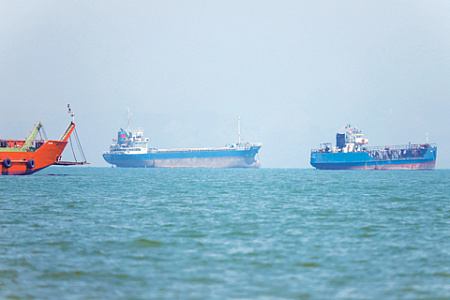
On Monday, June 15, Trump wrote on social media that ships, many carrying oil, had already begun moving toward the exit of the strait. ‘They are using the southern lane, which is completely safe and clear,’ he said, adding that alternative routes are also available.
The memorandum due to be signed, however, will not mark the end of negotiations on key issues. On the contrary, the most difficult discussions still lie ahead.
One clause of the memorandum, excerpts of which have appeared in the press, envisages 60 days of negotiations aimed at reaching a final agreement on nuclear issues and securing the complete removal of US primary and secondary sanctions, as well as resolutions adopted by the UN Security Council and the Board of Governors of the International Atomic Energy Agency.
In theory, the mood in both countries could shift repeatedly during those two months of negotiations.
‘It should be noted that diplomatic uncertainty remains,’ Yuri Mavashev, a Middle East specialist and lecturer at the Russian Presidential Academy of National Economy and Public Administration, told Nezavisimaya Gazeta.
‘The current arrangements appear more robust because they have been confirmed by both sides to the conflict and by Pakistani mediators. Nevertheless, concerns will remain until they are formally signed. In addition, confidence in official statements from both sides has declined significantly since February 2026,’ Andrei Smirnov, a stock market analyst at BCS World of Investments, told the newspaper.
Market reactions suggest that investors are taking the prospect of reopening the Strait of Hormuz seriously.
Brent crude prices fell sharply on the news. On Monday, prices dipped below USD 83 a barrel for the first time since March 10, compared with more than USD 87 at the end of last week.
For comparison, the average Brent price in May stood at USD 103 a barrel.
The most obvious consequence of reopening the strait is lower energy prices.
‘The restoration of this critical energy corridor returns up to 20% of global oil and natural gas supplies to the market,’ Mavashev said.
Russian policymakers now face another reassessment of the factors shaping the country’s economic outlook. This primarily concerns the Ministry of Finance, responsible for maintaining fiscal balance, and the Central Bank, which sets the key rate based on both domestic and external inflationary and disinflationary risks. As interviews with experts suggest, the picture remains, as usual, contradictory.
‘Lower oil prices mean reduced export revenues and lower oil and gas budget income, increasing fiscal risks and potentially putting pressure on the rouble,’ said Yaroslav Kabakov, director of strategy at Finam.
A weaker rouble would normally benefit exporters, who are often the strongest advocates of currency depreciation.
‘However, Russia’s key exporters, namely oil and gas companies, are already suffering from lower prices for oil and gas,’ Smirnov said.
‘The return of Iranian oil, currently under sanctions, to international markets is not the best outcome for Russia because it competes directly with Russian exports, putting downward pressure on global prices and reducing Russia’s export revenues,’ Mavashev added. ‘During the Strait of Hormuz crisis, the world’s increased reliance on alternative energy suppliers boosted the value of Russian oil and gas exports. Reopening the strait normalises the market and diminishes that geopolitical advantage.’
At the St Petersburg International Economic Forum, Minister of Finance Anton Siluanov said that if the price environment created by the closure of the Strait of Hormuz had persisted until the end of the year, Russia could have added an extra RUB 1 tn to the National Wealth Fund. At the time, Brent was trading at around USD 93–95 a barrel. Roughly 10 days later, market conditions have changed.
It is worth noting, however, that the latest forecast by the Ministry of Economic Development assumes relatively conservative prices for Russia’s Urals crude: USD 59 a barrel in 2026 and USD 50 a barrel throughout 2027–2029 under the baseline scenario.
According to the ministry, the average price of Urals in May was USD 86.5 a barrel. Russian crude will become cheaper alongside Brent, but the government’s assumptions still leave considerable room for prices to decline without causing severe damage to the federal budget.
Inflation is another contentious issue.
‘The restoration of unrestricted shipping will undoubtedly provide relief for international logistics, lowering insurance costs and reducing supply chain disruptions,’ Mavashev said.
Kabakov added that cheaper oil should lead to lower global prices for petrochemical products, some industrial goods and fertilisers. Wheat and food prices more broadly could also decline indirectly as transportation and energy costs fall. All of this would help cool global inflation, which inevitably affects Russia as well.
‘The Central Bank has cited external uncertainty as one reason for maintaining a tight monetary policy. The end of the Middle East conflict should reduce that uncertainty, which in theory broadens the scope for monetary easing,’ Smirnov said.
At the same time, Kabakov warned that if the rouble weakens significantly, it could instead accelerate inflation in Russia, forcing the Central Bank to respond.
ORIGINAL: NG/Ahead of the Key Rate Meeting, the Central Bank Is Once Again at a Crossroads