For the government’s economic authorities, it appears easier to discuss where Russia’s economy will be in a decade than over the next six to twelve months. Push the horizon out to 2036 and there seems to be greater clarity on demographics, technology and even foreign policy.
Long-term benchmarks matter. But policymakers also need answers to more immediate questions. A fresh wave of uncertainty is building, largely of the government’s own making. It centres on the parameters of the current budget, which will directly shape the Central Bank’s decisions on the key rate, as the regulator has itself made clear. Those decisions, in turn, will determine business prospects, and they are already doing so.
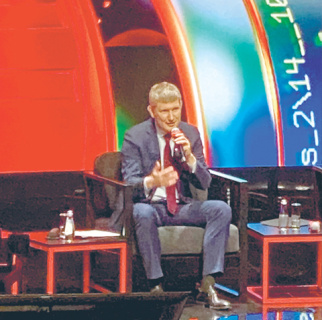
Few economic forums now pass without a focus on the distant future. It is envisioned, planned for and actively shaped. The Alfa Summit held in Moscow on April 28 was no exception, centring on what Russia’s economy could look like in a decade.
Opening the session, Maxim Reshetnikov, Minister of Economic Development, acknowledged that it is, in some ways, easier to talk about the outlook a decade ahead than over the next six to twelve months. Even so, he said, understanding long-term trends remains essential. He outlined three global challenges set to shape Russia’s economic growth over the next 10 years.
The first challenge relates to human capital. Life expectancy is rising even as the population ages, leaving the country with a markedly different demographic profile. This will reshape demands on the pension system, healthcare and social care, while consumer demand, its structure and purchasing power are also set to shift.
Demographic changes will also weigh on the labour market, making productivity gains a central challenge. This will require faster automation, broader adoption of advanced technologies and wider use of artificial intelligence.
A key issue is what Reshetnikov described as ‘smart, economically beneficial migration’. Without attracting foreign workers in shortage specialties, economic growth is already hard to sustain. The expansion of the platform economy will also reshape the labour market and the geographical distribution of the population.
The second global challenge is technological. Competition for advanced technologies is intensifying, while costs are rising and access is increasingly restricted. This applies to large language models, semiconductors, low-Earth orbit constellations and data transmission. This, in turn, requires substantial investment and a prioritisation of public spending.
The third challenge is Russia’s position in the global economy. ‘It is crucial to continue the integration processes we have pursued over the past four years. It is equally vital to remain an open economy, build strategic alliances and develop value chains,’ the minister said.
He added that these chains will often need to be built with countries that do not yet possess cutting-edge technologies, implying further investment will be required.
At another panel, Elvira Nabiullina, Head of the Central Bank, was also asked about Russia’s economic outlook over the next decade. Unlike the minister, she said such a question was ‘quite difficult’ to answer.
‘I think back to myself, and you should think back to yourselves in 2016. Did you imagine the economy would look like this today?’ Nabiullina said, drawing applause from the audience.
As the Central Bank governor has repeatedly noted, Russia is facing an unparalleled labour shortage. According to figures presented on Tuesday by Prime Minister Mikhail Mishustin at the ‘Znanie. Pervye’ (‘Knowledge. The First Ones’) educational marathon, the economy will need nearly 12 million additional workers by 2032.
Even so, Nabiullina added, if one were to venture a view, the future of Russia’s economy will be shaped by the tectonic technological shifts now under way, including artificial intelligence and the platformisation of employment.
‘But for me, as a central banker, one principle remains non-negotiable: whatever tectonic technological shifts may unfold, macroeconomic stability is essential,’ she said.
The Central Bank’s message brought the discussion back down to earth.
‘I am convinced that structural reform cannot be propped up with cheap money. There has to be a process of selecting the most efficient,’ Nabiullina said.
There is another factor that is currently grounding all these forward-looking debates. A new, partly self-inflicted layer of fiscal uncertainty is brewing within the Russian economy. This year, the Ministry of Finance once again intends to skip the procedure for amending the 2026 budget law and the planning period for 2027–2028.
The standard budget process envisages amendments in spring and autumn. These amendments are necessary to minimise discrepancies between planned indicators and actual economic performance. These changes are typically submitted to the State Duma as draft legislation, alongside revisions to the government’s three-year socio-economic forecast.
In the past, however, the Ministry of Finance has at times opted for a less visible, though still permitted, route, approving targeted adjustments through a specialised commission comprising representatives of the State Duma, the Federation Council and the Government. The Ministry reverted to standard procedures in 2025, but this year it has again proposed putting them on hold.
‘This spring we will forgo formal amendments, but will seek parliamentary approval to refine certain budgetary framework within the government’s existing powers,’ finance minister Anton Siluanov said. The changes will focus on expenditure priorities.
The Ministry of Finance set out these plans just days after the Central Bank’s key rate conference, where Nabiullina identified the budget as a primary source of inflationary risk. She pointed to ongoing discussions over possible changes to budgetary framework and said the regulator was waiting for amendments.
The path of the key rate will depend on those decisions, not in a decade but now.