Russia has launched a new national Space project. On April 9, Prime Minister Mikhail Mishustin said total funding would amount to around RUB 4.5 trillion, with part of the budget earmarked for building a domestic orbital station. Industry officials have also set out a timeline. The first module of the Russian Orbital Station (ROS) is scheduled for deployment in 2028, with the station expected to become fully operational by 2034. The project will draw on resources from the International Space Station, whose operations are expected to begin winding down from around 2028.
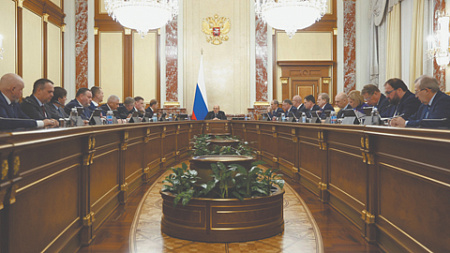
A government meeting on Thursday opened with a review of Russia’s space ambitions.
‘Strengthening Russia’s position as a leading space power is essential. It supports economic growth, improves living standards and underpins national security,’ Prime Minister Mikhail Mishustin said.
Officials stressed the long-standing link between space development and the wider economy.
‘We take justified pride in the fact that Russian scientists and engineers opened the path to near-Earth space, setting the direction for decades ahead. That, in turn, drove the development of key industries, from mechanical engineering and radio electronics to telecommunications,’ Mishustin said.
At the president’s instruction, Russia launched a dedicated national Space project in 2026, running through to 2036. Total funding will reach about RUB 4.5 trillion, Mishustin said.
‘The funds will go towards expanding the satellite constellation, building a domestic orbital station, developing efficient reusable rockets and other priority areas,’ he added. ‘Particular emphasis will be placed on talent, on highly skilled specialists in the space sector, which supports a wide range of related industries.’
Under the approved framework for the national project, the first module of the Russian Orbital Station is due to be deployed in 2028. Dmitry Bakanov, head of Roscosmos, told TASS that timelines for winding down the International Space Station (ISS) must be aligned with the rollout of the new platform ‘to avoid any gap in our crewed space programme’.
Bakanov said that, under the latest agreement with NASA, ISS operations are set to begin winding down in 2028, with deorbiting scheduled for 2030. ROS is expected to come online within the same timeframe, providing a fully fledged national platform for missions including scientific research.
However, speaking later at the Space with Knowledge educational marathon, Bakanov said Russia does not rule out extending the ISS programme until 2030.
‘A year ago, discussions focused on accelerating the shutdown of the ISS. Now, with our American colleagues, we are looking at keeping it operational at least until 2028, possibly until 2030,’ he said.
That leaves room for potential adjustments to the timeline for deploying the Russian station. Similar signals came from Vladimir Kozhevnikov, deputy chief designer at Energia Rocket and Space Corporation and chief designer of ROS, speaking at a separate industry conference held during Russia’s Space Week.
According to Interfax, Kozhevnikov said deployment of ROS would begin in 2030, following its separation from the Russian segment of the ISS, with full configuration expected by 2034.
The rollout is planned in stages. First, a universal node module will be installed, replacing the current Prichal node module. Prichal itself, according to Kozhevnikov’s presentation, will be detached from the ISS and deorbited into the ocean.
This will be followed by the addition of the Science and Power Module, then an airlock module, and finally the multipurpose laboratory module Nauka. ‘This assembly will then be detached, marking the start of the station’s autonomous operation,’ Kozhevnikov said, noting that the process will rely on ISS resources.
Roscosmos also plans to make the station highly automated, allowing it to operate without a permanent human presence.
ORIGINAL: NG/Russia’s Space Ambitions Put at RUB 4.5 Trillion