Physical oil prices have held above $130 to $140 per barrel, despite swings in futures trading, often dubbed the ‘paper oil’ market. Leading experts said last week the energy shock triggered by the attacks on Iran is likely to persist at least until the end of 2026.
The conflict will fuel inflation and slow global growth, the International Monetary Fund (IMF) managing director Kristalina Georgieva warned.
‘Even in the best-case scenario, there will be no clean return to the previous status quo,’ – she said. Rising energy costs, infrastructure damage, supply disruptions and weakening market confidence will continue to weigh on global activity regardless of how the conflict evolves, she added.
The IMF estimates emergency balance-of-payments support for affected countries at $20 billion to $50 billion, while around 45 million people could lose reliable access to food.
The US Department of Energy expects global oil markets to stabilise only by the end of 2026, assuming the active phase of the conflict ends in April. Even then, prices in 2027 are likely to remain above pre-war forecasts, keeping fuel costs elevated for consumers. Russia’s government says it will shield the domestic market from external price shocks through its fuel damping mechanism. In practice, however, the system has proved largely ineffective, prompting export bans on petroleum products and the introduction of fuel rationing at filling stations by regional authorities.
Iraq, Saudi Arabia, Kuwait, the UAE, Qatar and Bahrain cut output by about 7.5 mllion barrels per day in March, with the US Department of Energy forecasting a deeper drop to 9.1 million bpd in April. The outlook assumes the active phase of the conflict ends in April, allowing trade flows through the Strait of Hormuz to gradually resume. On that basis, the combined decline in production would narrow to 6.7 million bpd in May.
In Russia, oil companies raised wholesale petrol prices by 15 % in March following the attacks on Iran by Israel and the US. The government responded with a familiar measure, imposing a temporary export ban (see NG dated March 29, 2026). Wholesale prices have since eased, giving up roughly half of their wartime surge.
In Russia, oil companies raised wholesale petrol prices by 15 % in March following the attacks on Iran by Israel and the US. The government responded with a familiar measure, imposing a temporary export ban. Wholesale prices have since eased, giving up roughly half of their wartime surge.
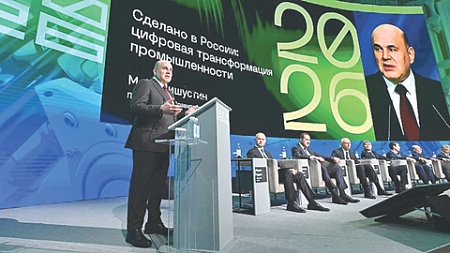
‘Protecting the domestic market remains our top priority. We must not allow external price shocks to be passed on to Russian consumers. The necessary mechanisms are already in place, including the fuel damping system and a moratorium on its suspension. Temporary restrictions on exports of petrol and mineral fertilisers have also been introduced,’ – Prime Minister Mikhail Mishustin said at a government strategy session on the fuel and energy sector last Tuesday.
Economists at the Institute of Economic Forecasting at the Russian Academy of Sciences (RAS) said last Wednesday that the economy contracted by 1.5 % year on year in the first quarter of 2026. They expect a full-year decline of around 0.6 %, one of the more optimistic forecasts for the downturn now unfolding in Russia. Commercial transport, manufacturing and construction led the contraction at the start of the year.
More downbeat projections emerged last week, pointing to a deeper and more prolonged slump. Participants at the Moscow Economic Forum warned that even a return to long-term average growth would see Russia slip from fourth to seventh or eighth place in the global economic rankings by 2030.
‘We are heading towards trouble, a double-digit contraction. A 10 % drop in consumption is manageable, but the decline could be even steeper,’ – said Robert Nigmatulin, an academic at RAS, at the forum’s plenary session.
He presented a cross-country analysis of the impact of investment on GDP growth and inflation. Russia’s performance lagged well behind that of the US, China and Poland, with similar levels of investment generating minimal output gains while driving stronger inflation. Nigmatulin argued that the focus should shift from curbing investment to improving its efficiency.
For now, reports from the regions point to a steady stream of reduced working hours and layoffs across industrial enterprises. Last Tuesday, the Chelyabinsk Electric Locomotive Repair Plant (CHERZ) said it would move to a four-day working week and cut staff. Earlier in the week, media reports said AvtoVAZ would halt production lines for more than two weeks in late April and early May as part of a company-wide shutdown.
ORIGINAL: NG/Global Energy Crisis Deepens as Russia Faces Economic Crisis