The Middle East conflict could boost Russia’s oil and gas revenues, with the VEB Institute estimating an additional RUB 500 billion to RUB 2 trillion in 2026. However, the upside is likely to be partly offset by a shortfall in non-oil revenues of RUB 600 billion to RUB 700 billion as economic growth slows. The net effect, according to the forecast, could force sharp cuts to parts of the budget, with some spending lines set to fall by as much as 21% this year. Support for industry, transport infrastructure, science and education are among the areas at risk.
At Urals crude prices seen late last year and early this year, around $40 per barrel, combined with weaker economic activity, the federal budget could face a total revenue shortfall of RUB 2.4 trillion in 2026.
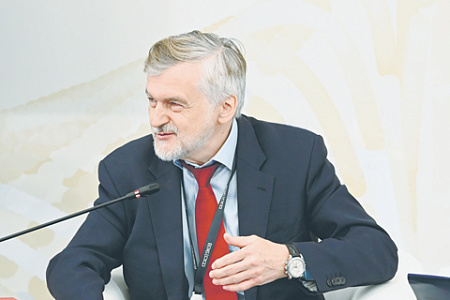
Andrei Klepach, chief economist at VEB.RF, presented the estimates late last week at a meeting of the Central House of Scientists.
However, the Middle East conflict has fundamentally reshaped the outlook. Russia’s budget now has a chance to offset what had looked like an inevitable revenue shortfall under previously depressed oil prices.
The outcome will largely depend on the rouble’s path, particularly how quickly and sharply it strengthens, as a firmer currency typically weighs on export revenues. Two scenarios are now in play.
In the first, according to Klepach’s presentation seen by NG (Nezavisimaya Gazeta), additional oil and gas revenues could reach about RUB 500 billion this year relative to the original 2026 budget assumptions. In the second, the figure rises to RUB 1.8 trillion.
‘The upside depends heavily on the rouble. Higher oil prices are likely to drive appreciation, which will erode budget revenues, though not entirely,’ – Klepach said.
At the same time, a parallel headwind is building, a widening shortfall in non-oil revenues as economic growth slows.
The presentation indicates this gap could reach RUB 600 billion to RUB 700 billion in 2026 relative to the original budget projections. Even so, stronger oil and gas revenues will not be enough to avert cuts to parts of the budget.
Klepach said the original draft of the 2026 budget had already envisaged both nominal and real cuts in defence spending, along with real-term reductions in funding for science, education and healthcare.
‘No one can say what the final picture will look like. But defence and security spending are unlikely to fall, meaning deeper cuts elsewhere,’ – he warned.
‘The 2026 spending reallocation assumes defence and security outlays will be kept at no less than 2025 levels, requiring an additional RUB 1.5 trillion compared with the current budget law. Transfers to regions will also increase by RUB 400 billion to cover a sharp rise in regional budget deficits,’ the presentation said.
At the same time, ‘spending on social support and on national projects aimed at technological leadership will not be reduced’.
‘All other spending will need to be cut by 21%, or RUB 1.9 trillion, to keep total expenditure within the 2026 budget limits. The most likely areas for cuts, effectively deferred, are industrial support, transport infrastructure, science and education,’ the materials state. ‘By category, investment, procurement and subsidies to companies will be reduced.’
Klepach concluded that the impact of higher export revenues would translate only ‘to a very limited extent’ into benefits for the real economy or households.
Recent expert discussions point to the risk of a self-reinforcing economic slowdown. As Alexander Shirov, head of the Institute of Economic Forecasting at the Russian Academy of Sciences (RAS), said at the outset, ‘the only way to reverse the cooling trend is through demand’.
‘At the initial stage, investment alone will not do it. Businesses will not commit capital in the current environment. Demand has to recover first, then capacity utilisation will increase, and only then will large-scale investment follow,’ – he said.
Citing a review of ongoing projects, Shirov noted that ‘around 40 % of investment projects, including in central Russia and other key regions, have been put on hold or frozen’.
‘They are not being financed because their underlying economics no longer stack up. The viability of such projects depends on demand prospects,’ – he said. – ‘Right now, there is no demand, neither consumer nor investment.’ He added that government demand is also unlikely to provide meaningful support in the near term, at least not at the scale required by the economy.
ORIGINAL: NG/Oil and Gas Revenues Turn Positive as Industrial Spending Falls