Hopes that Russia’s stagnating economy can be automatically revived simply by easing existing constraints, whether tax, credit, tariff or otherwise, may prove misplaced. The domestic market is sending warning signals, particularly the housing sector, which has demonstrated that even a 20% reduction in prices does not boost sales. It is an alarming symptom. In an environment of uncertainty, where concerns are growing about incomes, job security, the availability of certain goods and the ability to finance major purchases, there are increasingly few buyers willing to purchase housing.
The average price of housing under construction in Russia rose by 0.4% in May, according to DOM.RF. Between January and May, prices increased by 3.1%, slightly below accumulated inflation of 3.3%.
In real terms, therefore, primary-market housing prices have declined.
‘Weak demand continues to constrain price growth. Sales of new-build housing have remained below last year’s level for the fourth consecutive month, falling by 10% year-on-year in May,’ DOM.RF said
‘New-build prices essentially hovered around zero growth,’ analysts at the federal property portal Mir Kvartir said in their May market review, based on listings across 70 Russian cities
The price per square metre increased in 40 of the 70 cities surveyed, declined in 26 and remained unchanged in four. Across all cities, the average price per square metre in new developments rose by just 0.1% over the month. Belgorod recorded the strongest increase, at 2.5%, while Vladikavkaz saw the steepest decline, at 4.8%.
Demand for new-build apartments remains weak despite cheaper mortgage financing, while supply continues to grow. Available inventory increased by 7% in May, reflecting a growing glut of unsold properties, the report’s authors said.
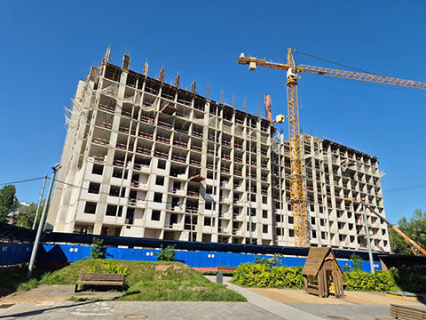
Yet these reports full of statistics pale beside the increasingly emotional statements being made by developers at industry conferences. The overall message is straightforward: much of what is currently being built in Russia cannot be sold. The issue was discussed at the Dvizhenie real estate forum held in Sochi last week.
Alexander Gaidukov, head of Strana Development Group, described an experiment involving coordinated price reductions in a particular location to assess market reaction. The response was effectively zero.
‘If prices across an entire location or city are reduced by 20%, sales do not increase. The number of transactions remains exactly the same,’ Gaidukov said, according to a video quoted by the industry portal Everything About Construction. In his view, there are cities where it may take more than three years to sell all the housing currently under construction because demand simply does not exist.
According to Valery Kochetkov, head of the new-build division at Inkom Real Estate, the market is currently missing around 40% of potential buyers, namely those unwilling to use instalment plans and even less willing to take out expensive mortgages
At the same time, lending criteria for subsidised mortgage programmes, particularly family mortgages, are becoming stricter.
‘Most potential buyers who are losing access to previous preferential lending terms cannot switch to market-rate mortgages. The key rate has fallen to 14.25%, but this remains an uncomfortable level for conventional mortgages, which banks are currently offering at around 19% on average,’ Dmitry Proskurin, Commercial Director at Metrium, told Nezavisimaya Gazeta.
As a result, developers are already postponing the launch of many projects because of the high cost of project financing and weak buyer activity
‘However, in the first half of 2026 developers are bringing slightly more projects to market than a year earlier, when the key rate stood at a record 21%,’ Proskurin noted
The Ministry of Construction nevertheless believes that its target of commissioning at least 100 million square metres of housing in 2026 remains achievable
‘Construction is an inertial process. What is being completed today was launched in 2021, 2022 and 2023. Therefore, the planned volume is achievable,’ Minister for Construction and Housing Irek Faizullin said
Yet industry sentiment suggests that building homes is only half the challenge; they must also be sold. The fact that even a 20% price cut is incapable of stimulating demand is a troubling sign
It casts doubt on hopes that a stagnating economy can be revived automatically simply by easing existing constraints, whether fiscal, financial or regulatory
The slowdown appears to have reached such a scale that one-off injections of support may no longer be sufficient
Moreover, policy-induced cooling has itself intensified uncertainty. Against the backdrop of recent years, concerns are resurfacing over future income growth, wage prospects, job security and the ability to find employment if dismissed. That, in turn, raises doubts about taking on long-term debt, especially when obtaining credit has become increasingly difficult.
Industry experts interviewed by Nezavisimaya Gazeta said that a period of flat prices and generous discounts should, in theory, favour homebuyers. The question is who is actually in a position to take advantage of the opportunity.
According to Pavel Lutsenko, chief executive of Mir Kvartir, conditions are favourable for buyers who already have the funds needed to purchase property.
‘The current environment primarily benefits buyers who can purchase housing through a one-off payment or an interest-free instalment plan without relying on bank loans,’ Proskurin agreed.
Such buyers could also benefit from future capital appreciation if the Central Bank continues to lower the key rate, which is expected to trigger another cycle of house-price growth. However, the number of such buyers remains relatively small.
ORIGINAL: NG/Even a 20% Discount Is Failing to Stimulate Housing Demand