This year, after the tax burden on businesses was increased, particularly through a higher value-added tax (VAT) rate, hundreds of billions of additional roubles have flowed into the budget, the Federal Tax Service of the Russian Federation (FTS) reported on July 29. According to experts, the increase in the tax burden has delivered a double benefit to the budget. First, there has been the direct gain from higher tax rates. Second, the budget has benefited from inflation accelerating beyond the government’s forecast, partly as a result of the tax changes. This creates future risks for a budget that has lost the foundation provided by steadily growing economic activity. If the inflation effect is stripped out, the budget could fall RUB 600 bln to RUB 800 bln short of its VAT target in 2026, the Gaidar Institute warned in a new study.
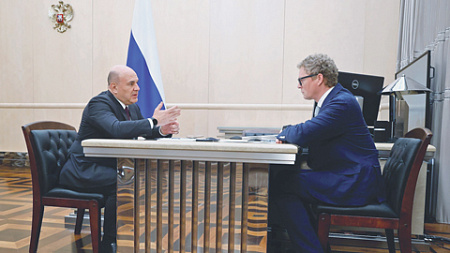
Effective tax administration makes it possible to mobilise resources to meet all the state’s obligations, primarily social ones, as well as to finance major economic development and industrial modernisation programmes. Prime Minister Mikhail Mishustin opened his meeting with Daniil Egorov. FTS Commissioner, stressing this point.
Egorov said that total revenues into Russia’s budget system reached RUB 31 trln in the first half of 2026, i.e. 8% more than in the same period last year. Regional budget revenues also rose by 8%. Federal budget revenues went up 6% year on year, with the overall growth driven by non-oil and gas revenues, which are not linked to hydrocarbon exports and have offset the decline in commodity-related revenues
Particular attention was paid to the positive impact of the higher tax burden on the budget.
‘As for the changes to the Tax Code and the tax system, specifically the VAT rate, raising the rate from 20% to 22% has already brought in additional RUB 426 bln. Forecasts that revenues might be lower have not materialised,’ Egorov reported.
The standard VAT rate was raised to 22% from January 1, 2026. The reduced 10% rate remains in place for essential items including food, medicines and children’s products.
Besides, the budget has benefited from changes to the simplified taxation system (STS), designed to bring more businesses into the VAT system.
According to the FTS, taxpayers with revenues of RUB 20 mln to 60 mln have already paid RUB 108 bln in VAT following the changes, while those with revenues of RUB 60 mln to 450 mln have paid RUB 415 bln.
In 2026, the revenue threshold above which a sole proprietor or company using the simplified taxation system becomes liable for VAT is RUB 20 mln. Last year it was RUB 60 mln, while previously businesses operating under the simplified system had not been subject to VAT at all
The threshold was initially due to fall further, to RUB 15 mln in 2027 and RUB 10 mln from 2028. However, in June, at the St. Petersburg International Economic Forum, President Vladimir Putin instructed to push back further reduction of the VAT liability threshold.
The instruction came after another public campaign by Alexander Shokhin, president of the Russian Union of Industrialists and Entrepreneurs. In May, he said the government’s desire to bring the economy into the formal sector and increase budget revenues was plausible, yet urged the authorities to prevent business closures that could result from the higher tax burden. Lower VAT liability threshold primarily impedes small and medium-sized businesses.
Egorov added that revenues from both social insurance contributions and personal income tax (PIT) rose 13% in the first half of the year. In this case, the increase in revenue, as it appears from his explanation, was also driven by growth in taxable incomes.
Meanwhile, a new study by the Gaidar Institute for Economic Policy, obtained by Nezavisimaya Gazeta, found that while the federal budget’s short-term stability is not in question despite a substantial deficit, the longer-term outlook is more uncertain. Risks of shortfalls in non-oil and gas revenues are increasing.
Ilya Sokolov, a leading research associate at the Gaidar Institute, explained that the recent increase in non-oil and gas revenues has been driven ‘not so much by sustainable economic growth’ as by other contributors.
First, there has been a successive increase in the rates of key taxes, including PIT, corporate income tax and VAT, the expert said. VAT has been the main driver of non-oil and gas revenue growth in 2026. According to the Ministry of Finance of the Russian Federation, VAT revenues amounted to RUB 8.6 trln in the first half of the year, equivalent to 49% of the annual target of RUB 17.5 trln.
Second, non-oil and gas revenues have benefited from inflation accelerating beyond the government’s forecast. The 2026 budget assumed annual inflation of 4%, but the rate had reached 6% by June.
Sokolov explained the case to Nezavisimaya Gazeta.
‘Higher inflation increases the tax base, primarily for VAT. So moderate inflation above the forecast helps the government meet its VAT target. Inflation pushes up the taxable base for other taxes as well. For instance, wage indexation generates additional PIT revenue,’ he said.
Currently, inflation primarily has an adverse impact on corporate income tax revenues. Companies are finding it increasingly difficult to pass rising costs on to consumers as demand weakens, reducing their financial results.
Two powerful inflation-related factors have emerged. In summer, one of those factors was the fuel crisis followed by disruptions of domestic fuel supplies and a surge in prices at petrol stations. But that was the second inflation-related factor. The first was the VAT increase itself.
The budget system has therefore effectively gained a double benefit from the government’s tax changes. But this is currently creating the main risks.
‘Given the likelihood that the Russian economy will enter a recession in the second half of the year and the continued decline in overall business margins, the planned level of VAT revenues can only be achieved due to the inflation factor. Otherwise, the VAT shortfall is estimated at RUB 600 bln to RUB 800 bln for the year,’ the Gaidar Institute warned in its study. The issue could be aggravated by the fact that federal budget projections for corporate income tax and PIT revenues ‘may also prove somewhat overestimated’.
Commenting on these findings, Olga Belenkaya, department head at Finam, confirmed to Nezavisimaya Gazeta that higher inflation increases nominal budget revenues. But there is also a downside, meaning that monetary policy is likely to remain tight for longer, which in turn increases the budget’s interest costs
Whatever risks are under discussion among economists, Prime Minister Mikhail Mishustin said at his meeting with the FTS Commissioner that the government had spent years working towards precisely this goal to reduce dependence on hydrocarbon rents. According to the Ministry of Finance, oil and gas revenues accounted for just 19.7% of federal budget revenues in January to June, while non-oil and gas revenues accounted for 80.3%. VAT alone accounted for 46% of all budget revenues.
The question, however, is how sustainable these non-energy sources of revenue are and whether the fiscal rule will need to be revised again, since it is no longer linked to oil prices (taking into account that the country has reduced its dependence on external oil market conditions) but to domestic economic conditions
‘There are indeed proposals among experts to change the structure of the fiscal rule by linking it to both oil prices and a part of non-oil and gas revenues. The arguments include taking into account shifts in the structure of budget revenues since 2022 and strengthening the countercyclical nature of fiscal policy,’ Olga Belenkaya told Nezavisimaya Gazeta.
‘Meanwhile, as we can see, the Ministry of Finance does not support this idea,’ she continued. ‘For now, the priority is to adjust the fiscal rule based on more conservative long-term forecasts for oil prices.’
Mary Valishvili, an associate professor at the Plekhanov Russian University of Economics, noted that the fiscal rule was introduced to stabilise the economy and federal budget revenues amid fluctuations in global hydrocarbon prices. Windfall revenues from energy exports are accumulated in reserves, while when export revenues decline, part of the accumulated reserves is used to balance the budget.
From this perspective, changing the fiscal rule in an attempt to link it to domestic tax revenues, such as PIT, corporate income tax or VAT, is still a disputable idea, the expert said.
‘Domestic demand, and, therefore, such tax revenues, is affected by various external and internal factors, making it extremely difficult to forecast windfall revenues from them,’ Valishvili explained. ‘The logic of reserve accumulation would then change, while businesses would most likely face an additional tax burden threatening to trigger an economic downturn.’
ORIGINAL: NG/Instead of an Oil-Fuelled Boost, the Budget Got an Inflation-Related One