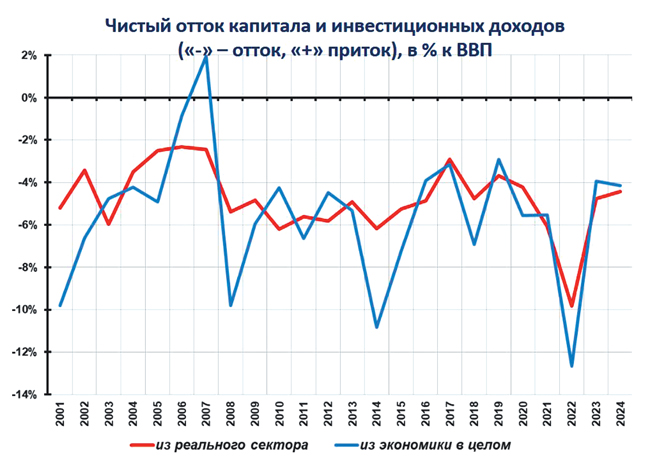
Despite a stronger push for economic sovereignty, capital outflows from Russia, long a major drain on the economy even before the pandemic and the military operation in Ukraine, have not stopped. What has changed is where the money goes. Instead of Europe, funds are now flowing to financial hubs such as Dubai, Hong Kong and Tel Aviv, analysts say. According to the Centre for Macroeconomic Analysis and Short-Term Forecasting (CMACP), net capital and investment income outflows have become structural. The real sector is moving abroad the equivalent of 3–5 % of GDP each year, or tens of billions of dollars annually. The picture, however, is not straightforward. These outflows are not purely speculative and may reflect objective factors.
CMACP has tried to answer a key question for businesses, particularly in the real economy: where to find funding as borrowing costs surge and fiscal support is likely to fade.
Its conclusion is simple. Companies could finance investment internally, provided they stop sending funds overseas under various pretexts.
‘Russia faces a persistent gap between gross national savings and domestic investment, averaging 3–5 % of GDP annually,’ said Oleg Solntsev, CMACP’s deputy head, and Vera Pankova, a senior analyst, in a report on financing the real sector prepared for an April economic session at the Central House of Scientists.
The gap reflects the difference between income generated in the economy that has not yet been spent on goods and services and the resources that have actually been invested.
This multi-billion-dollar shortfall, effectively flowing out of Russia, represents a potential source of funding that could be redirected back into the domestic economy.
‘Over the medium term, the only viable source of additional investment to close this gap is a reduction in net capital outflows from the real sector. In practice, this would largely take the form of greater self-financing by businesses,’ Solntsev and Pankova argue. In theory, this could also involve cross-investment among non-financial companies within the same corporate groups.
CMACP estimates that such a shift could provide additional funding for fixed and working capital investment equivalent to 3–5 % of GDP each year.
The issue was also discussed at the Moscow Economic Forum on April 7–8. Sergey Glazyev, an academic economist, noted that large-scale capital outflows from Russia persist ‘despite the military operation, despite current relations with the West and what he described as its aggressive stance’.
‘Even under these conditions, capital outflows continue at around $50 billion, $80 billion and sometimes more than $100 billion a year,’ the economist said
Figures presented at the forum and seen by Nezavisimaya Gazeta (NG) suggest that over 15 years, from 2010 to 2024, Russia channelled nearly $1 trillion into the global financial system.
Analytical Telegram channels add further context. ‘Despite claims of economic sovereignty, Russia remains a net exporter of capital,’ Proeconomics said.
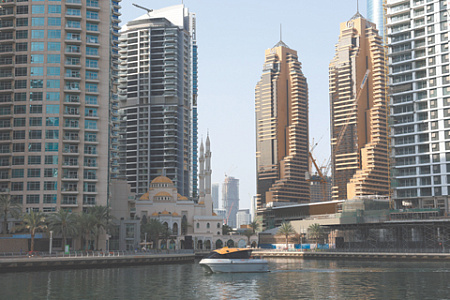
What has changed, analysts note, is the destination. Instead of Europe, capital is now flowing to hubs such as Dubai, Hong Kong and Tel Aviv.
At the same time, assessing the scale, geography and purpose of these outflows has become increasingly difficult. Sanctions and more complex payment chains have reduced transparency, said Boris Kopeykin, chief economist at the Stolypin Institute for Growth Economics.
In today’s globalised economy, investment in a company in one country can effectively mean acquiring assets in a different jurisdiction altogether.
Kopeykin said the clearest trend is a shift in trade and investment towards the global South, alongside a reduction in engagement with Western economies.
Even without these factors, analysis is complicated by long-running disputes over definitions. Reflecting on 2022 data, Сentral Bank head Elvira Nabiullina warned against conflating capital flight in the narrow sense, meaning the withdrawal of funds on dubious grounds, with the financial account balance, defined as the difference between net acquisition of financial assets and net incurrence of liabilities.
Capital flight in the narrow sense, defined as dubious or suspicious transfers, amounted to just $1 billion in 2022, a turbulent year. By contrast, the financial account balance surged to a record $227 billion, according to Central Bank data.
That balance reflects a range of components, including trade credits and advances as well as external debt repayments, Elvira Nabiullina said at the time.
‘What is recorded statistically as capital outflow can stem from various factors. These include a reduction in external debt, replaced by domestic borrowing. It also includes Russian companies acquiring foreign assets, including trading intermediaries, to sustain core operations that would otherwise be impossible under sanctions. Another factor is transfers by individuals to foreign banks, primarily in CIS countries, to access international payment cards,’ said Olga Belenkaya, head of research at Finam. ‘To be fair, capital outflows from Russia eased gradually between 2023 and 2025,’ said Alexander Abramov, head of the laboratory for institutional and financial market analysis at the Presidential Academy. ‘However, several drivers remain in place.’
First, Russian companies have largely lost access to foreign borrowing. Second, a significant share of outflows reflects the exit of foreign companies from Russia and the repatriation of part of their capital.
Abramov also pointed to another channel of outflows: foreign currency purchases by both households and companies, including financial and non-financial firms.
Belenkaya argued that the real sector’s loss of investment capacity due to capital outflows may be overstated. She noted, however, an additional source of uncertainty: potential deferred outflows linked to frozen financial assets held by non-residents from ‘unfriendly’ countries, along with the investment income they generate.
Kopeikin, for his part, said that in some cases overseas investments can benefit both individual companies and the Russian economy.
This is particularly the case when they support export and import logistics, secure supplies of raw materials, components and equipment, or help maintain access to foreign markets for Russian goods.
He cited examples of such ‘productive’ outflows: ‘A Russian machinery plant sets up an assembly facility abroad. A metals company invests in resource extraction in a developing country. An oil company acquires a tanker in a foreign jurisdiction.’
Discussing ways to curb outflows, Abramov warned that a blanket ban on capital exports would likely disrupt businesses and households while proving ineffective, as workarounds would inevitably emerge.
A more balanced approach, he argued, is to create conditions that incentivise investors to keep capital at home and channel it into the domestic economy.
‘The priority is to steadily improve the business climate and reduce operating risks, while making it more attractive to launch companies and production within Russia,’ Kopeikin said.
Abramov added that this means strengthening property rights, safeguarding shareholder interests and fine-tuning monetary policy. In his view, high borrowing costs remain one of the main constraints on domestic investment.
ORIGINAL: NG/ Economic Sovereignty Drive Fails to Stem Capital Outflows