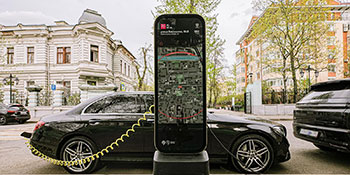
Russia’s electric vehicle market is gathering pace, with charging infrastructure expanding even faster than demand. Moscow is leading the push, rolling out a large-scale network of public charging stations under its Energiya Moskvy programme. Green energy and transport, however, depend on green materials.
Charging ahead
According to Autostat, Russia’s passenger EV fleet grew by more than a third last year, rising from 59,600 to 80,000 vehicles. In January and February 2026, sales reached 1,566 units, up 23 % year on year.
Charging infrastructure is also scaling up rapidly. Data from the Association Of Manufacturers and Operators of Electric Charging Stations (APOE) show that the public network expanded by 25 % in 2025 to more than 9,500 stations.
That level is sufficient for the current fleet, the association says. In most regions, EV owners face relatively little pressure on infrastructure, with around 10 vehicles per DC connector. Charging capacity is no longer a bottleneck for EV adoption and is even expanding slightly ahead of the vehicle base, analysts note.
The main federal incentive remains subsidised car loans, offering discounts of up to 35 % of the purchase price, capped at RUB 925,000, for new domestically assembled vehicles approved by the Ministry of Industry and Trade. The scheme has been extended through December 31, 2026. Regional authorities can also offer transport tax breaks. A zero rate applies in more than 30 regions, including Moscow, the Moscow region, St Petersburg and the Leningrad Region. In Moscow, EV owners also benefit from free parking on municipal streets.
A federal support scheme is in place for investors in charging infrastructure, with the government covering up to 60 % of equipment costs and grid connection fees. The programme is expected to fund the installation of around 1,900 fast DC charging stations between 2025 and 2027, with projects selected by the Ministry of Industry and Trade.
Earlier this year, Prime Minister Mikhail Mishustin approved an additional subsidy scheme to develop EV charging hubs. Each hub must include at least 10 fast DC charging points equipped with load-balancing systems, allowing multiple vehicles to charge simultaneously. Such facilities can bring a battery to 80 % in 20–30 minutes.
The programme also offers subsidised loans at 8 % annually for up to five years. In 2026, RUB 150 million has been allocated from the federal budget to support interest subsidies. Only projects using exclusively Russian-made equipment and software will qualify for preferential financing.
Moscow leads the charge
Moscow leads Russia in electric vehicle adoption. As of early 2026, more than 23,000 privately owned EVs were registered in the capital, according to Autostat. The number of charging points, both public and private, exceeds 10,700. Since early 2024, the number of new residential developments equipped with charging stations has increased by 50 %. Around 5 % of parking spaces in housing complexes now offer charging facilities, while in some premium developments the figure reaches 100 %.
‘We are closely monitoring market developments and adjusting support measures to reflect the needs of all participants, both EV owners and charging infrastructure investors,’ the Moscow Department of Transport and Road Infrastructure Development said.
Under the city’s transport strategy, approved by Mayor Sergey Sobyanin, Moscow aims to expand its EV fleet to 320,000 vehicles by 2030, including private cars, corporate fleets, taxis and car-sharing services. At that level, EVs would account for 7 % of the city’s total vehicle stock. To support this target, the authorities plan to expand the charging network to 35,000 stations by 2030.
‘Our goal is to create all the conditions needed for more residents to choose clean and quiet electric vehicles. Electric transport is the future, and its integration into the city’s transport system is an absolute priority,’ Deputy Mayor and Transport Chief Maksim Liksutov said.
Part of this effort is being delivered through the city’s Energiya Moskvy programme. The initiative envisages the installation of around 4,000 fast charging stations across the road network, near key urban sites and residential areas, the transport department said.
‘To date, more than 385 AC and DC charging stations have been installed on the road network under the Energiya Moskvy project. Additional stations are being deployed at petrol stations, shopping and business centres and near residential developments. Last year, the city also began installing EV charging hubs, with four already operational. This marks an important step in developing the city’s charging infrastructure,’ the department added.
Light metal drives Russia’s fast-charging expansion
Launched in 2020, the Energiya Moskvy programme has helped establish a domestic industry for EV charging equipment.
‘The city worked with prospective contractors to shape the programme and develop a unified standard,’ said Ilya Martyushov, chief executive of EVA Intermobility. ‘We designed slow, fast and ultra-fast chargers and built up manufacturing and operating capabilities. The scale of the programme allowed other Russian producers to emerge and keep pace with foreign rivals. Domestic suppliers are now competitive with European and Chinese players.’
That matters because federal subsidies are tied to the use of Russian-made equipment.
The standard approved by Moscow City Hall specifies aluminium casings. ‘This has defined the look of the infrastructure and allowed stations to integrate seamlessly into the urban landscape,’ said Mikhail Rudyk of the Aluminium Association.
Charging stations operate in harsh outdoor conditions, exposed year-round to rain and, in winter, to road chemicals. Aluminium’s corrosion resistance ensures long service life while preserving appearance throughout the lifecycle, without added maintenance costs, said Mikhail Rudyk. The material is also highly adaptable, allowing for complex architectural and design solutions that are difficult or impossible with alternatives such as steel.
In practice, aluminium is the only widely available material capable of delivering durable casings for charging stations. Galvanised steel offers corrosion protection for only a limited period, making it a short-term option. Stainless steel, meanwhile, is scarcely produced in Russia, would have to be imported, costs more than aluminium alloys and is harder to recycle.
Aluminium casings offer another key advantage: superior heat dissipation. Thanks to its high thermal conductivity, the metal draws heat away more effectively than alternatives such as steel, the expert said. As charging capacity rises, so does heat output, and aluminium helps prevent equipment from overheating.
‘Aluminium is a critical material across the electric mobility value chain, from vehicle manufacturing and battery production to charging infrastructure. Another domestic innovation has been charging cables with connectors using aluminium alloy conductors,’ said Evgeny Vasilyev, RUSAL’s Head of Aluminium Consumption Development.
‘Global standards call for at least one charging point per 10 electric vehicles. Moscow’s network is in line with these benchmarks and keeping pace with international trends,’ the city’s transport department said.