Expanding the use of integrated territorial development (ITD) is essential for the sustainable growth of Russian cities, Prime Minister Mikhail Mishustin said on Monday at a meeting with deputy prime ministers. Officials also stressed there is little undeveloped land left within urban areas, meaning further expansion will have to rely on this mechanism.Experts, however, question the economic efficiency for developers. Around two thirds of such projects are concentrated in just six regions. With the construction sector under pressure, additional regulatory burdens could prove critical for small and mid-sized developers, they warn.
‘The integrated territorial development mechanism is already being used very actively. It is important to expand its scope to ensure the sustainable growth of Russian cities and territories over the years ahead,’ the Prime Minister said.
He also noted that the strategy for developing the construction sector and housing and utilities sets a target of at least 1,000 regional decisions on applying the mechanism by 2030. He added that last year President Vladimir Putin instructed the government to allocate federal funding to support a number of regions in implementing integrated territorial development projects.
Deputy Prime Minister Marat Khusnullin said the target of at least 1,000 such decisions by 2030 has already been met ahead of schedule, with more than 1,100 approved as of April 1.
‘They cover territories with an urban development potential of over 153 million square metres, whereof 108 million are housing. Over the past five years, 4.4 million square metres of property have been built under ITD projects in the regions, including 3.6 million square metres of housing,’ he said on Monday.
He added that due to ITD mechanism in the past two to three years around 500 thousand square metres of dilapidated and unsafe housing had been demolished, with minimal budget support. As a result, some 23,000 people in 35 regions were rehoused.
More broadly, since 2019 more than 1 million people have moved out of dilapidated housing under national projects, the deputy prime minister said.
The Ministry of Construction (Minstroy) previously reported that between 2019 and 2026, some 944,400 people were rehoused from 16.04 million square metres of dilapidated housing, including 115,200 people from 2.02 million square metres in 2025–2026. Regions design rehousing programmes independently, drawing on all available funding sources, including integrated territorial development agreements and investment projects, the ministry said.
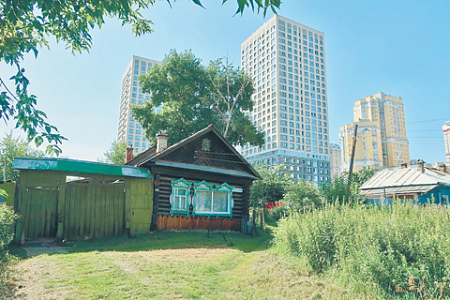
The integrated territorial development mechanism was introduced five years ago to transform urban spaces by upgrading infrastructure, removing dilapidated housing and improving living standards.
‘It directly improves the quality of the urban environment. It allows residential areas to be developed from the outset with the full range of social, engineering and transport infrastructure. In that sense, it has become a driver that brings together a number of comprehensive programmes,’ Khusnullin said.
Around 2,000 areas are currently under consideration, with a total urban development potential of 300 million square metres across 43,5 thousand hectares.
Khusnullin stressed that after several years of high construction volumes, available areas have effectively been exhausted, meaning further urban development is only possible through ITD.
‘In other words, this is the main tool to solve this problem,’ he said.
The mechanism continues to evolve. In March, a law was passed requiring developers to build social infrastructure as part of such projects. In effect, projects that do not include the related infrastructure may now be denied approval.
Ministroy also plans to continue subsidising ITD projects in regions with limited fiscal capacity, Aleksander Lomakin, Deputy Minister of Construction, Housing and Utilities, said in March. Support is currently available to 37 regions.
Ministroy, together with senators, is also working on proposals to give regions the authority to take decisions on integrated territorial development of federal lands transferred to their control.
Experts also point to ITD drawbacks, the main is reduced competition.
‘The scale of these projects requires vast upfront capital. Priority goes to developers capable of taking on large areas in one go, which inevitably weakens competition. In such conditions, small and mid-sized developers have virtually no chance of participating,’ said Yuri Kulchitsky, a senior lecturer at the Graduate School of Urbanism of the Higher School of Economics.
Other challenges include high upfront costs, driven by the need for large-scale investment in utilities infrastructure and the rehousing of dilapidated housing. Uncertainty over payback periods is another constraint. Long investment horizons of 10–15 years weigh on the appeal of such projects for private investors. Researchers also note that once a contract is signed, developers cannot withdraw even if conditions change. Limited financing options further constrain the mechanism.
The depletion of available areas is another constraint, according to Oleg Abelev, head of analytics at Rikom-Trust.
‘In that sense, this is not always a voluntary tool but often a forced one, which can create risks when negotiating with property owners in the affected areas,’ he said.
Implementation also depends heavily on regional capacity.
‘Federal support is in place, but in many cases success hinges on the quality of governance at the regional level. In the newly incorporated regions, launching of ITD projects is particularly challenging,’ Abelev added.
The rollout of the mechanism is accompanied by systemic challenges, said Maksim Maksimov, an associate professor at Plekhanov Russian University of Economics. In his view, the first set of issues stems from legal uncertainty and gaps in inter-agency coordination.
‘A key issue remains the legal uncertainty surrounding areas designated for integrated territorial development. Difficulties arise in securing land rights when plots are expropriated or where third-party claims exist, including federal ownership.
At the same time, public authorities bear no liability to investors for delays in amending land-use planning documents, while the costs of such delays fall on developers. This asymmetry creates legal uncertainty and complicates reliable planning,’ the expert said.
The second issue is the wide divergence in regulatory frameworks across regions. ‘Integrated territorial development is governed very differently from one region to another, which can sharply reduce construction profitability in some areas, drive companies out of the market and constrain housing supply,’ Maksimov said.
The third set of issues relates to the ITD economic model as a whole.
‘Overburdening contracts with social obligations often results either in a lack of bids at auction or in a winning bidder that has misjudged costs, after which the project stalls. Conversely, if such obligations are insufficient, land prices at auction can surge, while inadequate infrastructure and the heavy financial burden on developers remain unresolved,’ he said.
An economic downturn could pose additional challenges for ITD projects, which require long-term planning and significant capital outlays.
‘Volatility in construction material prices and uncertainty over access to credit are creating serious headwinds. At the same time, available areas has effectively been exhausted, meaning further development depends on this mechanism. Abandoning is not under consideration, even in a downturn. However, regional regulation of ITD has already reduced construction profitability in some regions, prompting companies to exit the market. With the sector under pressure, additional regulatory burdens could prove critical for small and mid-sized developers,’ Maksimov said.
He does not rule out adjustments of this mechanism, including extending contract terms, refining state support for the most affected regions and further adjustment of the regulatory framework to reduce business risks.
ORIGINAL: NG/ Government Moves to Speed Up Integrated Territorial Development