
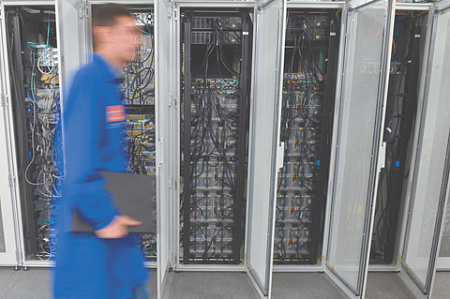
Artificial intelligence is fast becoming a key driver of business competitiveness. Yet only 9% of Russian companies have the computing infrastructure needed to deploy AI at scale, according to analysis by IT group T1. After NVIDIA, the leading supplier of AI chips, withdrew from the market, companies have been forced to look for alternatives. That shift has pushed up costs, extended delivery times and weakened technical support. Replacing graphics processors has also proved difficult due to software incompatibilities.
The Ministry of Digital Development is set to submit a draft law on AI development and deployment to the State Duma this spring. The legislation will govern the use of AI in sensitive areas such as healthcare, education and the judiciary, while largely excluding the commercial sector apart from critical infrastructure.
The proposals are expected to define what qualifies as ‘Russian’ AI, set out rights and liabilities and introduce mandatory labelling of AI-generated content.
Alongside regulatory questions, however, constraints on computing capacity are becoming more acute. Russia’s infrastructure for scaling AI remains limited.
According to analysis by T1, only 9% of organisations are fully equipped with computing resources, while around 40% have partial capacity. More than half, or 51%, face a shortfall. The figures were presented at a recent forum in Moscow.
Graphics processing units, or GPUs, remain the core component of modern AI workloads, handling data-intensive tasks such as training large language models and neural networks
Demand for high-performance computing is being driven by the rapid rollout of generative AI, particularly AI agents, alongside wider use of computer vision and AI-based recommendation systems.
Analysts say demand for GPUs is set to outstrip both production capacity and supply chains in the medium term. The result could be a sustained shortage of AI hardware, a risk facing global markets and Russia alike, especially given sanctions constraints
‘Since NVIDIA’s exit, Russian companies have had to find alternatives while dealing with higher costs, longer delivery times and weaker support. Replacing AI accelerators is further complicated by the software layer: adapting models to the specific, often isolated architectures of new suppliers effectively means rewriting the code,’ said Kirill Bulgakov, deputy chief executive of T1.
Experts interviewed by Nezavisimaya Gazeta outlined several routes for Russia’s AI industry under current constraints. ‘Some companies are pushing ahead by sourcing GPUs through parallel imports and partner channels, including NVIDIA-based solutions or chips from Chinese suppliers,’ said Dmitry Makhlin, development director at HRlink.
Another option is to shift from owning hardware to using infrastructure‑as‑a‑service, renting servers, storage and cloud computing capacity with remote access via the internet.
A further approach is to focus on fine-tuning existing models rather than training from scratch, which reduces infrastructure demands.
Companies can also continue training AI systems on hardware already imported into Russia, said Aleksandr Smolensky, chief executive of Expanta. While such equipment lags behind newer systems, it remains functional.
The choice of strategy depends largely on scale. ‘Small and medium-sized businesses typically do not need high-performance AI computing,’ said Dmitry Peslyak, business development manager at
N3COM. These companies are more likely to rely on cloud capacity or older-generation GPUs.
Large corporate clients can rely on parallel imports, although this pushes up capital spending as supply chains become more complex, as is the case with other components.
Makhlin also noted that switching to alternative processors is hindered by software incompatibility. Moving away from familiar NVIDIA-based systems to a different architecture often requires extensive reworking, in some cases a full rewrite of the code, adding further to costs.
Views on the outlook for the GPU market and the broader AI sector remain sharply divided.
‘At present, the market offers limited opportunities,’ said Roman Gots, chief executive of
DataRu. In his view, the challenge goes beyond the availability of domestic chips. While chips are a crucial element, they are only the starting point in the value chain. ‘Attempts to develop proprietary GPUs in different countries have largely fallen short,’ he added.
Makhlin, however, sees some upside. The market is gradually shifting away from reliance on a single supplier towards a multi-vendor model, which he describes as a more mature stage of development.
Russia is not alone in facing these constraints. ‘Companies worldwide are grappling with shortages of modern equipment. Priority access is reserved for a small group of leading players, primarily US corporations,’ said Smolensky. ‘Other market participants are left with what remains.’ That, in turn, is driving the search for alternatives.
A further potential challenge for the AI sector is the risk of new constraints linked to a possible energy crisis affecting Taiwan, South Korea and other producers of electronic components. ‘It is still unclear how and when this might play out,’ said Peslyak. ‘But it could resemble the disruptions seen during the Covid period, when supply chains came under severe strain.’