
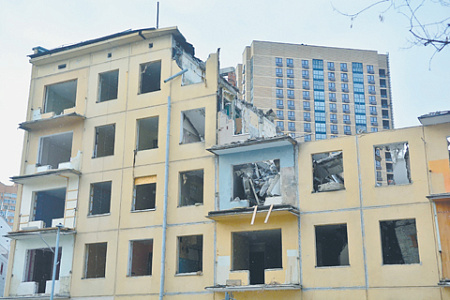
Russia’s spatial development strategy is pulling in opposite directions on internal migration and settlement policy. It seeks to stem population losses in Siberia, the Far East, the Arctic and in smaller towns, while also encouraging labour mobility to match regional workforce shortages. The plan includes building entirely new experimental settlements, though officials have yet to spell out what these will look like. Meanwhile, conditions in existing towns remain largely unchanged, particularly in unsafe and dilapidated housing. The stock of such housing, measured per capita, has stagnated at around 2 square metres per person.
Russia’s spatial development strategy has become a focal point of debate among economists and policy analysts, with several leading think-tanks revisiting concerns over the coherence of the government’s priorities.
The Institute of Economic Forecasting at the Russian Academy of Sciences (IEF RAS) has flagged a key inconsistency, highlighting tensions in the strategy’s approach to migration and settlement patterns. The issue is outlined in a presentation by deputy research director Olga Kuznetsova, published on the institute’s website
The strategy aims to stem population outflows from Siberia, the Far East, the Arctic, and from smaller towns and rural areas.
At the same time, it calls for greater labour mobility to address uneven workforce demand across regions.
Debate over regional labour needs also goes beyond simply attracting scarce workers. In some cases, it points to deeper structural risks, including the potential collapse of single-industry towns if their core companies shut down, raising the prospect of entire settlements disappearing altogether (see NG dated December 2, 2025).
The shift may reflect a different dynamic, with workers drawn into relatively well-paid service jobs in major cities and urban clusters, which are themselves facing shortages of couriers, taxi drivers and other support staff.
As a result, it remains unclear which labour gaps should be prioritised, and where, through greater mobility.
The strategy also calls for the creation of ‘new experimental settlements’, though officials have yet to define them in concrete terms.
The description in the document is broad, referring to newly established settlements that apply new approaches to demographics, housing, economic and technological development, among other areas.
What this means in practice can only be inferred from recent comments by the Ministry of Economic Development. In some cases, such settlements could grow around large investment projects, technology clusters or infrastructure hubs.
Their development would involve integrated planning, aligning job creation, housing and social and transport infrastructure, alongside special regulatory regimes. The ministry points to Dobrograd in the Vladimir Region, Innopolis in Tatarstan and Skolkovo near Moscow as examples.
At the same time, socio-economic problems remain unresolved in existing, conventional settlements. A separate report by the Centre for Macroeconomic Analysis and Short-Term Forecasting (CMASF) highlights this as another paradox in Russia’s spatial policy.
Housing stock with more than 66 % wear and tear, million sq m
Area of dilapidated housing (yellow) and unsafe housing (red), million sq m. The red line shows the combined area per capita, in square metres per person. Source: CMASF
According to the Territorial Development Fund, more than 900,000 people have been rehoused from over 15 million square metres of unfit housing since 2019. In 2025 alone, more than 93,000 people improved their housing conditions, with around 1.7 million square metres of unsafe housing cleared.
However, CMASF analysts including Oleg Solntsev and Olga Mikheeva say the problem remains unresolved despite sustained efforts to upgrade the housing stock.
Over the past five years, the stock of unsafe housing has risen by 21 %, despite large-scale resettlement… As of end-2024, it totalled 23.8 million square metres, or 0.6 % of the country’s housing stock,’ the centre said.
Regions with the highest levels of unsafe housing per capita include Karelia, the Nenets Autonomous District, Sakha (Yakutia), the Yamalo-Nenets Autonomous District and the Arkhangelsk Region.
Per capita levels of unsafe housing are lowest in the Bryansk Region, Sevastopol, Tatarstan, Dagestan, and the Stavropol and Krasnodar regions. ‘Moscow has no unsafe housing, while volumes in St Petersburg are negligible,’ experts said
Dilapidated housing is typically the first to be reclassified as unsafe. In this context, it refers to buildings with more than 66 % wear and tear.
The stock of such housing has continued to grow, rising from nearly 240 million square metres in 2019 to almost 257 million in 2024, or more than 6 % of total housing stock, excluding units already deemed unsafe.
As a result, the combined per capita stock of unsafe and dilapidated housing has held at around 2 square metres per person in recent years.
CMASF analysts also question the country’s resettlement priorities. In their view, housing remains relatively unaffordable, while overall provision per capita is low.
At the same time, population density is high, ‘particularly in major cities’. Efforts to expand housing availability risk clashing with the implicit incentives of local authorities and developers, who favour increasingly dense urban construction that delivers faster returns.
‘High housing space per capita is incompatible with dense living. It requires large-scale suburban expansion,’ CMASF analysts said. ‘For Russia, pushing density higher is not a constructive approach.’
Beyond the largest cities, this turns the spatial development strategy into a far more ambitious blueprint, one that effectively sets out a new phase of territorial expansion and a broader overhaul of the country’s socio-economic model. The agenda ranges from relatively practical steps, such as improving household access to private cars, ideally more than one per family, to structural shifts like moving towards a more polycentric model, with decision-making centres and economic hubs more evenly distributed. Some researchers see this as a timely response to emerging security risks (see NG dated March 26, 2026).
ORIGINAL:NG/New Experimental Cities to Sit Alongside Dilapidated and Unsafe Housing Stock
