In the fifth year of the special military operation, accompanied by the emergence of structural imbalances, and the second year of a deliberate cooling of economic activity, experts have begun taking stock of the interim results. Their main conclusions are as follows. Over the past five years, Russia’s economy has expanded ‘not across the board, but through a narrow chain consisting of the state sector, the defence-industrial and industrial complex, and the financial system’. Over the past 18 months, economic growth has slowed to near zero, largely due to measures taken by the financial authorities. In the second quarter of 2026, the economy has shown some signs of recovery, but growth remains ‘subdued and uneven across sectors’.
The next meeting of the Bank of Russia’s board of directors on the key rate is scheduled for July 24 and it is set to be a forecast-setting meeting. In addition to deciding on the key rate, the central bank is already conducting a comprehensive review of its macroeconomic forecast and may make substantial revisions based on incoming economic data. The updated medium-term forecast will be published on the day of the meeting.
Ahead of the event, analysts have also begun a review; not of forecasts but of results and interim outcomes that will shape the economy’s future prospects. There are clear reasons for doing so.
First, the Russian economy has spent almost four and a half years undergoing structural transformation caused by the exceptional challenges of recent years. As has become increasingly apparent, that transformation has led to growing sectoral imbalances.
Second, this period has coincided with more than 18 months of economic ‘treatment’ in the form of an intentional cooling of activity, accompanied by significant side effects.
‘Gross value added across sectors of the Russian economy was 7.69% higher in the first quarter of 2026 than in the fourth quarter of 2021 after seasonal adjustment, but this headline figure creates a misleading impression of balanced recovery,’ claimed financial analyst Pavel Ryabov (Spydell_finance Telegram channel).
According to his calculations, the Russian economy ‘grew not broadly, but through a narrow linkage: the state sector, the defence-industrial and industrial complex, as well as the financial system’
The subsequent tightening measures introduced by the financial authorities were layered on top of these existing distortions. As a result, the economy is now only slightly above its level of the third quarter of 2024.
‘In other words, growth over the past 18 months has been close to zero, but during that period around 55% of the economy was in decline while the remaining 45% expanded,’ Ryabov said.
According to Rosstat, the economy contracted by 0.2% year-on-year in the first quarter of 2026, a result reflecting a combination of both domestic and external factors.
However, after that first-quarter decline, the economy has begun to show signs of recovery in the second quarter, Olga Belenkaya, head of macroeconomic analysis at Finam, told Nezavisimaya Gazeta.
Economists at VEB Institute, publishing estimates ahead of official Rosstat data, calculated that Russian GDP grew by 1.1% year-on-year in April
As a result, GDP for January–April as a whole has finally returned to modest positive territory, according to the institute’s review.
Even so, economic momentum remains ‘subdued and uneven across sectors’, Belenkaya added.
Assessing the consequences of economic cooling by mid-2026, Yulia Myagkova, associate professor at Plekhanov Russian University of Economics, described the outcome as mixed.
On the one hand, she said, overheating has been reduced, labour shortages have eased and inflationary pressures have moderated. On the other hand, the cost has been near-zero GDP growth and a roughly 14% decline in investment activity in the first quarter compared with a year earlier.
| янв.21 / Jan 21 | мар.21 / Mar 21 | май.21 / May 21 | июл.21 / Jul 21 | сен.21 / Sep 21 | ноя.21 / Nov 21 | янв.22 / Jan 22 | мар.22 / Mar 22 | май.22 / May 22 | июл.22 / Jul 22 | сен.22 / Sep 22 | ноя.22 / Nov 22 | янв.23 / Jan 23 | мар.23 / Mar 23 | май.23 / May 23 | июл.23 / Jul 23 | сен.23 / Sep 23 | ноя.23 / Nov 23 | янв.24 / Jan 24 | мар.24 / Mar 24 | май.24 / May 24 | июл.24 / Jul 24 | сен.24 / Sep 24 | ноя.24 / Nov 24 | янв.25 / Jan 25 | мар.25 / Mar 25 | май.25 / May 25 | июл.25 / Jul 25 | сен.25 / Sep 25 | ноя.25 / Nov 25 | янв.26 / Jan 26 | мар.26 / Mar 26 | |
▬▬ Пищевые продукты / Food Products
▬▬ Нефтепереработка / Oil Refining
▬▬ Металлургия / Metallurgy
▬▬ Деревообработка / Wood Processing
▬▬ Химия / Chemicals
▬▬ Машиностроение / Machinery Manufacturing
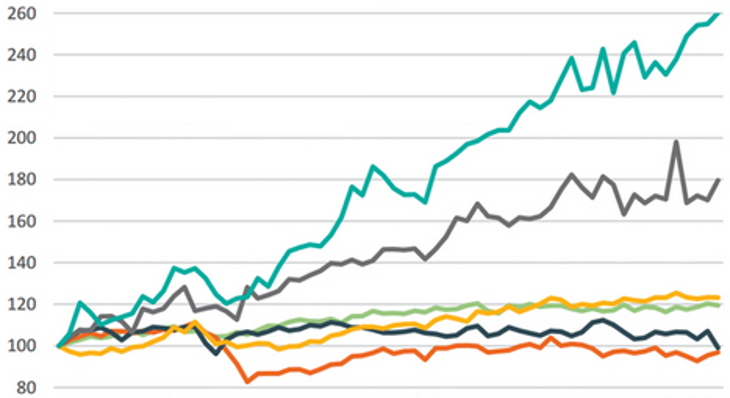
Performance of individual sectors (%). January 2021 = 100. Since spring 2022, Russia’s economy has clearly split into two parts: one directly or indirectly linked to the defence-industrial complex, and another tied to the civilian sector and market demand. Source: VEB Institute
‘The Russian economy is not simply stagnating around zero growth. It is experiencing a deep structural distortion,’ Myagkova said. ‘One part has been artificially overheated to its limits, while the other has been deliberately frozen.’
In her view, this masks the deterioration of market sectors that could otherwise serve as engines of long-term growth and innovation.
According to Belenkaya, the positive outcome of recent years is that inflation remains under relative control and the economy has so far avoided recession.
‘The negative outcome is the growing divergence between sectors, particularly between defence-related industries and civilian industries, many of which are experiencing little growth or outright decline, as well as falling investment (even if it was preceded by a significant growth in 2021–2024) and increasingly restrictive regulation,’ she stated.
Myagkova argues that the current economic model allows the authorities to address immediate priorities but reduces overall efficiency and leaves the economy highly vulnerable to changes in external conditions or domestic policy.
Indeed, one of the main supports for the economy has been an improvement in export conditions since the spring. Yet that same factor can quickly become a vulnerability whenever external conditions deteriorate, especially when compounded by domestic sectoral imbalances
In terms of monetary policy, these interim results carry important implications. ‘When the state, primarily through the defence-industrial complex, crowds out the private sector by competing for capital, production capacity, labour, raw materials and equipment, the supply of goods and services naturally declines even as demand remains elevated,’ Ryabov explained. The central bank is responding within the limits of the tools available to it.
‘The economy has hit a structural supply ceiling, and the central bank is forced to suppress private demand because it cannot create workers, technologies or productivity through monetary instruments. All it can do is regulate the cost of money and lending standards,’ he said. In his view, this answers the question of when monetary policy can return to normal. Under current conditions, he believes, it simply cannot.
In other words, normalisation would require another round of structural adjustment, this time aimed at correcting the sectoral imbalances that have accumulated over recent years.
Rosstat reported on June 24 that industrial production in Russia increased by 0.4% year-on-year in January–May.
Manufacturing output as a whole rose by 0.3%, although 17 manufacturing sectors remained in decline while only seven expanded. The strongest growth was recorded in ‘the production of other transport equipment, including aircraft, shipbuilding and related industries’, which increased by 31%.
ORIGINAL: NG/Near-Zero Economic Growth Masks Market Deterioration