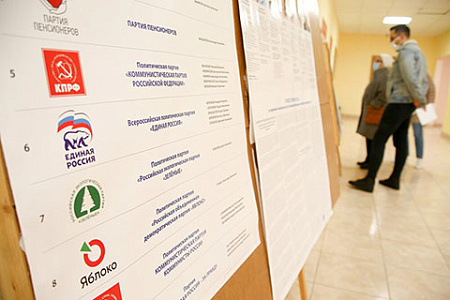
By the end of this week, the parties planning to take part in the election will hold congresses to approve their candidate lists for the State Duma. Not all 17 parties officially registered with the Justice Ministry are likely to do so. More probably, only the 11 parties exempt from collecting the 200,000 voter signatures required for ballot access will contest the campaign. These include the five parliamentary parties and six so-called non-parliamentary ones. Ranked roughly by their current polling numbers, the latter are: the Party of Pensioners for Social Justice, the Greens, Yabloko, Communists of Russia, Rodina and the Direct Democracy Party.
Incidentally, pollsters have continued publishing data on party support even after the election campaign officially began. And these snapshots of Russia’s electoral landscape contain some revealing findings. According to VCIOM, support for non-parliamentary parties has been rising in parallel with the share of respondents who say they are undecided. FOM adds another dimension to this picture of uncertainty: the number of people saying they do not intend to vote has increased sharply.
FOM also notes that while at least some respondents are familiar with the first four smaller parties, public awareness of Rodina and the Direct Democracy Party is close to zero. As for the remaining six officially registered parties, they appear to be virtually unknown altogether. That may explain why Alexander Kharichev, head of the Presidential Directorate for Monitoring and Analysis of Social Processes, recently argued that Russians do not need any additional political parties. In his view, the existing supply is already adequate. According to opinion polls, he noted, only about 10% of respondents would like to see new parties emerge. Yet that figure closely matches pollsters’ estimates of the size of Russia’s so-called liberal electorate, which also stands at around 10%.
In other words, there is a clear mismatch between supply and demand on Russia’s political marketplace. It is quantitative to some extent, but above all qualitative. The parties’ very names reflect this imbalance: most either promote socialist-populist agendas or build their platforms around official state narratives. Interestingly, Kharichev himself has previously argued that the electorate’s notional ‘democratic niche’ has not been filled by New People, while claiming that Yabloko has instead become increasingly radical.
It should be noted, however, that this shift has hardly been in a constructive direction. Grigory Yavlinsky’s party now argues that elections are no longer about winning votes or parliamentary seats. What matters, it says, is simply presenting voters with the slogan ‘For Peace and Freedom!’, while any discussion of how to achieve those goals under current circumstances is supposedly pointless. That appears to show little respect either for Yabloko’s own history or for the many voters who have supported the party over the past 30 years. More importantly, by approaching elections in this way, Yabloko further deepens the lack of political representation for a distinct segment of public opinion
It is understandable why the Russian authorities do not see public apathy approaching a critical threshold. Their overriding priorities are control and security. As a result, it is virtually impossible in Russia to establish a new political force quickly in response to emerging public demand, as often happens in other countries. Elsewhere, such parties may subsequently disappear or become integrated into the political system. In Russia, however, this is not permitted, even for the sake of creating the appearance of competition or demonstrating political contestation.
Yet there is, in fact, something worth campaigning for, including for Yabloko itself. At the very least, there is the inviolability of the constitutional foundations set out in Chapter 1 of the Russian Constitution. There is freedom of speech and conscience, the right to seek and disseminate information freely and the right to access media free from censorship. There is freedom of economic activity, the protection of private property and the prohibition on establishing a single official state ideology. And, of course, there is the people’s right to assemble peacefully and unarmed and, ultimately, ‘to exercise their power directly, as well as through state authorities and local self-government bodies.’
ORIGINAL:NG\Distortions in Supply and Demand on Russia’s Electoral Marketplace