Overall household indebtedness in Russia is declining even as debt burdens rise, according to data from the Central Bank, Rosstat and analytical agencies. The average debt burden has fallen to 27%. At the same time, experts are increasingly concerned about the continued growth of overdue debt. Mortgage arrears have reached their highest level since 2021, while the share of bad debt in unsecured consumer lending has exceeded 13%. In the corporate segment, one in four borrowers has fallen behind on repayments.
The average debt burden of Russian households fell from 29% to 27% in the first quarter of this year, according to the All-Russia People’s Front (ONF), which analysed data from the Central Bank, Rosstat and the country’s largest credit bureaux. The debt burden is calculated as the ratio of average outstanding debt to average annual household income.
At the same time, the issuance of new loans is increasing. According to the ONF, citing the National Bureau of Credit Histories (NBCH), the number of consumer loans issued in the first quarter rose by 27% year-on-year to 4.76 mln. Compared with the first quarter of 2024, however, lending remains down by 41%. More than 8 mln consumer loans were issued during that period, the researchers noted.
In May alone, more than 2.03 mln consumer loans were issued, an increase of 52% compared with May 2025. Overall, 8.78 mln consumer loans were granted in the first five months of this year, compared with 6.34 mln in the same period last year.
The average size of a consumer loan has also increased. In March 2026, it stood at RUB 180,000, up 11.2% year-on-year and 7.6% month-on-month, according to the ONF. In May, the average loan size eased to RUB 173,000
‘Over the past nine months, the average size of consumer loans has stabilised at between RUB 150,000 and 185,000,’ the NBCH said.
The trend is even more pronounced in certain lending categories. Car loan issuance, for example, rose by 21.3% year-on-year in the first quarter. ‘According to NBCH data, car loans worth a total of RUB 306.9 bln were issued in the first quarter of 2026,’ the ONF said. The organisation added, however, that lending volumes remain below the levels seen in 2024. Current issuance is 45.3% lower than in 2024, when car loans totalled RUB 560 bln.
Experts attribute the recovery in lending to the Central Bank’s current policy stance. After the
regulator tightened monetary conditions at the end of 2024, lending slowed and stabilised at a low level throughout 2025. ‘As monetary policy has eased somewhat, the number of loans issued in 2026 has increased,’ the ONF said. ‘Despite some growth in the first months of 2026, consumer lending remains at a relatively low level overall. The contraction in lending between 2024 and 2026 was driven both by weaker demand for loans and by the deteriorating quality of new applicants,’ the NBCH said. According to the bureau, lenders are now focusing on borrowers with strong credit histories and a debt-service-to-income ratio of no more than 50%, meaning individuals who spend less than half of their income on servicing debt.
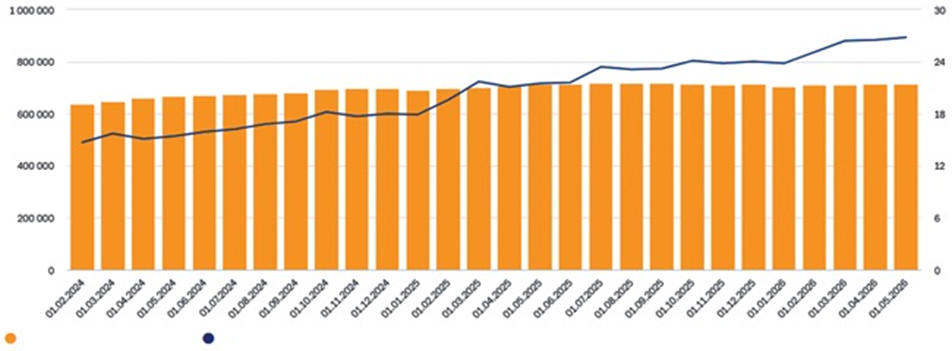
Share of borrowers with overdue debt, %.
Source: Central Bank of Russia
The housing finance market is also showing signs of recovery. According to preliminary estimates by Frank RG, mortgage lending amounted to RUB 321.6 bln in May. This was 9% lower than in April 2026 but 14.4% higher than in May 2025. In numerical terms, 71,700 mortgage loans were issued in May, up 28.9% year-on-year. Over the first five months of 2026, mortgage lending totalled RUB 1.7 tn, 48.5% more than during the same period in 2025, Frank RG reported. Mortgage issuance had already begun recovering in previous months.
However, the revival in mortgage demand has been accompanied by a further increase in overdue debt. According to the Central Bank, overdue mortgage debt exceeded RUB 223.7 bn as of April 1. Arrears have risen by RUB 16 bn since the start of the year alone. Compared with a year earlier, overdue debt has doubled, and it has increased by a factor of 3.5 since April 2024. On April 1, 2024, total overdue mortgage debt stood at RUB 63.8 bn, according to Central Bank statistics.
The regulator has partly acknowledged the problem. ‘The share of problematic mortgages increased from 1% to 1.7% last year and reached 1.8% as of April 1, 2026. Although the figure has nearly doubled, it remains low by historical standards,’ the Central Bank said (see Nezavisimaya Gazeta, May 11, 2026).
Overall overdue debt owed by Russian borrowers exceeded RUB 1.65 tn as of April 1, 2026, according to Central Bank data. The national average delinquency rate stands at 4.6%, the ONF added. The volume of overdue unsecured consumer loans reached a record high earlier this year, the highest level since 2021 (see Nezavisimaya Gazeta, February 8, 2026).
The share of problematic debt is considerably higher in unsecured consumer lending alone. Over the past six months, it has risen by 0.2 percentage points to 13.1% as of April 1, the Central Bank reported in early June. The regulator does not, however, expect arrears to continue increasing.
‘In the first quarter, the share of unsecured consumer loans carrying elevated risk, with a debt-service-to-income ratio above 50%, remained virtually unchanged at 18% of total lending,’ the Central Bank said.
The situation is considerably worse in corporate lending. In the first quarter, problematic loans to legal entities, including small and medium-sized companies, increased by RUB 500 bln to RUB 11.1 tn, equivalent to 11.6% of the total portfolio, according to the regulator. The Central Bank said the sharpest deterioration occurred among smaller companies operating in construction, property management, trade and manufacturing.
‘These companies are finding it increasingly difficult to cope with their debt burden because of rising costs,’ the regulator explained. The share of problematic loans in the SME segment rose to 18.9% over the same period.
The total corporate loan portfolio of Russian banks amounted to RUB 85.3 tn as of May 1. In April alone, banks issued RUB 7.7 tn in corporate loans, up 8.4% from March. Overdue debt increased by 4% month-on-month to RUB 3.1 tn. The share of overdue loans in the total corporate portfolio rose to 3.7%. At the same time, the proportion of corporate borrowers with overdue debt increased to 26.8% of all borrowers. For comparison, a year earlier the figure stood at 21%, and in 2024 it was 15%.
The total corporate loan portfolio of Russian banks amounted to RUB 85.3 tn as of May 1. In April alone, banks issued RUB 7.7 tn in corporate loans, up 8.4% from March. Overdue debt increased by 4% month-on-month to RUB 3.1 tn. The share of overdue loans in the total corporate portfolio rose to 3.7%. At the same time, the proportion of corporate borrowers with overdue debt increased to 26.8% of all borrowers. For comparison, a year earlier the figure stood at 21%, and in 2024 it was 15%.
In his view, the situation in corporate lending is more troubling. ‘The loan portfolio of companies and individual entrepreneurs rose to RUB 85.3 tn in April, and lending volumes increased. At the same time, overdue debt climbed to RUB 3.1 tn. This suggests that businesses continue to borrow, but the high cost of financing is already affecting the repayment discipline of some companies,’ Chernov said.