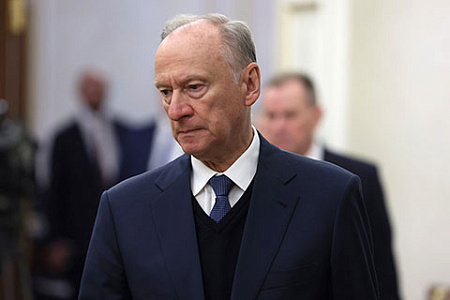
An interview with Nikolai Patrushev, in his equally official capacity as Assistant to the President of Russia and Chairman of the Maritime Board, has been published in the government’s official newspaper, Rossiyskaya Gazeta. (Russian laws enter into force after publication in Rossiyskaya Gazeta. ‘Verified. No fakes’ is the principle under which the socio-political newspaper, founded by the Government of the Russian Federation, says it operates on its website.)
Konstantin Remchukov
The interview’s headline, ‘When War Is at the Door’, recalls the titles of Soviet military commanders’ memoirs about the international situation on the eve of 1941. It is alarming. Mobilising. Frightening.
Patrushev is not simply one of the conservative ideologues of modern Russia. He is the most influential because, more successfully than anyone else in today’s conservative camp of thinkers, he has been able to institutionalise his views, assessments and convictions at the doctrinal level. As Secretary of the Security Council, for example, he prepared Presidential Decree No. 400 of July 2, 2021, ‘On the National Security Strategy of the Russian Federation’, which contains a separate chapter entitled ‘Protection of Traditional Russian Spiritual and Moral Values, Culture and Historical Memory’.
It sets out principles including ‘the priority of the spiritual over the material’, ‘collectivism’, ‘citizens’ rejection of destructive ideas imposed from outside’, and ‘strengthening oversight of compliance with the norms of the modern Russian literary language, preventing the public performance and dissemination through the mass media of products…’
For a state in which private property and capitalism are present-day realities, speaking of collectivism and the priority of the spiritual over the material as traditional values immediately elevates the poor and the dispossessed as role models for the wealthy and successful. How a millionaire is supposed to demonstrate spirituality within this framework is unclear. The spirituality of the poor is equally vague and difficult to define. By contrast, vilifying the rich in the spirit of Proletkult is easy and familiar. As for the arbitrary interpretation of ‘destructive content’ to justify prohibitions, it is difficult even to discuss rationally, given how subjective and value-laden the concept itself is.
It is precisely because of certain provisions in this document that today’s conservatives have been able, in effect on their own initiative, to circumvent a number of provisions of the Russian Constitution guaranteeing rights and freedoms.
Article 13 of the Basic Law states: ‘The Russian Federation shall recognise ideological diversity. No ideology may be established as state or mandatory.’
Article 29 provides:
• ‘Everyone shall be guaranteed freedom of thought and speech…’
• ‘No one may be compelled to express or renounce his or her opinions and convictions.’
• ‘Everyone shall have the right freely to seek, receive, transmit, produce and disseminate information by any lawful means. The list of information constituting state secrets shall be determined by federal law.’
• ‘Freedom of the mass media shall be guaranteed. Censorship shall be prohibited.’
Let us consider some of Patrushev’s key arguments.
‘Out of forty million French people, approximately three and a half million served the occupiers. I emphasise: not sympathised, but actively served. Meanwhile, around 250,000 French people took part in the Resistance. The figures are not comparable. The last defenders of the Reichstag were French SS soldiers. And yet France became one of the victorious powers, receiving a permanent seat on the UN Security Council thanks to the French anti-fascist movement and Stalin’s personal respect for General de Gaulle.’
‘Few people know about the German occupation of the Channel Islands in the English Channel, which belong to Britain. There was such a degree of cooperation between the British and the Germans that British police officers even carried out joint patrols with German soldiers.’
‘In general, it should long be understood that almost all of Europe consciously fought against the USSR. Nearly half of SS divisions were made up of representatives of other countries – Italy, Romania, Hungary, Finland, Slovakia, France, Croatia, Spain, Denmark, the Netherlands and others. For example, 11 countries took part in the blockade of my native Leningrad. Alongside Germans and Finns, Italians, Norwegians, Spaniards, Romanians, Belgians, Dutch and Baltic volunteers tried to destroy the people of Leningrad. Now their descendants hypocritically help Kiev attack St Petersburg with drones.’
On the formal neutrality of Europeans: ‘The Swedes supplied Germany with strategic raw materials and industrial goods, the Portuguese sold tungsten. Swiss neutrality is a separate topic. Gold ingots made from jewellery and dental crowns of murdered concentration camp prisoners are still kept in Swiss bank vaults. And the Irish prime minister Éamon de Valera arrived at the German embassy in May 1945 and expressed condolences over Hitler’s death.’
‘But they surely must understand that in the event of aggression, the peaceful and carefree life of Lithuania and its sovereignty will be the first to end. And yet Vilnius is pushing things too far. You know, I have many friends in Lithuania from childhood, we communicate, and they all say in one voice that their authorities do not represent national interests and are rapidly turning the country into a kind of colony of Brussels.’
‘In the course of the special military operation, we are also fighting for the future of the Ukrainian population. It has been placed literally on the brink of survival. The country has been half turned into a huge barracks and half into a concentration camp.’
‘In essence, today in Ukraine we are carrying out a mission to save our brothers who have fallen under neo-Nazi occupation.’
On the deployment of Soviet troops in Hungary and Czechoslovakia: ‘The Soviet Union used force only in response to terror: as in Hungary, where a mob literally tore its own citizens apart. As for Czechoslovakia, there were no casualties among the population at all.’
‘There will be as many centres of power in the world as there are great maritime powers. If we want Russia to remain great and be a true centre of power, we must strengthen our position at sea… I am convinced that Russia was, is and will be a great maritime power… Therefore we can and must become a link in maritime trade between four oceans.’
‘And for this purpose, among other things, we need a substantial naval capability. A state that does not adequately control maritime spaces risks finding itself in a difficult position at a critical moment, regardless of the strength of its land army.’
‘It is no secret that ships arriving in our ports already regularly carry magnetic mines attached to their hulls, effectively turned into floating bombs. We detect and neutralise these mines, but the fact remains. There are also suspicions that mines are being laid in European ports.’
‘Remember Admiral Ushakov’s famous principle: “Close range to the enemy is the best tactic.” There is no need to wait for NATO ships, aircraft and drones to appear at our maritime borders – they are already trying to remain there permanently. On the contrary, we should ourselves appear under the nose of the potential enemy. A good example is the escorting of merchant ships by our navy in the English Channel, literally off the coast of Britain. Not a single British ship or aircraft even moved to intercept our convoy.’
‘Many Europeans in the ranks of the Wehrmacht and SS brought death to the peoples of the USSR.’
‘I will not exaggerate if I say that in the 1990s Russia truly stood on the brink of disintegration… At that time, as today, almost all of Europe nurtured terrorists who sought to destroy Russia.’
‘I will not exaggerate if I say that in the 1990s Russia truly stood on the brink of disintegration… At that time, as today, almost all of Europe nurtured terrorists who sought to destroy Russia.’
Patrushev offers his own very specific interpretation of Europe’s role in the Second World War: that almost all of Europe fought against the USSR, including volunteers and collaborators; that the number of those who cooperated with Nazism significantly exceeded the number of resistance fighters; and that the neutrality of Sweden and Switzerland was formal and hypocritical.
Against this background, Stalin appears comparatively grateful and restrained. As early as July 3, 1941, in his address to the Soviet population, he emphasised that the war’s aim was not only to eliminate the threat to the USSR, but also to assist the peoples of Europe suffering under Nazi rule, and he explicitly expressed expectations of allied support.
‘The aim of this nationwide Patriotic War against fascist oppressors is not only to eliminate the danger hanging over our country, but also to help all the peoples of Europe groaning under the yoke of German fascism. In this war of liberation we will not be alone. In this great war we will have faithful allies in the peoples of Europe and America, including the German people enslaved by Hitler’s rulers. Our war for the freedom of our Motherland will merge with the struggle of the peoples of Europe and America for their independence, for democratic freedoms. This will be a united front of peoples standing for freedom, against enslavement and the threat of enslavement by Hitler’s fascist armies. In this connection, the historic speech of the British Prime Minister Mr Churchill on assistance to the Soviet Union and the declaration of the US government on its readiness to provide assistance to our country, which can only evoke a feeling of gratitude in the hearts of the peoples of the Soviet Union, are entirely understandable and indicative.’
Demonstrating an understanding of the context, Stalin argues that the overwhelming majority of Europeans are groaning under the yoke of German fascism. In doing so, he draws a distinction between the peoples of European countries and the fascist, Hitlerite regime.
On September 3, 1941, in a personal message to ‘simultaneously ensure the Soviet Union receives 30,000 tonnes of aluminium by the beginning of October this year and a minimum monthly assistance of 400 aircraft and 500 tanks (light or medium). Without these two types of assistance the Soviet Union will either suffer defeat or will be weakened to such an extent that it will lose for a long time its ability to assist its allies through active actions on the front in the struggle against Hitlerism.’ Can you imagine, Stalin himself speaks of possible defeat without Western assistance!
In November 1941, in a letter to US President Roosevelt, Stalin wrote that ‘the decision to grant the Soviet Union an interest-free credit in the amount of USD 1 bln for the supply of military equipment and raw materials has been accepted by the Soviet government with heartfelt gratitude as urgent assistance in the struggle against the common enemy – bloody Hitlerism.’
At the Tehran Conference on November 30, 1943, Stalin delivered a toast in which he said that ‘the most important thing in this war is machines,’ stressing that the United States produces several times more aircraft and other equipment than the USSR and Britain. In this toast he effectively acknowledged that without American Lend-Lease supplies the Soviet Union would have been in serious difficulty, calling the US a ‘country of machines’ and emphasising the decisive role of its industrial capacity.
Indeed, Allied assistance was significant, and in the early months of the war critically important: penicillin, explosives, communications equipment, trucks, locomotives, aircraft, canned food, and more. This assistance was widely acknowledged by Soviet leaders and military commanders.
Patrushev, through the media, is likely advancing what he sees as a constructive patriotic narrative and a framework for interpreting reality: that the West has always sought harm to Russia, and that the country was saved from collapse by security services, whose mission continues today.
But if Patrushev may have overlooked Stalin’s statements due to historical distance, ignoring the position of President Putin is more difficult to explain for his aide.
At the plenary session of the Eastern Economic Forum in September 2023, the Russian president was asked about the entry of Soviet troops into Hungary (1956) and Czechoslovakia (1968), which has led many there to believe that Russia behaved as a colonial power during the Soviet era. Putin’s answer was unambiguous: ‘It has long been recognised that this part of Soviet policy was mistaken and only led to tension. One must not do anything in foreign policy that is in clear contradiction with the interests of other peoples.’
Patrushev’s emphasis on the criterion of the country’s future greatness and its rightful place as a centre of power is notable. This, he suggests, can only be ensured through the naval fleet. Without control over the four oceans, it is impossible. Here the departmental interest of Russia’s ‘chief sailor’ becomes visible: a need for a significant increase in the naval budget.
At the end of the interview, Patrushev for some reason raised the topic of the Dubrovka terrorist attack. The authorities are reluctant to recall the tragedy of Nord-Ost: too many questions remain. But he raised it precisely because he has an answer: exemplary work by the FSB and confusion among emergency services staff. They mishandled antidotes, which led to deaths even after the release of hostages. This is a direct swipe at the current Secretary of the Security Council of the Russian Federation, Shoigu, who at the time headed the Ministry of Emergency Situations. He had a reputation as the head of the most effective service in the country. And now we learn from Patrushev that the effectiveness of the Shoigu-era EMERCOM is a myth. However, without Shoigu, EMERCOM, under its new minister, a former security services officer, has once again regained professionalism and efficiency. In other words: entrusting Russia’s future to security service officers is not frightening; with others, it is risky. They understand little of what is important, and are capable of even less.
In closing, the article urges readers to treat Patrushev’s worldview with care and attention, so that the future it implies does not come as a surprise.