Russia’s economic stagnation is expected to continue for at least another two years. By the end of 2026, GDP growth is projected to come in below the official 1% growth recorded in 2025. Such forecasts were presented ahead of the St Petersburg International Economic Forum by specialists from two organisations: the Institute of Economic Forecasting of the Russian Academy of Sciences (IEF RAS) and the Organisation for Economic Co-operation and Development (OECD). Current estimates for Russian economic growth in 2026 stand at either 0.5% or 0.7%, figures that are close to the margin of statistical error.
The updated government forecast assumes that GDP will either contract by 0.5% or grow by 0.4% this year under the government’s conservative and baseline scenarios respectively. Independent analysts agree with the government that economic performance will be weaker than last year, although they project somewhat higher growth figures.
In practice, however, a difference of one or two tenths of a percentage point is of limited significance, since such deviations are comparable to statistical error.
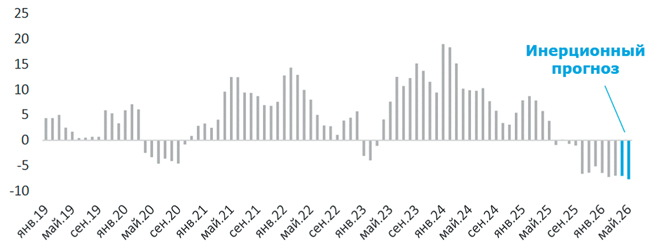
‘Economic indicators became substantially more volatile at the beginning of 2026. The economic downturn in January-February was replaced by a recovery in economic activity in March,’ specialists at the Institute of Economic Forecasting noted. This volatility is occurring against a backdrop of persistent negative trends in capital-goods-producing sectors, including construction, building materials, ferrous metallurgy and several branches of machinery manufacturing. The prolonged period of tight monetary policy continues to exert pressure on the financial condition of companies in the real economy.
‘In the first quarter of 2026, the output index for the economy’s core sectors fell by 0.7%, while production of consumer non-food goods (excluding petroleum products) declined by 3.8%. A similar pattern can be observed in investment demand for machinery and equipment, as well as in domestic production,’ IEF economists said
They expect higher global commodity prices to help Russia avoid an outright recession, with GDP growth reaching 0.7%. As a result, the trend of slowing economic growth is expected to continue this year. Even achieving such modest growth will not be easy, however. Analysts note that after near-zero GDP growth in the first half of the year, a significant revival in economic activity would be required in the third and especially the fourth quarter. Their calculations assume that disruptions in the Strait of Hormuz will be resolved in the second half of 2026. Export prices would then likely decline, leading to stagnant export earnings between 2027 and 2029. The forecast also assumes a gradual normalisation of monetary policy, although inflation is expected to remain persistently above the Central Bank’s target due to the gradual depreciation of the rouble and stronger consumer demand.
Under the inertia scenario, the economy would emerge from its cooling phase only gradually, with annual growth exceeding 2% no earlier than 2029, according to IEF.
At the same time, projections for Russian economic growth in 2029 carry limited weight given the uncertainty surrounding numerous military conflicts around the world, including those involving Russia.
According to IEF forecasts, budget revenues will increase this year, helping the government avoid a fiscal spending crisis.
ORIGINAL:NG/Russian Davos’ Opens Against Twin Forecasts of Economic Stagnation