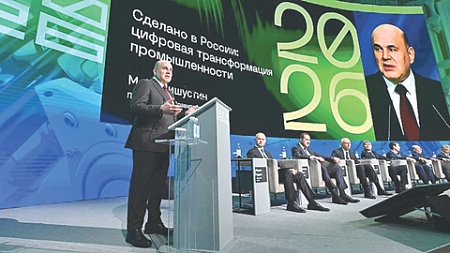
Russian authorities are urging businesses to accelerate their transition to domestic software. On Monday, Prime Minister Mikhail Mishustin instructed the Ministry of Digital Development, Communications and Mass Media of the Russian Federation to continue implementing Russian software at critical infrastructure facilities. According to the prime minister, there should be no loopholes that would allow companies to avoid switching to domestic solutions.
‘I ask the Ministry of Digital Development to continue actively implementing Russian software at critically important infrastructure facilities based on a full-fledged cloud environment. It is important that this transition to domestic software is as flexible as possible while taking into account sector-specific characteristics. At the same time firmness is also required when it comes to security issues,’ Mishustin said during the plenary session of the Digitalisation of Industrial Russia conference.
‘There should be no loopholes enabling companies to avoid transitioning to domestic products. We need to move in this direction, friends,’ he said. The prime minister instructed officials to set up monitoring of purchases of Russian software by companies that own critical infrastructure. ‘This needs to be done intelligently. Of course, everything could be enforced through restrictive legislation, but incentives and motivation are more important. If we rely solely on prohibitions, we risk slowing technological development through non-implementation and undermining solutions developed on legacy software,’ Mishustin said, highlighting the need for motivation mechanisms and strict monitoring.
According to the prime minister, as long as foreign solutions continue functioning and do not require immediate replacement, businesses often lack motivation to invest in the transition. ‘Companies must understand that by postponing this they are creating future technological risks for themselves,’ he said. Such an approach, he argued, leads to a dead end: dependence on ageing code and unsupported platforms will only increase, while competitors will actively adopt generative AI, new technologies and optimisation models.
The state will continue stimulating demand for Russian IT solutions.
‘Our goal is for the information technology sector to move from emergency import substitution to systematic work on creating highly sophisticated ecosystems. We must not simply preserve what has been achieved, but make Russian software the number one choice for industry. That means improving quality and increasing competitiveness not only domestically but globally,’ Mishustin said.
Earlier reports said the Ministry of Digital Development had proposed deadlines for transitioning significant critical information infrastructure facilities to domestic software ranging from January 1, 2028 to January 1, 2036. According to Interfax, the ministry drafted a resolution requiring significant critical information infrastructure facilities to use only Russian software from January 1, 2028, with the share of Russian software reaching 100%.
Two additional deadlines are proposed. The first applies where a particularly significant project had already been implemented at a facility before January 1, 2026 or where a contract for development of relevant Russian software was signed before September 1, 2027. Such organisations would be allowed to complete the transition by January 1, 2031. The second deadline would apply where particularly significant projects for standard critical infrastructure facilities were launched during 2026–2027. These organisations would be permitted to postpone migration until January 1, 2036.
Critical infrastructure entities include government agencies, Russian legal entities and entrepreneurs owning information systems, intelligent transport systems and automated control systems in healthcare, science, transport, communications, energy, property registration, finance, fuel and energy, nuclear, defence, aerospace, mining, metallurgy and chemical industries.
Market participants noted that owners of critical infrastructure facilities still successfully using foreign software had resorted to various workarounds, including understating the importance level of infrastructure facilities or splitting information systems into smaller units
According to estimates by the Association of Software Product Developers, roughly 40–45% of critical infrastructure entities have switched to domestic software. The greatest challenge remains migration to domestic hardware and software systems, especially hardware components.
Nevertheless, Russian companies are increasingly choosing domestic software, Mishustin noted on Monday.
‘It is already being used at more than 10 million workplaces, supporting financial management and business processes at thousands of enterprises nationwide,’ he said.
In several sectors, the share of domestic solutions exceeds 90%.
‘In geological exploration, environmental management, electricity generation, oil and gas, petrochemicals and natural resource extraction, all key management and production processes are fully supported by domestic software. In aviation, engine manufacturing, shipbuilding, machinery manufacturing, rail engineering, light industry, transport, logistics, retail, finance, construction and utilities, the figure exceeds 90%,’ Mishustin said.
A joint study by CSoft and the Moscow Power Engineering Institute found that around 85% of Russian industrial companies use domestic software. However, adoption remains uneven. Around 35% of companies use Russian software for half of their IT solutions, while another third report domestic software shares of between 16% and 50%. Fifteen percent of companies do not use Russian software at all.
When asked what could encourage wider adoption, 22% of respondents cited subsidies and special offers, almost 20% said they would increase use of Russian software if foreign alternatives became entirely unavailable, while another 20% said in-house development was more cost-effective than purchasing third-party software.
‘Although the government says 90% of production and management processes in several sectors have switched to domestic software, industrial digitalisation is progressing much more slowly. In December 2025, the Ministry of Industry and Trade of the Russian Federation reported that only 39% of companies in the radio electronics sector used domestic computer-aided design systems. The issue is that software deployed for different tasks does not function independently. Business software is always an ecosystem of interconnected solutions. Accordingly, the continued use of core foreign systems such as CAD and PLM slows implementation of incompatible domestic products,’ said Olga Magomedova, researcher at the Gaidar Institute for Economic Policy.
‘The biggest problem is that large businesses have enormous fleets of foreign software embedded into every company process over many years. Replacing one link leads to changes in the entire operating model. No business can switch overnight,’ said Valery Ushkov, marketing and communications director at DELTA.
According to him, migration of large systems involves years of work, risks of data loss, duplicated processes and significant pressure on staff.
‘Such projects are almost always accompanied by internal resistance from employees because people have to work simultaneously in old and new systems. At the same time, domestic software cannot always be described as cheaper. Businesses focus on efficiency and process stability,’ he said. ‘Poor compatibility between solutions requiring infrastructure modifications for each customer increases labour and financial costs that businesses operating under severe restrictions and economic crisis conditions are unprepared for,’ said Irina Dmitrieva, analyst at Gazinformservice.
Russian solutions can be more expensive than Western alternatives because foreign vendors operate across multiple markets, while Russian suppliers only focus on the domestic market, which remains limited despite the country’s scale, according to Dmitry Shatskov, commercial director at Code Security.
‘Foreign companies have a major advantage: thanks to their global presence and broader installation base, they can gather more feedback and adapt product functionality more quickly to customer needs. Domestic vendors operate in a relatively limited market, which makes the process of product development and functional improvements slower,’ he explained.
‘The main problem in transitioning Russian companies to domestic software is largely linked to insufficient functionality and compatibility with existing systems. These difficulties stem from numerous interconnected factors that ultimately complicate import substitution. Domestic solutions do not always cover the full range of functions available in foreign equivalents. Overall, the Russian IT landscape is highly fragmented, creating difficulties integrating legacy systems with popular domestic products,’ said Alexander Khonin, head of consulting at Angara Security.
As Olga Magomedova noted, under the New Industrial Software roadmap Russian developers are expected to create 2,300 new CAD and PLM software products by 2030.
‘But even domestic solutions from different developers may be incompatible with each other. Overcoming fragmentation requires significant integration costs, while high-quality integration and technical support demand specialist expertise,’ she said.
To accelerate migration further, the authorities have promised to maintain VAT exemptions for transactions involving Russian software and extend the benefit to cloud services
‘Transactions involving rights to Russian software are exempt from VAT, enabling buyers to purchase more licences and products and making migration to domestic software simpler and less financially burdensome,’ Mishustin said on Monday.
As part of support measures for the IT sector, expenses on purchasing Russian software can now be included in tax declarations using a special double coefficient, reducing companies’ tax liabilities. Accelerated depreciation for domestic software and integrated hardware-software systems has also been introduced, giving businesses greater flexibility in asset management and faster recovery of investments.
ORIGINAL: NG/Business to Be ‘Firmly and Flexibly’ Shifted to Domestic Software