The competitiveness of a modern economy increasingly depends on its positioning in the international market for digital innovation. Convenient and attractive online services are becoming instruments of soft power, shaping a country’s image abroad, first among young people and then among businesses and officials. However, according to surveys of young people in China, a country friendly towards Russia, Russian digital services remain largely invisible outside the CIS. Chinese youth primarily perceive Russia as a resource-and-military power. While this image is undoubtedly important, the ability to export ‘digital habits’ is no less significant.
The Russian-Chinese Committee for Friendship, Peace and Development and the Public Opinion Research Centre of Renmin University of China analysed how young people in Russia and China perceive each other’s countries.
The survey covered respondents aged 18 to 35, including around 2,600 participants from Russia and approximately 1,600 from China.
According to the study, new digital resources and platforms play an important role in shaping a country’s image through their convenience, attractiveness, recognisability and integration into everyday life.
It is precisely in this area that one of the most problematic divides between Russian and Chinese youth emerges.
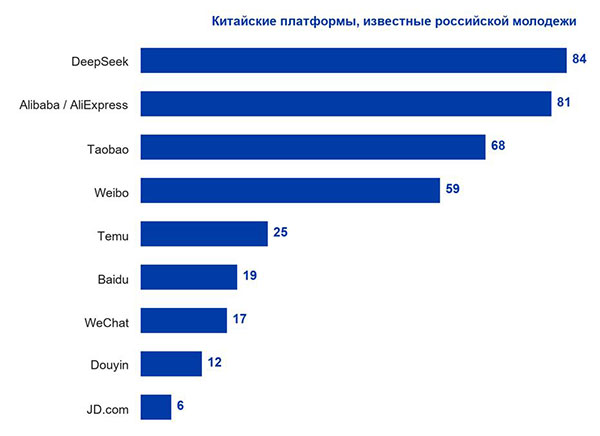
Russian young people demonstrate a high level of awareness of Chinese digital services, especially artificial intelligence and e-commerce platforms
For example, the AI model DeepSeek was mentioned by 84% of surveyed young Russians. Platforms operated by Alibaba Group and AliExpress were recognised by 81% of respondents, while Taobao was identified by 68%. These formed the top three.
At the same time, awareness of Russian digital platforms among Chinese youth was described as ‘generally low’. ‘Even the highest figure, for Telegram, amounted to only 32%,’ the researchers said. Second place went to the Yandex ecosystem with 26% recognition, followed by Kaspersky with 22%.
Even these relatively modest figures are in some ways an achievement. A quarter to a third of surveyed Chinese youth are familiar with and use Russian products connected to big data, artificial intelligence and cybersecurity, rather than only entertainment or online shopping services.
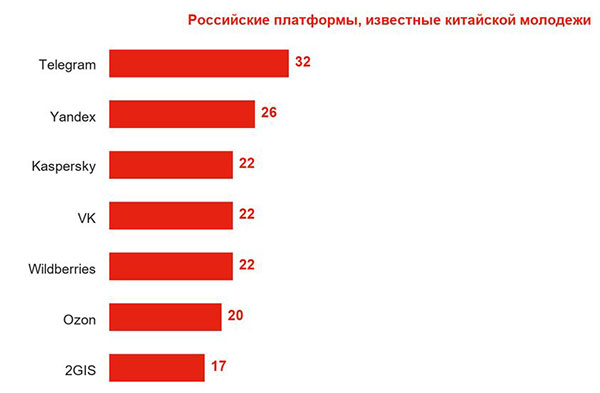
Percentage of respondents, according to the Russian-Chinese Committee for Friendship, Peace and Development
Still, the broader picture remains uneven. The study concluded that Chinese digital platforms are already deeply integrated into the daily lives of young Russians, while the influence of Russian digital products in China remains ‘highly limited’.
The surveys also revealed what researchers called a ‘structural gap in perceptions of each other’s modern development’. For young Russians, contemporary China is most strongly associated with ‘technology and digital services’ (75% of responses) and ‘manufacturing and industry’ (71%). Russian youth have largely formed an image of China as a technological power.
Young Chinese respondents, by contrast, most often associated Russia with the ‘military sphere’ (51%) and ‘energy and raw materials industries’ (40%). In the eyes of Chinese youth, Russia is primarily a resource-and-military power.
According to Marina Kholod, a senior researcher at the artificial intelligence laboratory of the Plekhanov Russian University of Economics, advanced military technologies and abundant natural resources represent a traditional ‘hard power’ set of attributes. ‘This is certainly important, but it is not soft power,’ she told Nezavisimaya Gazeta.
In the current environment, the competitiveness of the Russian economy will increasingly depend not only on resource exports but also on the ability to create globally sought-after digital services, Kholod explained. Such platforms provide a direct channel for influencing economic behaviour, consumption patterns and technological culture. Yet judging by the responses of Chinese youth, who are generally friendly towards and interested in Russia, Russian digital solutions remain ‘practically invisible’ outside the CIS.
‘Our digital products, such as Gosuslugi or domestic software, are designed primarily around internal security needs and hardly translate into attractiveness for mass foreign users,’ said Anton Shport, commercial director at CommuniGate Pro.
‘Even Telegram, although it is essentially a global product of Russian origin, is weakly associated with the image of the Russian state and does little to promote Russian culture or lifestyle,’ he added. Telegram’s position within Russia itself has also become increasingly unstable as the platform periodically falls out of favour with regulators.
‘If Russia does not export digital habits and continues to be seen by Chinese youth mainly as a military and resource power, then we are losing the battle for the most valuable resource of all: the attention of the next generation,’ Shport warned.
All of this suggests that Russia’s digital image abroad has not yet realised its technological potential, although such potential undoubtedly exists.
‘It is necessary to promote our digital products systematically, not as “Russian equivalents” but as independent sources of value,’ Kholod argued.
Alexei Postrigailo, senior partner at IT integrator Ensign, said that merely showcasing products at forums and exhibitions isn’t enough.
‘The services themselves must function properly outside the Russian market,’ he explained. ‘If a product is not integrated into the daily routines of users abroad, it remains a domestic achievement rather than an exportable digital asset.’
According to Postrigailo, Russia’s domestic level of digitalisation is already high.
‘Banking and government services, marketplaces and corporate systems are implemented at a strong level domestically, yet international appeal does not come automatically. Products require full adaptation for local markets, not just translation of the interface,’ he said.
At the same time, experts warned against responding to such survey findings with another wave of restrictions or bans.
Russian youth’s strong interest in advanced technologies, including foreign ones, can itself become a powerful driver of domestic development.
At first glance this may appear to involve consumption of foreign digital products and partial immersion in foreign standards of living. But viewed more broadly, it also creates incentives and foundations for developing unique domestic technologies, provided such goals are properly understood and pursued.
‘Russian specialists are actively working on import substitution in artificial intelligence, e-commerce and digital services, building an ecosystem that is already demonstrating high effectiveness within the country,’ said Sergei Karpovich, deputy head of AI at IT holding company T1.
The next step after import substitution, the article suggests, should be the development of fundamentally new domestic solutions.
At the same time, discussions about Russia’s image abroad must take into account the serious external challenges and restrictions the country faces in trying to build a reputation as a technological power.
‘We are currently seeing difficulties in exporting digital technologies directly connected to international sanctions,’ Karpovich noted. ‘These restrictions create additional barriers for promoting domestic solutions in global markets.’ Such constraints, however, are also pushing Russian developers towards unconventional approaches.
ORIGINAL: NG/Chinese Youth View Russia as a Resource-and-Military Power