One of Russia’s key economic objectives is to achieve growth rates above global averages. This means annual GDP growth of at least 3% to 3.3%. Otherwise, the domestic economy will hardly manage to ensure reliable national security, technological leadership, social stability and fiscal sustainability.
Global economic growth in 2026 is projected to slow down to be in the range of 2.5% to 3% depending on the forecasting agency. Yet even these slower rates appear unattainable for Russia today. Most forecasts project Russian GDP growth under 1% for 2026.
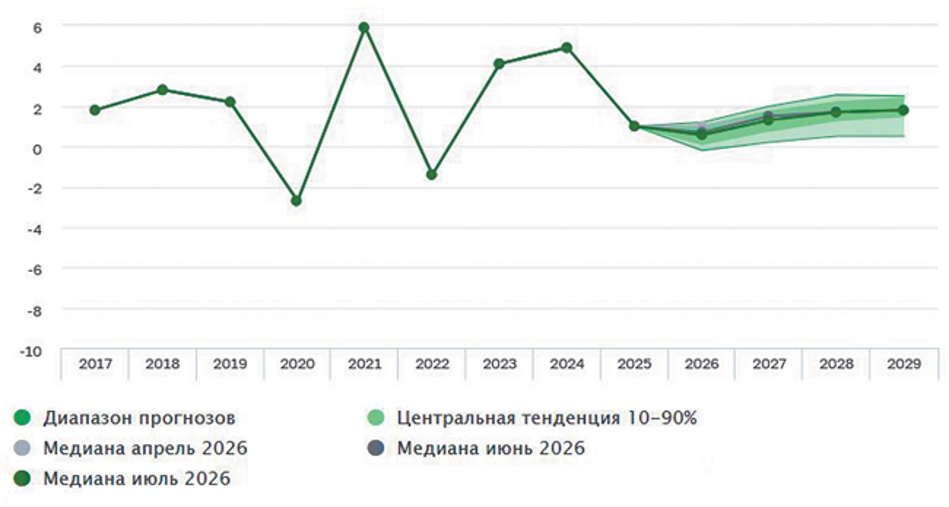
| Forecast range |
| Median April 2026 |
| Median July 2026 |
| The 10 to 90th percentile range |
| Median June 2026 |
Year-on-year GDP growth, actual and expected (%). The forecasts show the range of values expected by analysts. Source: Macroeconomic survey of the Bank of Russia
The World Bank’s updated estimates project global economic growth to ease from 2.9% in 2025 to 2.5% in 2026 amid the conflict in the Middle East and continued uncertainty.
The Organisation for Economic Co-operation and Development expects global economic growth to decline from 3.4% in 2025 to 2.8% in 2026. The International Monetary Fund expects the global economy to expand by 3% in 2026, down from 3.3% in 2025
‘Prolonged disruptions of energy supplies, including the disruption around the Strait of Hormuz, combined with weakened financial and labour markets, pose additional threats to global growth,’ experts at the Presidential Academy explained after analysing the international forecasts. ‘This could result in accelerated inflation, tighter financial conditions, weaker consumer demand and greater risks to financial stability.
The IMF has already warned that the ongoing closure of the Strait of Hormuz will make further price shocks inevitable, leaving central banks and governments less and less room for manoeuvre.
President Vladimir Putin’s Executive Order on Russia’s national development goals through 2030 sets the objective to ensure GDP growth above the global average.
While specific growth figures are not an end in themselves, with the quality of growth and economic, social and technological development in the country being more important, experts do set a tentative goal to ensure an annual economic growth of at least 3% to 3.3%.
According to Dmitry Belousov, Deputy General Director of the Centre for Macroeconomic Analysis and Short-Term Forecasting, the country’s ability to achieve such GDP growth will directly determine whether it can tackle the challenges of ensuring reliable national security, modernisation and social stability. This includes minimising (and even eliminating) widespread ‘near-poverty’, a situation when people, even if employed, have enough money only for food or for food and clothing items, but nothing more
However, even the declined rates of global economic growth once again seem unattainable for Russia today, which can be backed up by at least two forecasts including the official forecast from the Ministry of Economic Development and the consensus expert estimates based on a Bank of Russia survey of leading analytical centres.
The government’s baseline scenario projects the Russian economy to only grow by 0.4% in 2026. According to the macroeconomic survey of the Bank of Russia, experts expect Russian GDP to pick up 0.6% over the year. This is the median estimate, with exactly half of respondents giving a higher figure and half a lower one.
In fact, the country’s economy has grown by merely 0.2%, according to Ministry of Economic Development data for January to May compared with the same period last year.
Despite the objectives set for the country, Mikhail Zeltser, an expert at BCS World of Investments, believes that it is no longer appropriate to compare Russia’s growth rate with the global figure. ‘China, with its 5% GDP growth, is one of the primary drivers behind the growing global economy,’ he said. Whereas some developed economies are facing the risk of stagnation settling into recession. ‘Given our circumstances, even a small increase is fairly good,’ he added, referring to the state of the Russian economy.
Commenting on Russia’s current GDP performance, Olga Belenkaya, a department head at Finam, noted that it was hardly possible to think of any examples across the world of ‘a country in a state of military conflict and under large-scale sanctions for an extended period of time, while still being able to meet all its immediate social welfare, military security and technological development needs with no effort’.
‘Actually, in such circumstances we deal with shrinking resources available in the economy. So, they have to be allocated according to the state’s priorities, thus limiting the opportunities for the rest of the economy,’ she explained.
Nevertheless, Boris Kopeikin, chief economist at the P. A. Stolypin Institute for the Economy of Growth, confirmed to Nezavisimaya Gazeta that the economy indeed needs to grow. ‘Only a growing economy can generate sufficient resources to increase capital investment and consumption simultaneously, while supporting advanced development in the social sphere among others,’ he said. ‘Economic growth is also vital for the long-term sustainability of the fiscal system.’ Even a small budget deficit may lead to a higher national debt when the economy is stagnating.
Kopeikin reminded that the results of 2023 and 2024 demonstrated that the Russian economy was quite capable of growing in parallel or even outpace the global economy, as it did in those years. That success, however, is now in the past. Repeating it will require consistent measures to improve conditions for business and investment.
ORIGINAL: NG/Russia Lagging Behind the Global Average Rate of Economic Growth