While businesses and the government tend to point at the Central Bank in discussing Russia’s economic outlook, the regulator itself is actively promoting the idea that the current high key rate is largely a consequence of fiscal policy: if inflationary risks intensify in one area, they must be offset elsewhere by suppressing private demand and lending. This creates the main paradox of the current situation: while the Bank of Russia cites inflation having halved as evidence of its effectiveness, its own outlook for further disinflation appears uncertain. As Deputy Governor Alexey Zabotkin told Nezavisimaya Gazeta during a Q&A session, monetary policy cannot influence the root causes of inflation linked to supply-side changes.
After the St Petersburg International Economic Forum, notable mainly for the absence of Governor Elvira Nabiullina, after conspiracy theories and speculation about the future of the Central Bank leadership, after President Vladimir Putin saying ‘we have every reason to expect a reduction in the key rate’. After all that the Central Bank nevertheless cut the rate by only 25 basis points instead of the 50 expected by the market, to 14.25%.
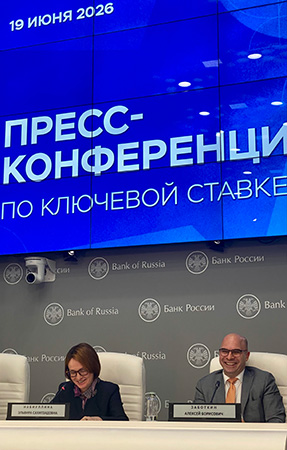
On June 19 at 3 p.m., Elvira Nabiullina appeared before journalists smiling. A routine press conference, held on schedule, was nonetheless awaited with unusual anticipation, giving it an almost sensational atmosphere.
Despite a decision that clearly disappointed business sentiment, as reflected in the comment by Russian Union of Industrialists and Entrepreneurs head Alexander Shokhin (‘This is a disappointment’), the press conference itself was light in tone, even somewhat humorous. Nabiullina compared the Central Bank, which protects the economy from inflation, to a football goalkeeper
This comparison was partly prompted by journalists’ leading questions. Naturally, she was also asked about her recent absence from the public eye.
‘I can only confirm that I had a cold and temporarily lost my voice,’ the Central Bank governor said.
But these are surface details. Ahead of the St Petersburg Economic Forum, an attempt was made, at the initiative of its organisers, to launch a discussion about the kind of inflation that should be measured and used in monetary policy under the current conditions (ongoing special military operation).
The suggestion implied that in these ‘special’ circumstances, the regulator should take into account a different, just as special, form of inflation: a ‘clean’ one. Clean from all noise, and from all factors that drive it up and are objectively beyond the Central Bank’s control, regardless of the interest rate level.
‘Lending to “strategic budget sectors”, which includes the special military operation, the military-industrial complex and other state-funded companies, should be taken outside the Central Bank’s perimeter… and the inflation induced by their activity should be excluded from the overall price index,’ stated a report by Roscongress (see Nezavisimaya Gazeta, May 26, 2026).
In addition, given the sharp tightening of sanctions accompanying the new phase of Russia’s economic development, it would arguably be logical to also exclude sanctions effects from inflation calculations. And following recent attacks on oil refineries and related infrastructure, along with fuel supply disruptions in the domestic market, fuel prices are clearly becoming another inflationary factor the Central Bank can do little about.
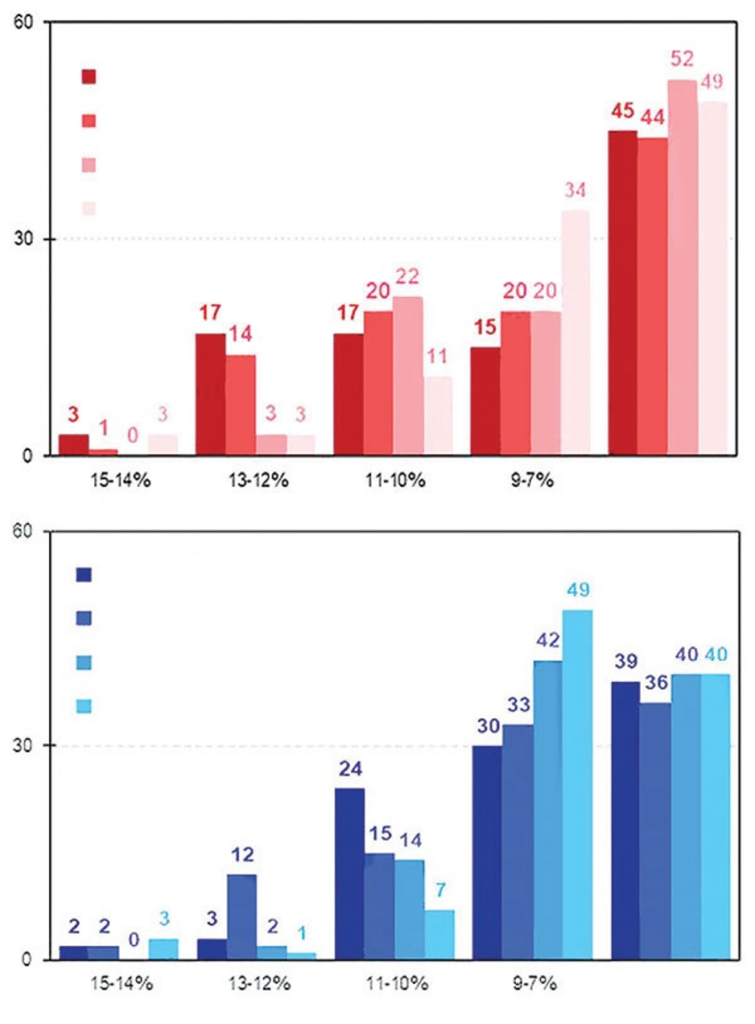
The share of industrial companies planning to increase output (red line) and investment (blue line) under different key rate levels, %. Source: IEF RAS surveys.
The call to separate inflation from such factors has a clear logic: if the Central Bank, after recalculations, obtained a figure consistent with its target perception (around 4%), it would no longer be able to justify maintaining a high key rate and would be forced into a faster, more aggressive easing, which is something the RSPP’s Shokhin has also called for.
During the press conference, Nezavisimaya Gazeta asked the Central Bank leadership what indicators it could currently present as convincing proof of the effectiveness of its monetary policy
Another question was on how the regulator views proposals to base policy not on standard consumer inflation, but on its ‘clean’ version, excluding factors that have significantly reshaped the Russian economy since 2022.
‘The criterion of truth, as we know, is facts. Let us look at the facts on annual inflation. Over the past year, it has halved. This did not happen by itself or due to some fortunate coincidence. In fact, conditions were working in the opposite direction, with inflationary risks materialising. This is primarily the result of monetary policy,’ Nabiullina told Nezavisimaya Gazeta.
But then, how does one explain the apparent misunderstanding regarding the effectiveness of Central Bank measures? According to Nabiullina, it is the lag in monetary policy transmission, estimated at three to six quarters. The Bank of Russia held the key rate at 21% for a long period, and the effects are now materialising with a delay. Therefore, she argued, the view that higher interest rates increase inflation does not hold, as it ignores such lags.
Responding to questions about alternative inflation measurement approaches, Nabiullina told Nezavisimaya Gazeta that inflation can be ‘cleaned’ analytically in any way, but interest rates would not become lower as a result.
‘If inflation is, say, 10%, and “clean” inflation is 2%, lending rates will not be 2%. They will still be above 10%. If we want lower rates, we need lower overall inflation. For people, it does not matter why inflation is high; the purchasing power of their savings and incomes depends on overall price growth,’ she explained
Deputy Governor Alexey Zabotkin added another key point: ‘Monetary policy cannot influence the root causes of inflation linked to supply-side changes. But what it can do is bring demand into line with these conditions.’ In that case, he argued, inflation would be low and interest rates would be moderate.
However, this is where the main paradox of the current economic situation emerges. On the one hand, the Central Bank cites slowing inflation as proof of its effectiveness. On the other hand, its own outlook for further disinflation is uncertain, as many of the underlying drivers, which there are a lot of, are beyond its control. Nevertheless, the regulator continues to apply the limited policy levers at its disposal.
In addition to conventional tools such as the key rate and regulatory limits, the Central Bank is also increasingly relying on another instrument: targeted influence on public expectations.
It is steadily reinforcing the narrative that fiscal policy and monetary policy are jointly responsible for demand in the economy.
‘If the fiscal policy contribution increases in order to implement priority objectives, monetary policy must act as a stabiliser. Its tightness must adjust accordingly to reduce the contribution of credit to aggregate demand,’ Nabiullina said. ‘This is the only way for us to avoid demand exceeding supply and a new wave of inflation.’
‘Fiscal policy over the next three years will be more expansionary than assumed in our baseline forecast,’ she added. ‘In recent months, credit growth has accelerated significantly. This may limit room for further rate cuts.’
According to Nabiullina, neither further reductions in the key rate nor the size of future steps are predetermined; pauses may also be required. ‘Only a balanced approach, especially amidst high uncertainty, will allow us to achieve sustainable results and stabilise inflation at a low level,’ she concluded.
Ahead of the Central Bank’s policy meeting, the The Institute of Economic Forecasting of the Russian Academy of Sciences (IEF RAS) published new survey data of industrial firms. According to the findings, companies would decisively plan to increase output if the key rate were reduced to 7–9%. ‘The cumulative positive effect of such a reduction would trigger output growth in 51% of firms,’ said IEF RAS expert Sergei Tsvetlov. A rate of 7–9% would also, he added, stimulate large-scale investment activity in industry.
ORIGINAL: NG/Nabiullina Explains How the Budget Is Putting Pressure on the Key Rate