Ahead of the Central Bank’s board meeting on the key interest rate, the government reported a further slowdown in weekly price growth. Official annual inflation has returned to levels last seen in the summer of 2023, when the current leadership of the Central Bank began its policy of regular increases to the key rate. Businesses are urging the regulator to move beyond symbolic cuts and reduce the rate to below 10% by the end of the year. Data on actual purchases point to a continuing decline in consumer demand.
A new investment cycle should begin in Russia now that several major investment projects have been completed, President Vladimir Putin said at a meeting with government officials, regional governors and business representatives on June 10. The president also stated that inflation was falling (see Nezavisimaya Gazeta, June 14, 2026).
On Wednesday, the Ministry of Economic Development announced that inflation slowed to 0.15% week-on-week in the period from June 9 to June 15, 2026. Food price growth eased to 0.17%. In the non-food segment, prices rose by 0.13% week-on-week, while monitored services recorded growth of 0.09%.
‘Given that inflation slowed to 5.31% in May, the logical step at the Bank of Russia’s next meeting would be a one percentage point cut in the key rate. If the Russian economy is not to freeze completely, business needs not a thaw but summer warmth,’ said Alexander Shokhin, head of the Russian Union of Industrialists and Entrepreneurs (RSPP), on Thursday. ‘The RSPP is calling on the Central Bank to maintain the trend towards lower rates amid weakening demand. Despite some improvements in macroeconomic indicators, the RSPP’s business environment index for May showed that companies are still facing softer demand, while the problem of payment arrears persists. Businesses have sharply scaled back investment programmes, and this is already being reflected in official statistics,’ the organisation said.
‘A prolonged period of elevated interest rates is having a negative impact on investment activity and on companies’ financial performance. The current level of rates is also damaging for the budget, as it increases the cost of servicing government debt. In such circumstances, predictability and clear signals from the authorities are especially important. Companies need confirmation that the trend towards lower rates will not merely continue but accelerate,’ Shokhin added.
At the meeting with President Putin, he proposed cutting the key rate to single digits, meaning below 10%, by the end of this year.
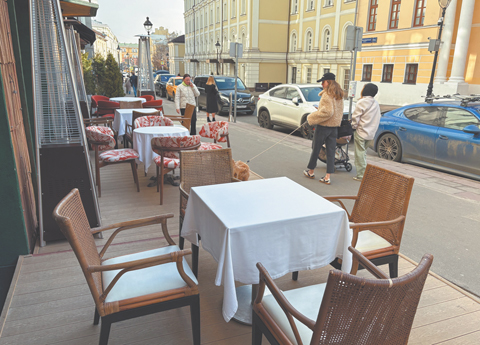
The growing confrontation between the Central Bank and the government became evident immediately after the regulator’s April board meeting, when Central Bank Governor Elvira Nabiullina referred to the budget and government policy more than ten times, explicitly linking monetary measures to decisions by the executive branch.
‘We are waiting for updated parameters of this year’s budget. Our general logic remains unchanged: the greater the fiscal impulse, the less the second component of the money supply, namely lending, should grow. That, all else being equal, would require a higher key rate,’ she said (see Nezavisimaya Gazeta, April 26, 2026). Almost immediately afterwards, Finance Minister Anton Siluanov announced that the government had no intention of holding public discussions or parliamentary votes on the new parameters of the 2026 budget. Last Tuesday, the State Duma approved in its first reading amendments to the Budget Code that would allow the government to borrow beyond planned levels and increase spending without the traditional parliamentary votes (see Nezavisimaya Gazeta, June 9, 2026).
At the beginning of June, Central Bank officials repeated their familiar arguments in favour of only gradual rate cuts at future meetings. Deputy Governor Alexei Zabotkin, in particular, said there had been no increase in the scope for monetary easing. The regulator could therefore consider reducing the key rate by as little as a quarter of a percentage point.
Yet warnings from business about the economy continuing to cool are supported not only by corporate surveys or official statistics. The SberIndex laboratory also points to weaker demand. According to its data, real consumer spending in Russia in the week from June 8 to June 14 was 0.4% lower than a year earlier. The weekly slowdown in household spending amounted to 0.5 percentage points. The decline was driven by non-food spending, which slowed by 0.8 percentage points, and the food service sector, where growth weakened by 1.1 percentage points.
Most analysts surveyed by news agencies expect the Central Bank to lower the key rate by another 50 basis points to 14% per annum at its meeting on Friday, June 19. Some experts predict a more modest move, a reduction of 25 basis points to 14.25%.
Analysts at T-Investments expect Central Bank officials to adopt a softer tone on June 19.
‘News about a settlement of the conflict between the United States and Iran favours monetary easing. External turbulence and a spike in global inflation were among the regulator’s main concerns at meetings in March and April. As attention shifts away from external risks, domestic factors move to the forefront, and in our view they create much stronger grounds for easing,’ the analysts said.
Analysts at Sovcombank believe economic conditions are evolving in line with the Central Bank’s baseline forecast, allowing the regulator to continue cutting rates in standard 50-basis-point increments. Meanwhile, analysts at Veles Capital expect a more cautious tone from the regulator. In their view, part of the recent slowdown in inflation is attributable to temporary factors, while its more persistent components remain elevated.
ORIGINAL: NG/Business Urges Central Bank to Cut Rates More Aggressively