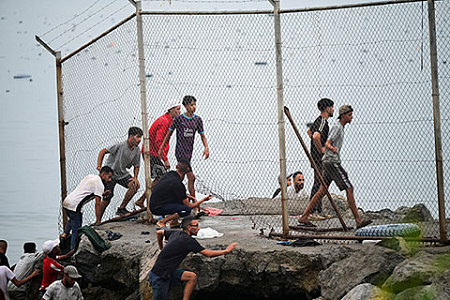
Following the recent events in the Spanish enclave of Ceuta, where crowds of Moroccan border violators surged across the frontier, the European Union’s leadership is once again grappling with two timeless Russian questions: who is to blame, and what is to be done? These issues are being discussed at the August 4 videoconference of EU interior ministers, in intergovernmental negotiations, within the European Commission and the European Parliament. The outcome of those debates is unlikely to satisfy most Europeans. It is, of course, possible to identify those responsible, not least because someone must have created the conditions in which tens of thousands of Moroccans, and according to some reports migrants from other North African countries as well, simultaneously decided to try their luck. Perhaps, they thought, they could break into Ceuta, disappear somewhere in the city, and eventually make their way to mainland Spain. Suspicion falls on many parties. These include organised criminal groups that smuggle illegal migrants into Europe, the Moroccan authorities, who have long-standing grievances against Spain, and Israel, reportedly unhappy with Prime Minister Pedro Sánchez’s support for Palestine. There is also, although it has not gained much traction, speculation about a ‘Russian trace’. It is far more difficult to answer the question of how to prevent a repeat of what happened in Ceuta
Put more broadly, how can Europe deal with a migration problem that, for millions of EU citizens, is a more immediate concern than Russia? A Russian invasion remains a theoretical possibility. By contrast, the growing number of people arriving from Africa, the Middle East and what is variously called the Third World or the Global South is a reality unfolding here and now
No matter how free a person may be from nationalist or racist prejudices and stereotypes, the visible transformation of the ethnic composition of one’s city or country is bound to provoke negative feelings, even if the newcomers are law-abiding and pose no threat, which unfortunately is not always the case. Appeals to demographic studies, which clearly suggest that Europe faces neither population replacement nor Islamisation at current birth and assimilation rates, are unlikely to change those emotions. The distinction between ‘us’ and ‘them’ operates at a deeply instinctive level, something rooted in human nature that cannot simply be reasoned away.
Nor, however, are the solutions proposed by increasingly popular far-right movements likely to succeed. Experience has shown that Europe cannot simply seal itself off from the Global South. As long as there are countries offering greater freedom, stability and prosperity, people from places where those things are scarce will continue trying to reach them, legally or otherwise. Periods of lower illegal migration may follow peaks, though this depends more on political developments in countries of origin than on the effectiveness of policing. Fundamentally, little will change
Europe’s troubled experience offers lessons for Russia. Whatever anyone may say, Russia is not part of the Global South, and until recently it too attracted immigrants with its relative freedom, stability and prosperity. That means Russia will eventually face its own versions of Ceuta. Not now, however. At present, the country is pursuing a path that would be unimaginable to Europeans. Migrants are readily admitted, while life inside Russia is made as difficult as possible in the hope that they will quickly exchange their Tajik, Uzbek or other passports for Russian ones. Such new citizens are more convenient for the state. They can be handed not only a broom but also a rifle. Military service under contract is now a sought-after profession. Much of Russia’s native-born population does not object to this approach and, if anything, tends to support it. How long this specifically Russian model will last is impossible to say. The only certainty is that it will eventually come to an end. When it does, it will become clear that Russia and the European Union ultimately face the same migration-related, civilisational challenge, one for which no satisfactory answer has yet been found
ORIGINAL: NG/Peculiarities of the National Migration Challenges