Russian officials are reporting a recovery in economic growth in Russia. Independent experts, however, say the economy is stagnating. Meanwhile, conditions in key industrial sectors are expected to keep deteriorating. Oil production is forecasted to decline further by the end of the year, even though Russia’s oil production is remarkably lagging behind the permitted output quotas.

| % growth rate vs December 2014 |
| 95% confidence interval |
| Actuals |
| Q1 2026 |
| Trend |
| Q2 2026 |
| Trend forecast |
| June 2023 |
| July 2023 |
| August 2023 |
| September 2023 |
| October 2023 |
| November 2023 |
| December 2023 |
| January 2024 |
| February 2024 |
| March 2024 |
| April 2024 |
| May 2024 |
| June 2024 |
| July 2024 |
| August 2024 |
| September 2024 |
| October 2024 |
| November 2024 |
| December 2024 |
| January 2025 |
| February 2025 |
| March 2025 |
| April 2025 |
| May 2025 |
| June 2025 |
| July 2025 |
| August 2025 |
| September 2025 |
| October 2025 |
| November 2025 |
| December 2025 |
| January 2026 |
| February 2026 |
| March 2026 |
| April 2026 |
| May 2026 |
| June 2026 |
| July 2026 |
| August 2026 |
| September 2026 |
| October 2026 |
| November 2026 |
| December 2026 |
Actual and projected dynamics of Russia’s mineral extraction index, relative to December 2014. Source: Gaidar Institute.
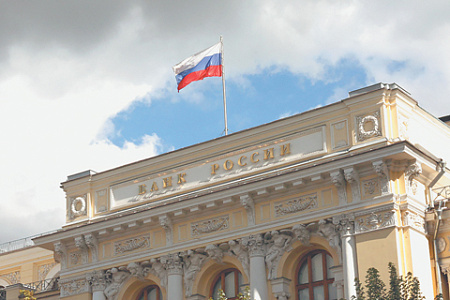
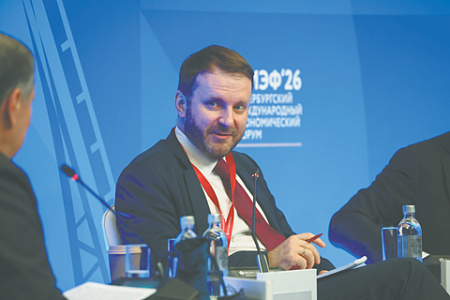
Russia’s economy is regaining growth due to the coordinated work of the Central Bank and the government, according to Minister of Economic Development of the Russian Federation Maxim Reshetnikov.
‘This coordinated work allows us to water down the knock-on effects on the economy in the current circumstances and enables us to normalise our fiscal and monetary policies. Ultimately, the economy is regaining growth,’ Reshetnikov said.
According to Rosstat and the Ministry of Economic Development, the Russian economy grew by 1.3% in the second quarter compared with the same period a year earlier. In the first quarter, Rosstat recorded a 0.2% year-on-year decline.
The latest optimistic reports from Russian officials contrast somewhat with the conclusions of independent experts, who see industrial stagnation and expect conditions to worsen in the coming months.
‘In the short term, industrial production can be expected to remain stagnant. Whereas upstream yields are forecasted to decline further, including the production of coke and petroleum products. Growth is expected in electrical equipment and motor vehicle production, albeit from a low base,’ noted Gaidar Institute experts Andrei Kaukin, Vladimir Kosarev and Anastasia Levchenko.
The main trends across Russian industrial sectors in the second quarter of this year showed that stagnation had become entrenched. The upstream sector saw declines in oil production as well as in thermal coal and anthracite output. Manufacturing was characterised by growth rates close to zero. The sharpest declines in trend indicators were recorded in the production of coke and petroleum products, as well as machinery and equipment manufacturing.
The forecast through the end of 2026 points to continued stagnation in industrial production, with a possible decline in December, as the economists commented on their calculations.
Stagnation and contraction are particularly evident in the upstream sectors. In the second quarter of 2026, calculated trend indicators in the upstream sector declined. ‘The forecast through the end of 2026 points to a further decline in upstream yields,’ Gaidar Institute economists mentioned
According to OPEC data, Russia’s oil production fell by 61,000 barrels per day in June compared with May. OPEC estimated Russian oil production in June at 8.928 million barrels per day, 834,000 barrels per day below the production target set for participants in the OPEC+ agreement. Russia’s quota for June was 9.762 million barrels per day. In other words, oil companies were producing more than 100,000 tonnes of crude oil per day below the permitted quota. Attacks on oil refining and transport infrastructure acted as a constraint and, according to estimates by Argus specialists, kept production below the permitted production ceiling. Meanwhile, the armed conflict between the United States and Iran, accompanied by the closure of the Strait of Hormuz, led to increased demand for Russian crude and higher prices.
According to a report by the International Energy Agency, Russia increased exports of liquefied natural gas by 8% in the first half of the year, equivalent to about 2 billion cubic metres. The main driver of growth was an 18% increase in gas supplies to Europe. Liquefied natural gas production rose to 2.6 million tonnes in June 2026, up 12.5% from a year earlier. LNG production in the first six months increased by 10.7% to 18.2 million tonnes. In the pipeline segment, exports via TurkStream rose by 5% in January to June. However, in June, TurkStream deliveries fell by 26% from May because of scheduled maintenance. Therefore, the gas sector in the second quarter gained steady growth in export deliveries and LNG production, offsetting fluctuations in pipeline exports
The drop in Russian coal production accelerated in the second quarter. According to Rosstat, coal output fell by 2% year on year in the first half of 2026 to 212 million tonnes. In June, production fell by 5.7% compared with May, to 34.9 million tonnes. However, coking coal output went up by 3.5% to 53.8 million tonnes and lignite production rose by 1.1% to 50.2 million tonnes, while anthracite output fell by 11.4% to 10.1 million tonnes and production of other hard coal shrank by 5% to 98.5 million tonnes.
The increase in coking coal production was linked to the development of the Elga deposit, whose operator set a record in April for shipments to ports in Russia’s Far East. In June 2026, Russian coal exports rose by 18% year on year to 20.6 million tonnes. Coal exports in the first half of the year climbed 6% to 105.3 million tonnes
The Indian market was the key driver of growth in Russian coal exports. Coal shipments to India rose by 48% year on year in June, reaching 3.5 million tonnes. The coal sector therefore underwent a structural shift in the second quarter of 2026, with declining overall production along with higher exports, primarily as a result of reorientation towards India, the Gaidar Institute concluded.
Trends in the Russian metals industry also deteriorated in the second quarter of 2026. The forecast points to a continued downward trend in the sector through the end of the year, experts said. The negative trends in metals segment were attributed to lower domestic demand, the high key rate, declining exports because of logistics constraints and sanctions pressure, as well as rising costs for raw materials and energy
The short-term forecast through the end of the year is for industrial production as a whole to remain stagnant. The upstream sector is expected to contract further. The trend in manufacturing will remain close to zero. The sharpest decline will continue in the production of coke and petroleum products. Machinery and equipment manufacturing will stabilise, with a tendency towards a slight decline by the end of the year. Electrical equipment manufacturing will maintain a strong upward trend. Motor vehicle manufacturing will continue its moderate recovery, driven by the passenger car segment, although output will remain significantly below pre-crisis levels. The chemical sector will show steady growth, while metals production will remain in decline under pressure from weaker demand and export restrictions, the Gaidar Institute expects.
ORIGINAL: NG/Industrial Stagnation Expected to Deepen in the Second Half of the Year