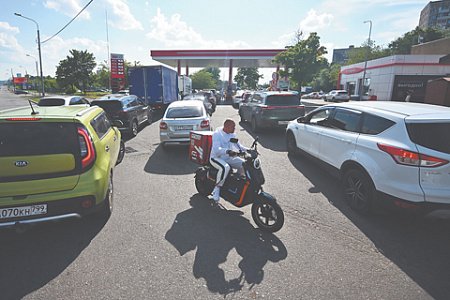

The government acknowledges that the fuel supply at gas stations remains strained in a number of Russian regions. At a meeting on the conditions in the domestic fuel market, Deputy Prime Minister Alexander Novak ordered relevant agencies and oil companies to take additional measures to ensure fuel supplies to regions where petrol availability remains a problem. A second wave of the fuel crisis is gathering pace across the regions. A growing number of them are returning to odd-even rationing and limits on fuel sales.
According to the government press service, a meeting chaired by Russian Deputy Prime Minister Alexander Novak on the fuel market paid particular attention to supplies in the Orenburg, Lipetsk, Tver and Oryol regions, the Republic of Tuva, Krasnodar Territory, the Republic of Khakassia, and the Trans-Baikal, Primorye and Krasnoyarsk territories
Russian Ministry of Energy reported that major oil companies were currently taking the necessary steps to increase supplies to the most vulnerable regions. The government also emphasized, with a reference to data by the Ministry of Agriculture, that ‘agricultural facilities have sufficient fuel supplies and the harvesting campaign is proceeding as normal’
Nevertheless, fuel crunch still persists in a number of regions. On Friday, Orenburg regional governor Yevgeny Solntsev said the oil refinery in Orsk, which had come under attack, had been completely shut down. As a result, the region will have to rely on fuel brought in from elsewhere.
‘Striking elements damaged key infrastructure that cannot currently be restored. The equipment is imported and, given the sanctions, repairs will take up to six months. The plant has been completely shut down,’ Solntsev said. According to him, logistics are already being reconfigured in the region. ‘Of 287 filling stations, 80% are operating. I would remind you that emergency and special-purpose vehicles are top priority today,’ Solntsev noted.
Filling stations in the Orenburg region had previously introduced an odd-evenrationing scheme based on a license plate and date. In other words, petrol is sold to private motorists depending on whether their vehicle license plate is odd or even. The Orenburg region also introduced a complete ban on filling fuel cans, which had previously been allowed at certain gas stations. Limits were also imposed on the amount of fuel sold. Thus, petrol, including AI-92 and AI-95 grades, is limited to a minimum of 15 litres and a maximum of 30 litres per customer. Diesel is limited to 60 litres within populated areas and 200 litres at filling stations located on intermunicipal, regional and federal highways within the region.
Kaluga region is also rolling out the odd-even system from August 15. ‘The fuel market conditions have deteriorated, with long queues seen at filling stations across the region once again. Additional measures are needed to stabilise the fuel crunch,’ Kaluga regional governor Vladislav Shapsha said. On August 13, the odd-even system was reinstated at a number of filling stations operated by major chains in the Lipetsk region. Sales limits were also reintroduced there, with no more than 30 litres of petrol per vehicle
‘Our primary task, given current supply volumes, is to bring more order to queues and distribute traffic more evenly among filling stations,’ Lipetsk regional governor Igor Artamonov said.
In response to a proposal from Lukoil and Gazprom, Authorities in the Astrakhan region have introduced temporary limits of up to 40 litres of petrol per purchase at filling stations in cities, as reported by regional governor Igor Babushkin. According to him, the measure will help reduce seasonal demand and the residual panic buying left over from the previous wave of restrictions, while stabilising fuel stocks.
Authorities in the Volgograd and Irkutsk regions have also returned to fuel sales subject to volume limits.
In the Tambov region, by contrast, the odd-even system was abolished at independent filling stations from August 14. It had been in force since July 20. The rule remains in place at filling stations operated by major chains. A limit on petrol sales also continues to apply at all filling stations without exception, with no more than 30 litres per vehicle. Local authorities said each filling station has a daily fuel sales limit set by its owner. Major-chain stations also continue to prohibit sales of fuel into cans. The actual operating hours of each station depend on the pace of sales. Police officers are also reported to be on duty at filling stations to prevent conflicts
‘The petrol supply today is challenging. The Tambov region is entirely dependent on fuel deliveries from other regions,’ Tambov regional head Yevgeny Pervyshov explained.

In Sevastopol, sales of AI-95 and AI-92 petrol were due to be carried out using QR codes on August 17, with a limit of 20 litres, Sevastopol governor Mikhail Razvozhayev said. Other types of fuel were to remain freely available, although also subject to a 20-litre limit. Fuel supply problems in Crimea and Sevastopol stem from late May followed by the introduction of various sales restrictions by the authorities. Fuel supplies and availability on the peninsula are expected to return to normal by early September.
Authorities in Sochi describe the fuel situation as strained. ‘At present, petrol and diesel stocks and distribution remain under pressure, but the situation is fully under control,’ Sochi mayor Andrei Proshunin said on Saturday. He pointed out that the city is assisting filling stations in maintaining uninterrupted operations and ensuring security. Volunteers are on duty at stations every day, informing motorists about opening hours and fuel availability and helping them navigate queues. ‘We also discussed the logistics of unloading fuel and mechanisms for ensuring that it is distributed evenly among the city’s filling stations each day, so that the necessary reserves are maintained for organisations and public services,’ he added.
Earlier, Krasnodar Territory governor Veniamin Kondratyev appealed to Russian Deputy Prime Minister Alexander Novak to order an increase in petrol supplies to the region amid higher demand during the holiday season. The most challenging situation is on the Azov and Black Sea coast, where the holiday season is at its peak and the number of tourists arriving at Krasnodar Territory resorts in private cars has risen to 50,000 vehicles a day
In a number of regions, local authorities are reaching agreements with oil traders and filling station operators to restrain petrol prices. The Novosibirsk region, in particular, became the first Russian region where authorities agreed with market participants on curbing petrol prices. The Novosibirsk regional Ministry of Industry, Trade and Entrepreneurship Development signed an agreement with independent oil traders and regional filling station chains on voluntarily limiting fuel retail margins. Under the agreement, the maximum retail margin on fuel supplied to the region must not exceed 15% of the wholesale price.
Nevertheless, there is a significant gap between fuel prices at filling stations owned by major chains and those at small independent stations. Regional media cite the Novosibirsk region as an example, where AI-92 petrol costs from RUB 62 to 64 per litre at major-chain filling stations, while prices at private stations can reach RUB 120. The same is relevant to AI-95. At filling stations owned by major chains, it sells for RUB 66 to 69 per litre, while at private stations the price can reach RUB 100 to 130.
The Russian Fuel Union (RFU), which represents the country’s retail petroleum product operators, had previously drawn attention to the issues independent filling stations are facing. They continue to suffer from the shortage of petroleum products even when the overall fuel stance stabilises. According to the union, private filling stations are unable to buy fuel at acceptable prices, while petroleum products purchased on the exchange are simply not delivered to them because oil companies’ current priorities center around supplying their own filling station networks. Finally, independent operators have access only to small volumes of fuel at prices 1.5 to two times higher than exchange benchmarks. Such supplies are either imported or sold on an ex-works basis
Rosstat, meanwhile, reports that consumer petrol prices are stabilising. Over the week, as of August 10 versus August 4, the average cost of the main fuel types in Russia fell. AI-92 petrol became 60 kopecks cheaper, AI-95 fell by 50 kopecks and diesel fuel declined by RUB 2.3. However, petrol prices remain above RUB 100 per litre in a number of regions. The most challenging conditions are in Crimea, Sevastopol, Kalmykia, Chechnya and Tuva
Experts believe fuel concerns point to a second wave of petrol shortages. Igor Yushkov, a leading analyst at the National Energy Security Fund, believes the current circumstances do resemble another wave of shortages, driven by broadly the same factors as in the summer, including issues in oil refining and strikes on Russian refineries. According to him, if refining volumes have fallen again, the market will inevitably feel the impact. Less fuel production means less capacity to meet high summer demand without disruption. In addition, petrol consumption is higher in summer, as people travel more across various cities, go on holiday, return home and spend more time driving. Therefore, even a relatively small reduction in supply in August is felt much more strongly than during the colder months, he said. In his view, the stabilisation is expected in the upcoming autumn season.
‘The fuel shortage has appeared to return. This affects both central Moscow and places very far from the capital. Apparently, the additional supplies that came from storage facilities have now run out, while there are disruptions to deliveries of new batches. The harvest campaign is more complicated under these conditions. A cascade of challenges dealt a blow to farmers suffering from falling producer prices for their products and constrained exports aggravated by a current uncertainty as to how to harvest the crops. The next agricultural year will be arduous, at least for those operating below the scale of the largest agricultural holdings,’ warned Oleg Nikolayev, an expert at the Stolypin Institute for the Economy of Growth.