Big business has so far failed to find common ground with the Central Bank. The months-long ‘information campaign’ by Alexander Shokhin, head of the Russian Union of Industrialists and Entrepreneurs (RSPP), calling on the regulator to cut the key rate more aggressively, appears to have received little response from the Central Bank, which has largely watched the criticism with restraint. The fuel crisis has become a new source of concern. Shokhin attempted to act pre-emptively by urging the Central Bank not to raise the key rate in response to the surge in petrol prices. The increase has indeed been sharp and painful for households, regardless of whether they own a car or not. Some experts fear that the problems could snowball, as any downtime involving a freight truck carrying goods can trigger a chain of negative consequences
Many of the challenges currently facing the Russian economy are now assessed by domestic businesses not directly, but indirectly, through the hypothetical reaction of the financial ‘mega-regulator’: whether or not it will raise the key rate.
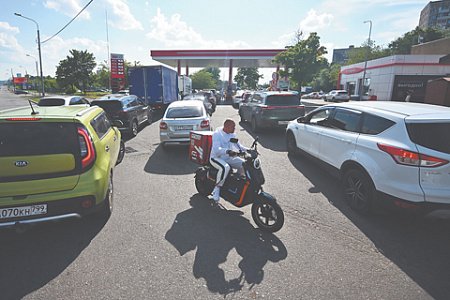
The current focus is on the imbalance in the domestic fuel market and sharp increases in petrol prices. While petrol prices across Russia rose by 1.6% in a single week, which is already significant for a seven-day period, in some regions prices jumped by 8%, 12% or even 31% over the same period. These figures refer to Chechnya, Tuva and Sevastopol respectively, according to Rosstat data as of June 29.
Signals from the Central Bank suggest that at its next board meeting on July 24, the regulator will, in the best-case scenario, keep the key rate unchanged. In the worst-case scenario, it could raise it. This view was expressed by RSPP head Alexander Shokhin. A rate increase, he said, could become a ‘reaction to the fuel crisis’.
‘It is clear that higher fuel prices will ultimately lead to higher inflation. Or rather, they will prevent us from expecting deflation (a decline in prices, Nezavisimaya Gazeta) during the seasonal period in August. Therefore, the Central Bank may act pre-emptively and raise the rate,’ Shokhin explained in an interview with Interfax.
He also decided to act in advance by warning that ‘fighting non-monetary inflation factors through monetary methods is not very effective and, as a rule, does not work’.
Alexander Shokhin has frequently spoken about the negative consequences for the economy of what the business community considers excessively tight monetary policy.
However, this ‘information campaign’ by Shokhin has become particularly prominent and emotional in recent months, following his appointment at the end of May as business ombudsman, a position that had remained vacant for a long period since June 22, 2022. Before that, from 2012 to 2022, the post was held by Boris Titov.
The fact that RSPP head Shokhin was appointed business ombudsman can be seen as a sign that problems are spreading across the business landscape, moving from small and medium-sized companies, whose interests were previously represented by Titov, to large corporations, which now appear to be losing their footing.
The main refrain repeatedly voiced by Shokhin, who represents the interests of big business, has been the need to reduce the key rate.
Ahead of the Central Bank meeting at the end of June, Shokhin said that the RSPP was calling on the regulator to maintain the trend of rate cuts, given weaker demand, payment arrears and reductions in investment programmes.
‘A logical step at the upcoming Central Bank meeting would be to cut the rate by 1 percentage point. For the Russian economy not to freeze completely, business now needs not a thaw but summer warmth,’ he said. In other words, Shokhin was calling for the rate to be reduced from 14.5% to 13.5% annually.
The Central Bank took a different approach, cutting the rate only to 14.25%. Shokhin called the move disappointing.
‘I literally yesterday and in previous days, including at the St Petersburg International Economic Forum, urged a more aggressive rate reduction so that by the end of the year we could reach a clear single-digit figure, meaning below 10%,’ he said at the time. But these ambitious appeals produced no result
It cannot be said that the Central Bank does not hear business representatives. It does, and very clearly. But that is where it ends.
‘We certainly take into account the views of experts and businesses. There are many voices calling for lower rates, and they are understandable,’ Central Bank Governor Elvira Nabiullina said at a press conference on June 19. ‘But we do not perceive this as pressure, and we make decisions independently based on our own analysis,’ she added.
For now, it is difficult to predict the Central Bank’s response to the fuel crisis. In a published summary of discussions on the key rate following its June meeting, the regulator said that developments in the fuel market could have a ‘more prolonged impact on inflation’ than in previous cases.
‘Since mid-May, the growth in motor fuel prices has accelerated. Petrol and diesel are included in the consumer basket, so their price increases directly affect inflation. In addition, higher fuel prices may feed through into prices for other goods and services via transport and production costs,’ the Central Bank said.
Petrol is also a symbolic benchmark for households and businesses, influencing inflation expectations. Therefore, rising fuel prices may have secondary effects both through higher costs and through inflation expectations.
The government is taking measures to stabilise the market. This is positive, but their effect has yet to be assessed.
At last week’s Financial Congress, Central Bank department director Andrei Gangan estimated the impact of higher fuel prices on June inflation at ‘one-third of a percentage point’, adding that the more important issue was not the price spike itself, but the indirect effects and their scale.
Nabiullina added that the Central Bank had not yet observed secondary effects. But that was only ‘for now’: the regulator is awaiting the July survey on inflation expectations.
Summarising the Central Bank’s statements, Olga Belenkaya, head of research at Finam, concluded that the regulator’s likely choice at the upcoming meeting would be between another small cut of 25 basis points or a pause, meaning the key rate could stand at either 14% or 14.25% annually.
Experts interviewed by Nezavisimaya Gazeta split into two groups, pessimists and optimists, when assessing the prospects for Russia’s fuel market.
‘Under current conditions, the Central Bank has not the slightest reason to cut the rate. Much to our collective disappointment,’ Oleg Nikolaev, a member of the general council of Delovaya Rossiya, told Nezavisimaya Gazeta.
According to him, the cause of the fuel crisis lies not in economic factors. Therefore, it is unlikely that its consequences can be effectively mitigated through economic measures, including tax incentives for oil refineries, which Shokhin recently proposed. ‘At least because nobody knows where the next pieces will fall tomorrow or the day after,’ the expert added.
For the same reason, he believes the contribution of the fuel crisis to inflation cannot be accurately assessed.
‘Because it works like a snowball: any downtime involving a freight truck carrying goods triggers a chain of consequences that increase costs and need to be compensated for. In fact, suppliers in various industries have already raised prices, citing delivery problems as the reason. What happens next is unknown,’ Nikolaev warned.
The chief economist at BCS World of Investments, Ilya Fedorov, offered a different assessment. He agrees that keeping the key rate unchanged is currently the baseline scenario.
However, this is not because the fuel crisis is continuing or worsening, but rather because he believes there are ‘good chances that the fuel problem will be localised within several months’.
‘Therefore, there is no point in disrupting the debt market by raising rates,’ the expert said.
As Boris Kopeikin, chief economist at the Stolypin Institute for Growth Economics, explained to Nezavisimaya Gazeta, rising petrol prices do indeed increase costs throughout supply chains
‘But the effects should not be overestimated,’ he added.
‘Fuel costs account for no more than 30% of transport expenses, according to most estimates,’ Kopeikin said. ‘The rest consists of wages, leasing and loan payments for vehicles, which are also affected by the level of the key rate, as well as other expenses that are less dependent on petrol prices.’
ORIGINAL: NG/Big Business Sees ‘Mega-Regulatory Risks’ in Fuel Crisis