Russians have significantly increased their spending on dining out and leisure activities, according to analysts at the audit and consulting network FinExpertiza. The experts attribute this consumer behaviour to the growing unaffordability of major purchases such as homes and cars. Instead, households are shifting toward a more accessible ‘experience economy’
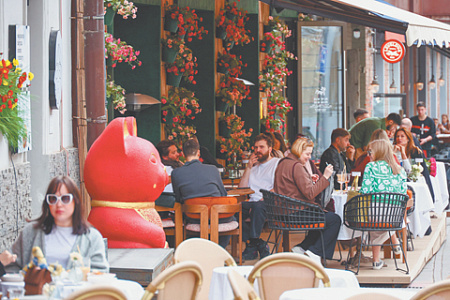
In 2025 alone, household spending on cafés and restaurants increased by 27%, well above the overall rate of inflation, the analysts said. Annual spending on meals eaten outside the home by a family of three rose from RUB 2,700 to 3,500 per month. Regionally, residents of St. Petersburg spent the most on cafés, restaurants and ready-made food deliveries. A three-person household spent an average of RUB 8,900 per month, 2.6 times the national average.
The Khanty-Mansi Autonomous District ranked second, with average monthly spending on food away from home of RUB 7,300. In Moscow, households spent around RUB 7,000 a month on food service, while in the Moscow Region the figure was RUB 5,800. Residents of the Samara Region and Primorsky Territory each spent about RUB 5,000 per month. Spending also exceeded the national average in the Sverdlovsk, Novgorod, Arkhangelsk and Nizhny Novgorod regions
The increase in spending on food service substantially outpaced price growth, FinExpertiza noted. Over the year, prices for cafés and canteens rose by 12.8%, while restaurant prices increased by 11.8%. Overall consumer inflation in 2025 stood at 5.59%.
Nominal spending on dining out increased in 63 regions, or nearly three-quarters of Russia’s federal subjects. In four regions, however, the increase or decrease was marginal, amounting to less than 1%.
According to Rosstat, turnover in Russia’s food service sector totalled RUB 4.28 tn, up 8.7% from the previous year. Food service prices increased by 11.6% over the same period.
During the same period, Russians’ spending on cultural events, sports and recreation increased by 8.5%, rising from RUB 6,200 to 6,700 per month for a family of three. The share of such spending in household consumption also edged up from 7.0% to 7.1%. Higher leisure spending was recorded in roughly three-quarters of Russia’s regions.
In absolute terms, Magadan Region recorded the highest spending on hobbies, recreation, cultural events and sports in 2025, at an average of RUB 14,400 per month for a family of three. Moscow ranked second at RUB 14,200, followed by the Nenets Autonomous District at RUB 12,300.
At the same time, spending on cultural activities, sports and recreation declined in nearly a quarter of Russia’s regions, or 22 federal subjects. The sharpest drop was recorded in Sakhalin Region, where leisure spending almost halved to RUB 5,000 per month for a family of three. Spending also fell by one-and-a-half times or more in Tambov Region (to RUB 1,500), Mordovia (to RUB 1,000) and Chuvashia (to RUB 2,200). In the regions of the North Caucasus, meanwhile, families spent less than RUB 1,000 a month on leisure.
As a result, the share of spending on leisure and food service in Russians’ consumer expenditure, which had remained relatively stable throughout 2020–2022, reached 10.8% last year, almost returning to its pre-pandemic level.
‘In the record year of 2019, entertainment, cafés and restaurants accounted for 11.6% of consumer spending. Neither geopolitical developments nor elevated inflation have reversed this long-term trend. In recent years, the only factor that significantly changed recreational behaviour was the pandemic, when cafés, restaurants, cultural events and tourist travel became temporarily unavailable,’ the analysts said.
The researchers link the growth in leisure and restaurant spending to the broader development of the ‘experience economy’.
‘When major purchases such as cars, household appliances and real estate become less affordable, some disposable income is redirected toward relatively inexpensive but emotionally meaningful purchases, including restaurants, concerts and other forms of leisure,’ said Sergey Zubkov, head of FinExpertiza’s tax practice. That is why spending on experiences often proves more resilient than might be expected based solely on household income dynamics, he added.
At the same time, the company expects growth in spending on leisure and food service to slow this year because of rising rental and logistics costs.
Industry experts and market participants have previously reported a slowdown in the growth of Russia’s food service sector. Between 2023 and 2025, the market’s turnover almost doubled from RUB 2.87 tn to RUB 5.27 tn. Over the same period, however, business profitability declined from 8.9% to 7.9%, according to media reports citing data from the National Credit Ratings agency. Restaurant operators also reported weakening consumer purchasing power alongside rising costs for rent, staff and food products.
According to analysts at Gidmarket, Russia’s food service market reached RUB 4.28 tn in 2025, increasing by 21.4% year-on-year, the strongest growth in five years. Since 2021, the sector has expanded by a factor of 2.2. However, the analysts attributed this surge not only to an increase in customer numbers but also to substantial inflationary pressures: higher costs for raw materials, logistics and labour automatically pushed up the average bill. For comparison, Russia had just over 209,900 food service establishments in operation in 2025, only 1.7% more than a year earlier.
At the beginning of the year, the corporate information service Rusprofile also reported that growth in Russia’s food service industry was slowing. The number of cafés and restaurants opened in 2025 was virtually unchanged from the previous year, while closures increased (see Nezavisimaya Gazeta, January 21, 2026). Analysts attributed the slowdown to market saturation in large cities and intensifying competition.
According to Vasily Kutyin, Director of Analytics at Ingo Bank, consumer behaviour in Russia is indeed undergoing a transformation.
‘This is confirmed by the latest study from the Analytical Centre of the Russian Public Opinion Research Centre, which tracked changes in attitudes toward major purchases between 2006 and 2026. In 2006, good housing was regarded as the main marker of a successful life by 55% of respondents, whereas this year half chose the ability to provide a good education for their children. A car as a status symbol was selected by 27% of Russians in 2006, compared with just 15% this year. Foreign holidays also declined as a status marker, from 23% to 15%, while expensive consumer electronics fell from 10% to 3%,’ he said.
Among younger generations, the rejection of traditional major purchases reflects both a change in values and today’s difficult economic realities. For older age groups, however, the shift in spending toward experiences is more often a forced adaptation to the growing inaccessibility of major purchases because of interest rates, banks’ lending requirements and high prices, the expert added. ‘As for major purchases, although the key rate now stands at 14.25% per annum, it remains high. Under these conditions, mortgages remain too expensive for many families, so people prefer not to take on long-term debt and postpone buying a home until conditions improve. The car market is also characterised by considerable uncertainty. Buyers do not know how fuel prices, vehicle ownership costs or the technologies most likely to dominate in the coming years will evolve. As a result, many are delaying car purchases, opting for more fuel-efficient models, while some consumers are likely to consider electric vehicles as a possible alternative,’ said business analyst Vitaly Lavrinovich.
‘Unlike major purchases such as homes and cars, spending on restaurants and entertainment depends much less on access to credit. That is why one of the main reasons for the changing structure of consumer spending is not generational differences but the continuation of an exceptionally tight monetary policy,’ said Boris Kopeikin, Chief Economist at the Stolypin Institute for Growth Economics.
Olga Lebedinskaya, an associate professor at the Plekhanov Russian University of Economics, said the increase in spending on dining out and entertainment reflects a combination of factors.
‘Life is becoming faster-paced, and people are busier. Ordering delivery or stopping at a café on the way home is often a rational decision rather than a luxury. The difference between food inflation in supermarkets and in food service also plays a role: restaurants can keep prices under control through economies of scale, making the gap between the cost of a home-cooked meal and a restaurant meal less noticeable. ‘There is also a generational shift. For younger people, restaurants are a form of leisure, a place to spend time with friends, go on dates or discuss business. The popularity of dining out may also reflect changing priorities. If someone is not making huge monthly mortgage payments because they rent with a flatmate, or does not own a car because they use car-sharing services or public transport, they have more disposable income to spend on other pleasures,’ she said.
ORIGINAL: NG/The Central Bank’s Tight Policy Has Pushed Russians To Spend More on Leisure