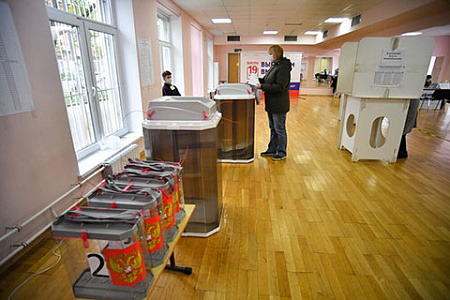
Late last week, alongside its regular measurements of party ratings, the Russian Public Opinion Research Centre (VCIOM) published the results of a survey devoted specifically to the September elections to the State Duma. 53% of respondents correctly identified the election date, while 39% were unaware that voting is due to take place this year. 65% said they would definitely or ‘most likely’ go to the polling stations.
An overwhelming majority of respondents, 87%, agreed with the statement: ‘Everyone should make use of their vote; no one should stay on the sidelines.’ One might assume there would be similar consensus over the idea that by taking part in elections, citizens influence their own future. After all, the two statements appear to complement each other. Yet only 61% believe that their future depends on participating in elections, while 34% disagree. Some of those who reject this idea nevertheless still believe it is necessary to vote. That raises an obvious question: why do they do so? However, the poll did not encourage respondents to reflect on that issue.
Perhaps the explanation is that ‘no one should stay on the sidelines’ and ‘shape your own future’ are understood differently. The first implies that someone else, whether the state or those in power, already knows what should be done, and citizens simply need to offer whatever support they can. The second assumes that voters have at least a basic understanding of how the political system works. It is about making a conscious choice from the available options. Placing a tick next to such an option turns out to be a more demanding proposition.
Among those intending to vote, 64% said they had already decided which party they would support and would not change their minds. That is an interesting finding because it naturally prompts further questions requiring deeper research. For example, what if ‘your’ party disappoints you, loses credibility, or you discover that it intends to pursue policies that conflict with your interests, values or priorities? Such situations do arise, and election campaigns and debates exist precisely to help voters make informed choices by taking all relevant details into account. As things stand, however, the results suggest that 64% intend to stick with their decision regardless, as though two-thirds of the population, allowing for the limitations of polling and sampling, were a core party electorate. Another 32% said they had a tentative preference but would make their final decision on polling day.
If elections were held now, 34% of VCIOM respondents said they would vote for United Russia. The gap over its nearest rival stands at 23%. Moreover, 49% told pollsters they could envisage voting for the ruling party. These are the undecided voters who expect to make their choice on polling day or shortly beforehand. At the same time, 45% of respondents said they would not consider voting for United Russia. At first glance, that would appear to create political space, encourage competition and offer opposition parties grounds for optimism.
However, the share of respondents unwilling to vote for the other parties is even higher. 45% ruled out voting for the LDPR, 49% for the KPRF, 51% for New People, and 52% for A Just Russia. The survey therefore suggests that many people would like to see an alternative to the ruling party. Yet they do not currently see such an alternative among the existing political offerings. As a result, many of these voters simply stay away from the polls. That becomes their choice on election day. This does not harm the ruling party’s position and may even benefit it, since election results are calculated as a share of those who actually vote rather than of the total electorate. At the same time, a substantial proportion of respondents, between 33% and 44% depending on the party, still hope that the existing opposition parties will eventually come up with a compelling alternative. They have not entirely lost faith in them; they simply believe the opposition has not done enough to justify that confidence.
ORIGINAL:NG/Is There Demand for an Alternative to the Ruling Party?