The Kremlin’s message appears to have reached its intended recipient. The Bank of Russia has delivered another symbolic cut in its key interest rate. But the regulator also issued a warning of its own to all those keeping up attempts to dictate terms. Thus, the Central Bank’s official materials no longer contain any documented indications of further rate cuts.
The planning horizon appears to have contracted to a minimum not only for households and businesses, but also for the institutions directly influencing the country’s economic outlook. Some experts describe the Bank’s approach as ‘office economics’. Observers get the impression that decisions are made on the spot behind office doors in attempts to adjust to immediate political circumstances among others, rather than being a reasonable outcome of the long-term planning.
On July 24, 2026, the Bank of Russia Board of Directors decided to cut the key rate by another 25 basis points to 14% per annum. The decision reinforced its unofficial reputation among investors and analysts as ‘the world’s most unpredictable regulator’.
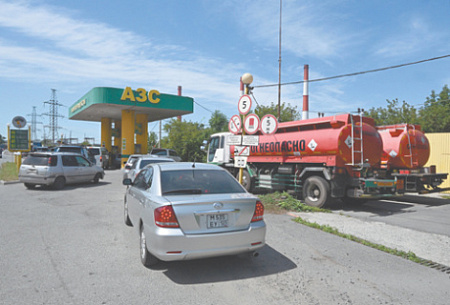
The market had expected the rate either to remain at 14.25% per annum or to be raised in the aftermath of the fuel crisis. This explains why Alexander Shokhin, president of the Russian Union of Industrialists and Entrepreneurs (RSPP) and a representative of large-scale businesses, had repeatedly urged the Bank not to tighten further.
Yet comments about the Central Bank’s unpredictability may also point to the confusion among analysts and investors themselves, who appear to be losing focus.
In retrospect, the decision taken by the Central Bank on July 24 seems entirely plausible following hints made by President Vladimir Putin in mid-July during a meeting with Aisen Nikolayev, Head of the Republic of Sakha (Yakutia) (see Nezavisimaya Gazeta, July 14, 2026).
The president said that a reduction in the key rate ‘would be a natural process’. What kind of reduction did he mean? No specific figures were given.
The president said that a reduction in the key rate ‘would be a natural process’. What kind of reduction did he mean? No specific figures were given.
The episode had a familiar feel. A month earlier, Putin said that ‘we are entitled to expect a reduction in the key rate’. The Bank duly responded, but with a minimal cut of just 25 basis points
The volume of conflicting data on the Russian economy now gives the Central Bank enough evidence to justify almost any policy decision, according to some analysts.
‘Hypothetically, it could point to the fact that the underlying components of inflation were not far from the target, that inflationary factors are temporary and that the risks of an excessive economic slowdown, effectively a recession, have increased, as indicated by business surveys and disaggregated industrial data,’ financial analyst Pavel Ryabov described the case on the Spydell_Finance Telegram channel.
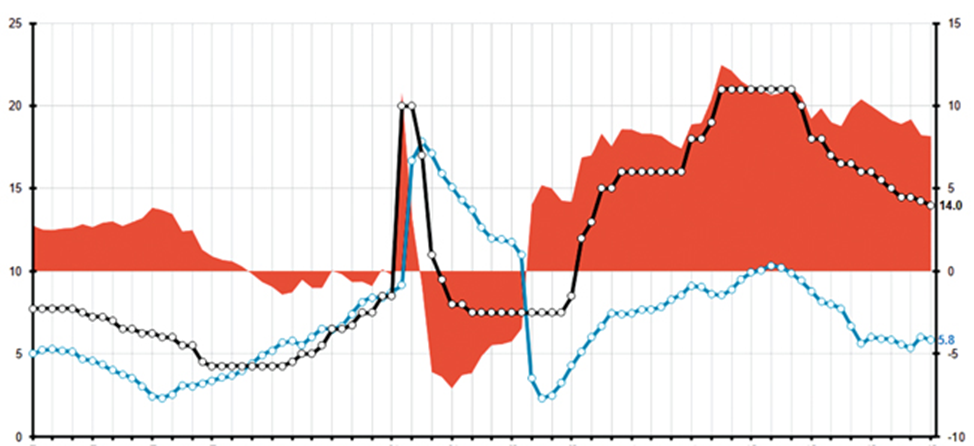
| янв. 19 / Jan. 19 | мар. 19 / Mar. 19 | май 19 / May 19 | июл. 19 / Jul. 19 | сен. 19 / Sep. 19 | ноя. 19 / Nov.19 | янв. 20 / Jan. 20 | мар. 20 / Mar. 20 | май 20 / May 20 | июл. 20 / Jul. 20 | сен. 20 / Sep. 20 | ноя. 20 / Nov. 20 | янв. 21 / Jan. 20 | мар. 21 / Mar. 20 | май 21 / May 20 | июл. 21/ Jul. 20 | сен. 21 / Sep. 20 | ноя. 21 / Nov. 20 | янв. 22 / Jan. 20 | мар. 22 / Mar. 20 | май 22 / May 20 | июл. 22/ Jul. 20 | сен. 22 / Sep. 20 | ноя. 22 / Nov. 20 | янв. 23 / Jan. 20 | мар. 23 / Mar. 20 | май 23 / May 20 | июл. 23/ Jul. 20 | сен. 23 / Sep. 20 | ноя. 23 / Nov. 20 | янв. 24 / Jan. 20 | мар. 24 / Mar. 20 | май 24 / May 20 | июл. 24/ Jul. 20 | сен. 24 / Sep. 20 | ноя. 24 / Nov. 20 | янв. 25 / Jan. 20 | мар. 25 / Mar. 20 | май 25 / May 20 | июл. 25/ Jul. 20 | сен. 25/ Sep. 20 | ноя. 25 / Nov. 20 | янв. 26 / Jan. 20 | мар. 26 / Mar. 20 | май 26 / May 20 | июл. 26 / Jul. 20 |
| Реальная ставка (пр. шк.) Real interest rate, right axis | Индекс потребительских цен базисный Consumer price index, base period | Ключевая ставка Банка России (на конец периода) Bank of Russia key rate, period-end |
Key rate and inflation, %. The real interest rate is the difference between the Bank of Russia’s key rate and inflation. Source: Centre for Macroeconomic Analysis and Short-Term Forecasting.
Hypothetically, all of this would already make it possible to cut the key rate radically, to 8%.
However, the Central Bank could refer to combined impact of pro-inflationary factors including a budget moving ever further away from projected deficit levels, expenditure and revenue as well as the high uncertainty surrounding so-called ‘one-off factors’, embracing the fuel crisis and attacks on logistics infrastructure.
According to Ryabov, this would instead create room for tighter monetary policy, with the rate climbing within the range of 17% to 19%.
‘Another option is to adjust policy incrementally at every meeting in response to the latest mix of market, macroeconomic, geopolitical and domestic political conditions, which is office economics,’ the analyst continued. In that case, the result would be precisely the approach the Central Bank is now pursuing by modestly slicing the key rate.
Experts are therefore suggesting that the Central Bank has entered into a kind of ‘crisis management’, with its measures becoming compromises shaped by immediate risks and windows of opportunity.
‘In other words, there is no medium-term, let alone long-term planning, and nor can there be, given the circumstances. Problems are dealt with as they arise, hence the uncertainty,’ Ryabov said.
It is notable that the Central Bank’s official press release published on July 24 no longer contained a clearly formulated indication that further reductions in the key rate would follow.
The July press release stated: ‘The Bank of Russia will make further key rate decisions based on the dynamics of inflation and inflation expectations as well as the analysis of risks posed by domestic and external conditions’
In June, the wording was:
‘The Bank of Russia will assess the advisability of further reductions in the key rate at its forthcoming meetings, depending on the sustainability of the slowdown in inflation, movements in inflation expectations, and its assessment of risks arising from domestic and external conditions.’
A month later, the Central Bank conspicuously removed the words referring to any ‘advisability of further reductions in the key rate’.
At a press conference on Friday, Central Bank Governor Elvira Nabiullina explained, ‘Different scenarios are possible, depending on how the situation develops.’
Nevertheless, the Central Bank has not abandoned its underlying strategy. According to calculations by the Centre for Macroeconomic Analysis and Short-Term Forecasting, following the July meeting of the Central Bank’s board of directors, the real interest rate, calculated as the difference between the key rate and annual consumer inflation, stabilised at approximately 8% per annum
This means that market-rate loans have not become more affordable for either businesses or households so far. The status quo still persists.
Under any scenario, all measures taken by the Bank of Russia will be aimed at returning inflation to 4% over the forecast horizon, Nabiullina said at the press conference. Achieving the targeted 4% is either repeatedly postponed or made substantially more difficult. But the target itself remains in place
The Central Bank has downgraded its inflation forecast for 2026. Instead of the previously expected 4.5% to 5.5%, inflation is now expected at 6% to 7%. Nevertherless, the regulator continues to insist that the 4% target will be reached as early as 2027.
‘As for changing the target, we believe that only a contraction is feasible in the future,’ Nabiullina said at the press conference. ‘We are not considering an increase because we believe everyone would lose. It is an illusion that a higher target would lead to lower interest rates. If we raised the target, market rates would only go up. We therefore believe this would impede the economy.’
Meanwhile, revising the inflation target has become another persistent demand from large-scale business.
‘The 4% target was established in 2015 under different macroeconomic conditions,’ said Alexander Murychev, vice-president of the Russian Union of Industrialists and Entrepreneurs. ‘Today, the economy is undergoing a profound structural transformation. Monetary policy objectives must therefore be balanced against the need to develop investment, upgrade industry and maintain sustainable economic growth.’ In his view, returning inflation to the 4% target in the near term is all but impossible.
ORIGINAL: NG/Kremlin Signals Reach Their Intended Recipient at the Central Bank