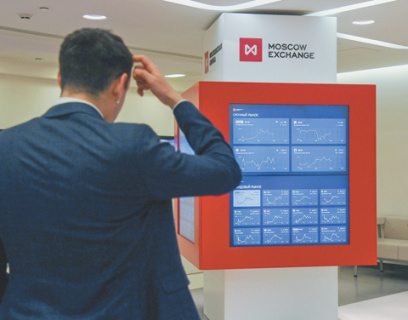
On Tuesday, indices on the Moscow Exchange hovered near the lows reached on Monday. The dollar-denominated RTS index of the Moscow Exchange is now almost 10% lower than it was six months or a year ago. The rouble-denominated MOEX index is also nearly 15% below its level of a year or six months ago. The prolonged decline in Russian equities is continuing at a record pace, prompting many analysts to speak of yet another collapse in the Russian stock market. Central bank officials acknowledge that the lack of internal investment resources is the main obstacle for Russian companies. Current assessments of investment activity, as well as forecasts for future investment, remain at their weakest levels since at least 2019.
Strengthening the role of the Russian stock market as a source of investment, and doubling its capitalisation, was set as a target for the government and the central bank two years ago. Finance ministry officials regularly reiterate the goal of doubling market capitalisation to create a new source of investment.
In practice, however, the direction of travel has been the opposite. Investment activity continues to soften, companies are cutting capital expenditure plans and forward-looking indicators remain subdued. The central bank itself has described the environment only as ‘moderate growth in business activity’, a formulation that sits uneasily alongside falling investment and weakening utilisation rates.
Fixed capital investment declined by 2.3% last year and is expected to fall further in 2026. Investments are forecast to fall by a further 3.5% or 1.3% depending on the conservative or baseline government scenario. (see Nezavisimaya Gazeta, May 28, 2026).
Business surveys commissioned by the Central Bank also confirm the ongoing investment contraction. This is reflected in a negative balance of firms’ responses on current investment activity (–4.8% in the first quarter).
Among the factors constraining investment activity, uncertainty about the economic situation (23.6% of respondents) and moderate demand for output (20.4% of firms) have again increased in importance. ‘The cost of credit remains only fourth in the list of constraining factors, and its restrictive impact is declining,’ central bank officials write, without emphasising that the lack of funds (own or borrowed) is the main obstacle to capital investment. Nearly 28% of surveyed companies pointed to insufficient internal funds for financing investment, according to the central bank’s survey report.
Official claims of “moderate growth in business activity” sit poorly alongside data showing declining capacity utilisation, which continued into 2026. ‘A slight reduction in capacity utilisation was observed in almost all sectors, except for mining, transport and storage, where utilisation increased,’ the regulator noted.
Officials have sought to improve companies’ access to investment resources by expanding the domestic stock market. By 2030, Russia’s stock market capitalisation should reach 66% of GDP, Minister of Finance Anton Siluanov said in an interview with Kommersant. He said the main aim is to create an ‘efficient, deep and liquid’ market where citizens can grow savings and companies can raise investment.
The idea of ‘growing savings’ or ‘raising investment’ is challenged by the performance of Russian equity indices, which have been on a sustained downward trend for at least five years. The RTS dollar index is now almost 50% lower than five years ago, while the rouble index is down roughly 40% over the same period. This long-term contraction is punctuated by periodic sharp falls, including the one that began earlier this week.
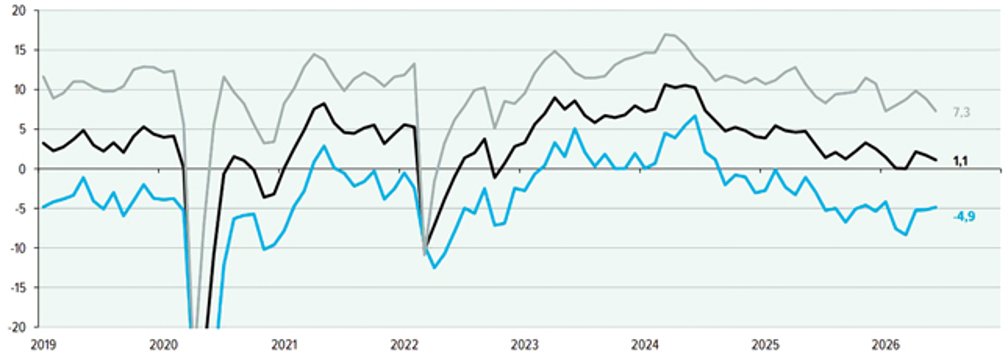
▬▬ Composite
▬▬ Current assessments
▬▬ 3-month expectations
Change in the Bank of Russia’s business climate indicator, which represents the sum of companies’ positive and negative assessments of production and demand (current assessments and expectations for the next three months). Source: Bank of Russia.
Financial analyst Pavel Ryabov (Spydell Finance Telegram channel) notes that Monday’s intraday drop of more than 5% on June 22 was not an isolated event.
‘The last similar episode was on April 4, 2025; before that, on October 7, 2022, September 26 and 20, 2022, June 30, 2022 and in February 2022,’ he said. However, the current 16-week uninterrupted decline is unprecedented.
‘There is money in the market, and the number of participants has increased significantly, but the market is still flat,’ Ryabov said. One reason, he argues, is a loss of belief in positive prospects combined with deep psychological fatigue. ‘The collective investor is emotionally exhausted by a concentration of negative factors, losing the ability to project optimism. The dominant emotional backdrop is apathy, fatigue and depression — a return to 2022 conditions, but worse, because in 2022 there were hopes of a V-shaped recovery. Those hopes are now gone,’ he said. Corporate profits, he added, are no longer seen as returns for shareholders. ‘If a company earns strong profits, the state may take part through taxes, duties, one-off payments, regulation or dividend decisions. If not via taxes, then through capital expenditure, sanctions-related costs or debt repayment. Profits now mean little for shareholders.’
He also pointed to a crisis of trust in corporate governance and risks of asset seizure.
‘The period of transparency is over. Business is becoming more closed due to restrictions on disclosure, and there is a shift away from “everything for the investor” towards “everything for survival”. At the same time, there are more cases of state asset seizures and negative corporate events for minority shareholders,’ he noted.
Regional companies in Russia should be able to access incentives and motivation to conduct IPOs and attract investment as an alternative to bank financing, said Deputy Minister of Finance Ivan Chebeskov in April. He later announced the cancellation of previously planned listings of state-owned companies.
In autumn 2025, Chebeskov said the Ministry of Finance expected at least three IPOs and secondary share offerings of state companies in 2026. Industries mentioned by Minister of Finance Anton Siluanov included energy, transport and the financial sector, RBC reported. In June 2026, Chebeskov said no state-related IPOs are expected in 2026, with listings now likely only from 2027 onwards.
ORIGINAL: NG/The Russian Stock Market Is Becoming Toxic for Investors