
Russian officials say the economy has overcome its downturn and is now entering a period of structural transformation. As the key rate falls, they expect the Russian economy to enter a new investment cycle. July’s incoming economic data, however, are difficult to interpret as evidence that the downturn has been overcome. Independent economists estimate that the first half of the year did indeed show relative stabilisation, driven by a revival in consumer demand. But this contribution is unlikely to last. Surveys of the public’s psychological state point to a significant rise in financial anxiety.
The Russian economy is in a state of overheating in reverse, or ‘overcooling’, according to a number of macroeconomic indicators, Herman Gref, head of Sberbank, said on Thursday. ‘At this point, in my view, it is already obvious. There is always a play on words, depending on what meaning we attach to particular definitions. The Central Bank talks about a gradual slowdown, while we call the situation cooling, and now overcooling. The figures speak for themselves,’ he told journalists on the sidelines of the Eastern Economic Forum (EEF).
He pointed to a substantial deterioration in the business climate indicator in summer 2026, as well as unemployment, consumption and gross fixed capital formation. Russian GDP grew by 0.6% in the first half of 2026, well below the economy’s potential growth rate, which the Central Bank of Russia estimates at 1.5%–2.5%, Gref said.
‘All these factors suggest that we need to move towards policies that support and stimulate growth, including investment growth. We will not see a turnaround until market rates are normalised and are in the 10%–12% range. Returning to these normalised levels is, in my view, the key task today for restarting and stabilising economic growth. I think everyone needs to pay attention to the macroeconomic conditions. Business needs help,’ Gref said.
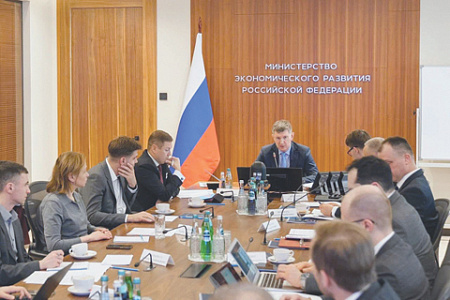
Also speaking at the EEF, Economic Development Minister Maxim Reshetnikov said the Russian economy was currently undergoing structural transformation after several years of strong growth. The government’s main efforts are now focused on launching a new investment cycle, he said.
The minister considers the current cooling ‘a natural stage of the economic cycle, because economies are cyclical’. ‘During the previous stage, there was such strong growth that, as a side effect, it led to higher inflation. And clearly, this concentration [of efforts, Nezavisimaya Gazeta] on reducing inflation naturally resulted in tighter credit, which in turn pushed interest rates higher and slowed the pace of growth,’ Reshetnikov explained, adding that this situation was evidence of the ‘normal nature of the Russian economy’.
Officials expect the new investment cycle to begin as the key rate continues to fall. As previously reported, Russian GDP increased by 1.3% year on year in the second quarter of 2026 after declining by 0.2% in the first quarter. Overall, the economy grew by 0.6% in the first half of the year.
Experts at the Institute of Economic Forecasting of the Russian Academy of Sciences (IEF RAS), analysing economic dynamics in the second quarter, confirm the officials’ assessment that, despite difficult conditions, the economy as a whole overcame the downturn of the first quarter of 2026. According to their findings, three factors supported the Russian economy in the second quarter: a revival in consumer demand amid lower deposit rates; the normalisation of inventories, which led to a limited revival in demand for intermediate goods such as metals, chemicals and construction materials; and an improvement in external economic conditions (see Nezavisimaya Gazeta, August 11, 2026).
It was the combined effect of these factors that stabilised the macroeconomic situation in the second quarter and created the conditions for improved assessments of a number of macroeconomic indicators, the IEF RAS experts write in their quarterly forecast.

The researchers also note that faster growth in government spending provided significant support to the economy in the first half of the year. ‘However, the accumulated deficit and the advance funding of a number of government purchases at the beginning of the year mean that it is not possible to count on an equally significant fiscal impulse in the second half of 2026,’ they stress.
The IEF RAS says that without a consistent easing of monetary policy, it will become impossible to sustain economic growth in 2026–27. ‘From the perspective of the fundamental mechanisms supporting economic growth, three areas can be considered: the budget, the exchange rate and monetary policy. Given the fiscal constraints and the limited tools for managing the exchange rate, monetary policy should have the key role in supporting growth. It should be noted that although the reduction in the key rate over the past six months has been relatively modest, it has had a direct impact on changes in households’ saving behaviour. Continuing the monetary easing cycle could extend the period of support for consumer demand, further increase capacity utilisation and create the conditions for growth in private investment,’ the researchers believe.
The incoming July data, however, are difficult to interpret as evidence that the economic downturn has been overcome. According to the Economic Development Ministry, Russian GDP grew by 0.6% year on year in July, down from 1.7% growth in June. Over the first seven months, the Russian economy grew by 0.6% year on year. The figure was the same for the first half of the year (see Nezavisimaya Gazeta, August 13, 2026).
A number of sectors deteriorated noticeably in July compared with June. Output of goods and services across the main economic activities grew by 0.8% year on year in July, down from 1.8% in June. Over the first seven months, growth was just 0.1%. Industrial output increased by 0.4% year on year in July, compared with 0.7% in June. Over the first seven months of 2026, industrial growth was just 0.1%.
Construction and wholesale trade also weakened. Construction output increased by 0.8% year on year in July, compared with 3.5% in June. Over the first seven months of 2026, construction output fell by almost 4%. In residential construction, even with an improvement in summer dynamics, new housing completions fell by 15% over the first seven months. Wholesale trade turnover, meanwhile, increased by 0.4% year on year in July, compared with 2.7% a month earlier. Over the first seven months, wholesale trade turnover fell by 0.3%.
Growth continues in freight transport and retail trade. Freight turnover excluding pipelines increased by 7% year on year in July, compared with 4.9% growth in June. Over the first seven months of 2026, freight turnover rose by 2.4%. Retail turnover grew by 5.3% year on year in real terms in July, after rising by 7.3% in June. From January to July, turnover increased by 5.4%.
According to calculations by financial analyst Pavel Ryabov, who runs the Spydell Finance Telegram channel, retail trade, industry and freight transport made the largest contributions to annual economic growth in July. Over the first seven months, however, output of goods and services across the main economic activities grew by just 0.1% year on year, with only one sector, retail trade, making a dominant contribution. All other sectors have been in negative territory since the start of the year, with construction unsurprisingly showing the worst performance, Ryabov says. ‘Only 20% of the output index is in positive territory, and that is entirely trade. The remaining 80% of the index is declining to varying degrees,’ the analyst says. In other words, retail trade and industry are driving growth, with industry supported by sectors linked to the defence-industrial complex, Ryabov emphasises.
The IEF RAS does not rule out the current consumer boom gradually fading as growth in real disposable household incomes slows. ‘By the middle of 2026, the only significant factor behind their increase was the growth in wages at large and medium-sized organisations. Even there, however, substantial growth is concentrated mainly in sectors where average pay is relatively low,’ the economists note.
In their quarterly forecast, they also cite data from monitoring by the Institute of Psychology of the Russian Academy of Sciences, which tracks the psychological state of society. The survey shows that financial anxiety is increasing among the population. Moreover, while anxiety and depressive symptoms were rising among older age groups in winter, since spring they have also been increasing among young people aged 18–34. ‘The share of respondents reporting symptoms of depression was 49%, while 33% reported symptoms of difficult-to-control anxiety. A high level of anxiety and depressive symptoms was found among 36% of Russians. This indicator is driven primarily by pessimistic economic expectations and weakening hopes for an early end to the special military operation,’ the researchers report.
Depressive symptoms are more common among residents of large cities, while anxiety symptoms are more prevalent among rural residents. Psychological wellbeing is lowest among people aged 25–34, low-income Russians and employees of commercial organisations, the experts say.
Optimism has fallen sharply. Last year, residents of cities with populations of 500,000 to 950,000 were relatively optimistic about the economy. Now only 12% of respondents in those cities expect the economic situation to improve, three times fewer than in 2025.
‘Depressive states are in themselves a factor that reduces economic activity,’ the researchers note. As a result, this may affect perceptions of economic indicators and lead to rising economic pessimism even if the macroeconomic situation stabilises, the experts conclude.
ORIGINAL: NG/Russia’s Economy Has either Overheated or Emerged from Crisis