Conditions in the financial markets have become extremely unfavourable for government securities placements. Servicing the debt that the Ministry of Finance (Minfin) would announce under current conditions would later prove too costly for the budget system. Therefore, the ministry’s decision to suspend placement auctions seems reasonable. The problem, however, is that experts believe that the Minfin will not be able to maintain the pause for long because of the urgent need to plug the hole in the budget. The federal budget deficit for the first half of the year has already exceeded the amount the ministry had planned to borrow on the domestic market for the full 2026. This clearly illustrates the current importance of borrowed funds for the government
Under the originally approved schedule, the Minfin was supposed to hold auctions of federal loan bonds, known as OFZs, every Wednesday
During the first half of the year, the ministry increased domestic government debt by more than RUB 2.5 trln through such auctions. In the third quarter, it was due to borrow another RUB 1.5 trln on the domestic market.
The target for 2026 as a whole was more than RUB 5.5 trln in domestic government borrowing. When the plan was completed, the federal budget deficit for 2026 was expected to be about RUB 3.8 trln and to be fully covered by borrowing, with some funds left over.
Yet reality has intervened with those plans. First, the federal budget deficit for the first half of the year was already one and a half times higher than the level set for the whole year. Between January and June, the deficit exceeded RUB 5.7 trln. Experts forecast its widening to RUB 7 trln by the end of the year (See Nezavisimaya Gazeta, July 14, 2026).
As a result, the domestic government borrowing planned for the whole 2026 will now be sufficient, in the best case scenario, to only cover the deficit accumulated during the first six months.
Second, OFZ placement is no longer expected on Wednesday, July 22. The prospects for subsequent auctions are also unclear. The Minfin announced their suspension ‘to facilitate the stabilization of debt market conditions’. Information regarding the resumption of OFZ placement auctions will be communicated by the ministry in due course
Anton Siluanov’s ministry made the decision after the auction held on July 15 was declared unsuccessful ‘due to the absence of the acceptable level of prices in these bids’. Auctions scheduled for July 8 and June 24 had already been cancelled because of volatility in the financial markets.
‘There is a sell-off in the equity market. The Moscow Exchange index has lost 20% of its capitalisation over the past month. Securities are falling in price, and so are bonds,’ Evgeny Goryunov, head of a laboratory at the Gaidar Institute, explained in a commentary for Nezavisimaya Gazeta.
In practice, this means that to make government securities more attractive, the Minfin would have to offer higher yields. In other words, it would have to commit to paying investors much more generous interest than usual on the money it borrows from them now.
This essentially means an additional burden on the budget, deferred and spread over time, especially as the cost of servicing government debt is already substantial.
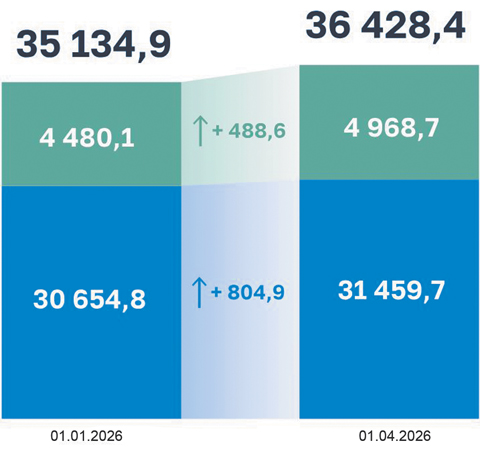
According to the Accounts Chamber, servicing the country’s accumulated government debt, both domestic and external, cost the federal budget almost RUB 733 bln in the first quarter of this year alone. These costs accounted for nearly 6% of total budget expenditure
‘Yields on medium-term OFZs have risen by 1 to 1.5 percentage points recently. Uncertainty is also high. Since mid-June, the volatility index has more than doubled,’ Goryunov added. In other words, this is clearly not the best time to raise capital, so the Finance Ministry’s decision to suspend auctions is entirely plausible
For now, the move can be interpreted as a partial postponement of the borrowing programme rather than its abandonment, as mentioned by Denis Gabdulin, a director at BCS World of Investments. He believes the most likely scenario is the following:
‘The Ministry of Finance will complete its annual borrowing programme but will seek to choose the timing of its market placements as flexibly as possible in order to minimise the cost of raising funds.
The Ministry might also attempt to complete almost the entire borrowing target through a one-off targeted placement of floating-rate bonds at the end of the year
Much will depend on the outcome of upcoming meetings of the Central Bank’s board of directors on the key rate. The next meeting is scheduled for July 24.
‘If the Bank of Russia confirms that it is prepared to continue easing monetary policy and bond yields begin to decline, the Minfin could resume scheduled auctions within the next few months,’ Ivan Yefanov, an analyst at Tsifra Broker, explained to Nezavisimaya Gazeta. He confirmed that the government had for now chosen not to borrow at high interest rates, which is quite uncommon yet not extraordinary decision.
Experts voiced rather different views as to whether deferred borrowings would create even greater problems for balancing the federal budget in the future.
‘In terms of the budget deficit, such a suspension is not critical. It mainly shifts the borrowing schedule. However, if tensions persist, new placements may require higher yields and increase the cost of servicing the debt,’ said Yury Kravchenko, a department head at Veles Capital.
‘It will be difficult to prolong the suspension because the borrowing target for the third quarter is substantial. A continued break would mean having to place larger volumes later, which could once again put pressure on the market,’ mentioned Nikita Borodanov, an analyst at Finam.
There is another detail. According to financial analyst Pavel Ryabov, who runs the Spydell_Finance Telegram channel, by postponing OFZ placement auctions the Ministry of Finance is creating ‘a potential cash shortfall in meeting its obligations if this continues for too long’.
Experts estimate that the suspension of OFZ auctions is not critical when the budget is in surplus or running only a modest deficit. But when the deficit reaches the scale seen today, the government will have to place securities, even if auctions are interrupted by pauses. The wider the deficit grows the less scope the Finance Ministry will have to impose its own terms on the market.