

In the new agricultural year, Russian wheat exports may fall to 44.5 mln tonnes from 49 mln tonnes a year earlier. In July alone, wheat shipments could halve compared with average monthly levels, marking the lowest volume since 2017, analysts warn. The main problem is the difficulty of transporting grain through the market’s key route, the Black Sea basin. Experts warn that the accelerating rise in wheat prices will continue if the disruption persists.
Russia’s grain harvest may decline to 139 mln tonnes this year from 141.2 mln tonnes a year earlier, according to the Institute for Agricultural Market Studies (IKAR). ‘We currently estimate grain production in Russia at 139 mln tonnes. That may be somewhat excessive, and we may have to make another downward adjustment in the near future. It is lower than last year, but it is nevertheless a perfectly solid harvest,’ said IKAR chief executive Dmitry Rylko
IKAR estimates this year’s wheat harvest at 90 mln tonnes, compared with 91.1 mln tonnes last year
‘Overall, a fairly good harvest is expected in the south. There is a possibility that the Stavropol region will surpass last year’s harvest and produce another record gross yield. The harvest may recover in the Rostov region, while expectations in central Russia are also good,’ Rylko said. ‘Thus, 90 mln tonnes is most likely our current estimate.’ He did not rule out, however, that the current estimate could be too upbeat. ‘Perhaps the damage we see in some regions of Siberia will be much more severe. But for now, our estimate is 90 mln tonnes (of wheat harvest, a comment from Nezavisimaya Gazeta), providing export potential (of wheat, a comment from Nezavisimaya Gazeta) of 44.5 mln tonnes. It could reach even 46 mln tonnes if current challenges we are currently facing in the market disappear,’ Interfax referred to remarks by IKAR general director.
The organisation estimates the export potential for all grains in the new agricultural year, from July 2026 to June 2027, at 58.5 mln tonnes. It could be higher, but foreign markets conditions mean some of that export potential may instead ‘go into stocks’, Rylko said. IKAR estimates that grain exports totalled 60.9 mln tonnes in the previous agricultural year
The International Grains Council (IGC) expects Russian wheat exports to reach 47.7 mln tonnes in the 2026/27 season.
The SovEcon analytical centre had also previously lowered its grain harvest forecast. It expects Russia to harvest up to 88.3 mln tonnes of wheat in the new agricultural season. Analysts attributed the revision to worsened prospects in southern regions and reduced areas planted with spring wheat.
More often we come across with even deeper concerns about grain supplies. Last week, SovEcon cut its forecast for Russian wheat exports in July 2026 to 1.5 mln tonnes from a previous estimate of 2 mln tonnes. ‘If the forecast materialises, this will be the lowest July volume since 2017, when Russia exported 1.4 mln tonnes of wheat,’ the organisation said. By comparison, the average monthly export volume over the past five years has been 3.1 mln tonnes.
The main reason for the decline is restricted navigation through the Kerch Strait. Weak demand from Egypt and Turkey is adding further pressure, according to the report.
Last week, Russia’s Ministry of Transport introduced restrictions on vessels anchoring in waters adjacent to the ports of Azov and Kavkaz. Under the orders, anchoring is permitted only in areas protected by air-defence systems. Vessels with faulty navigation or communications equipment have also been banned from entering or moving through these areas. The decision was taken in response to increasingly frequent drone attacks on civilian vessels near key logistics hubs in the Azov and Black seas. Several incidents resulting in deaths and damage to infrastructure have been recorded in recent months
Russia’s Ministry of Defence, meanwhile, reported strikes on Ukrainian port infrastructure overnight into Saturday. Russian forces struck a dry cargo vessel carrying freight in the port of Mykolaiv, port infrastructure facilities in the port of Odessa as well as infrastructure used for loading and unloading fuel and lubricants and a warehouse containing military equipment in the port of Izmail.
Russia and Ukraine together account for 25 to 30 per cent of global wheat exports, and logistics disruption during the forthcoming harvest is pushing up global prices, market analysts say. Reciprocal attacks by Russia and Ukraine could disrupt exports through the Black Sea, the principal logistics route for two of the world’s largest grain suppliers.
Between 80 and 90 per cent of all Russian grain exports are shipped through the Azov-Black Sea basin. The largest grain port is in Novorossiysk. Grain is also loaded at Taman, Rostov-on-Don, Azov, the port of Kavkaz and Tuapse. The Black Sea basin’s deep-water ports can handle up to 4.5 mln tonnes a month, rising to 6.5 mln tonnes at the seasonal peak. In 2025, ports on the Sea of Azov handled 70 mln tonnes of cargo, equivalent to about 8 per cent of total cargo turnover at Russian ports.
According to Matt Darragh, grains and oilseeds market analyst at Kpler, current shipping circumstances and threats to key ports, particularly Novorossiysk, had complicated Russian grain exports. Whether Russia can make up the lost volumes in subsequent months will depend on how long the current logistics restrictions remain in place. ‘Russian shipping restrictions, continued attacks on port infrastructure and attempts to reroute grain exports have increased uncertainty over near-term export availability,’ Futures International said in an analytical note.
Amid these conditions, grain prices continue to soar on global exchanges. Wheat prices have reached two-year highs in Chicago and Paris amid escalating geopolitical tensions and worsening weather conditions in key grain-producing countries. Wheat prices have risen by 15 per cent in the past month alone following the concerns over global grain supplies. Further increases in grain prices may intensify the risk of higher prices for a wide range of goods, from bread and vegetable oils to meat and dairy products.
‘The wheat market clearly demonstrates how significantly geopolitical fluctuations can alter market conditions, especially when backed up by fundamental contributing factors,’ CRM AgriCommodities noted.
Western news agencies, with reference to statements by the Ukrainian Farmers’ Union, previously reported that Ukraine had lost about a third of its grain export capacity through Black Sea ports because of more frequent missile and drone attacks. It was also emphasised that the country exports 90 per cent of its agricultural products through three ports in the southern Odessa region.
Authorities in the Rostov region said they were seeking alternative routes for shipments of the new grain harvest amid increasingly frequent attacks on vessels in the Sea of Azov.
‘In view of temporary difficulties affecting logistics routes because of shipping conditions in the Sea of Azov, our top priority is to ensure stable shipments of grain from the new harvest. Our common task is to do everything possible to prevent temporary logistics difficulties from having a significant effect on the sale of the harvest produced by farmers in the Don region,’ said Rostov deputy governor Anna Kasyanenko.
The Ministry of Transport had previously said it was taking the necessary measures to maintain freight logistics in response to increasingly frequent attacks by the Ukrainian armed forces on civilian shipping in the Sea of Azov. The ministry stressed that bulk cargo would, ‘if necessary and taking account the current scene’, be redirected to other forms of transport.
In early July, Russian Railways announced a discount on the export transportation of grain and pulses along several routes. ‘The board of Russian Railways has decided to introduce a 38% discount for the export transportation of grain and pulses in grain wagons along the western route of the North-South International Transport Corridor, through the Samur border crossing in Dagestan and onwards through the Astara crossing on the Azerbaijan-Iran border,’ the company said. Russian Railways noted that the discount would remain in force until June 30, 2027, covering the remainder of the 2026/27 agricultural season.
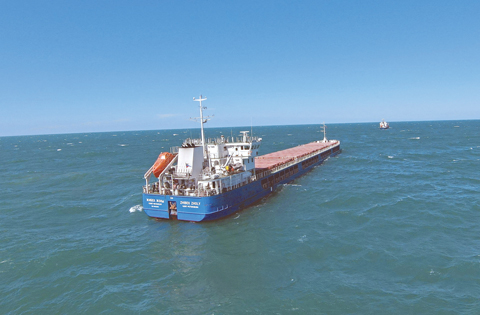
Western news agencies, referring to sources, have also reported a proposal by the authorities to reimburse most of the cost on rail transportation from the Rostov region to ports in the Black and Baltic seas.
Experts believe that discounts and the redirection of cargo flows will tackle the supply problem once and for all. ‘For the wheat market, the Black Sea is almost the same as the Strait of Hormuz is for the oil market. Serious issues there quickly turn into a global pricing event,’ said Andrey Sizov, director of the SovEcon analytical company. According to him, about a quarter of Russian grain exports regularly pass through the Sea of Azov.
Based on SovEcon’s preliminary estimate, Russia and Ukraine may export 1.5 mln to 3 mln tonnes less grain a month in the near future, mainly wheat. ‘That is around 20 to 30 per cent of their expected combined monthly exports under normal navigation conditions. To give an idea of the scale, the midpoint of our range is equivalent to about 13 per cent of the average monthly volume of total global wheat trade. This does not mean that the entire amount will disappear from the market. Some will be shipped later and some will use other routes. But disruption on this scale is quite sufficient to shift the global market significantly,’ Sizov stressed.
He expects the price rally to continue if the disruption persists for a few another weeks, especially if it starts having a dramatic impact on the operations of Russia’s large deep-water terminals.
‘For farmers in other countries, such rally may be a good piece of news following several years of low prices. Yet Russian and Ukrainian producers are unlikely to benefit from it in full. Pressure from the new harvest and high logistics costs will weigh on domestic prices and farmers’ incomes in both countries. In Russia, this is aggravated by the floating export duty, which rises along with the export price,’ Sizov said.
The two-million-tonne reduction in the grain harvest forecast, to 139 mln tonnes from 141.2 mln tonnes a year ago, is a statistical spread, according to Oleg Nikolayev, an expert at the Stolypin Institute for the Economy of Growth.
‘Export results in the first half of the year were excellent, but the beginning of the second half coincided with the challenged entirely unrelated to crop yields. If the bottleneck on the Azov-Don Canal is not cleared soon, grain producers could face an oversupply after the new harvest. As a result, they will not have the profits required for the successful start of the next season,’ he said. He also believes that in response, the government may start buying surplus grain for government reserves. ‘Unfortunately, Russia does not have enough modern storage capacity to survive without losses over a sufficiently long period,’ Nikolayev said.
Actual exports may prove lower due to unfavourable external conditions, said Kirill Yermolenko, head of the agricultural committee of the OPORA RUSSIA business association in the Samara region.
‘Although exports are supported by high carry-over stocks, they are primarily constrained by logistics risks and sanctions-related restrictions. The situation in the Black and Azov seas has a direct impact on exports. Attacks on vessels and shipping restrictions in the Kerch Strait create risks for stable shipments, particularly through the key southern ports, driving up global wheat prices,’ he said.
Yermolenko believes that rising global prices and strong demand for grain amid a worldwide supply deficit are creating an opportunity for Russian farmers to increase export revenues and improve shipment margins, but only if the logistics challenges are resolved.
ORIGINAL: NG/Grain markets receive unexpected support from Russia and Ukraine