More than half of Russian industrial enterprises consider the Central Bank’s key rate of 14% per annum too high for borrowing, unsuitable for boosting output and unlikely to stimulate demand. For more than two-thirds of industrial companies, the current key rate means abandoning investment, according to surveys
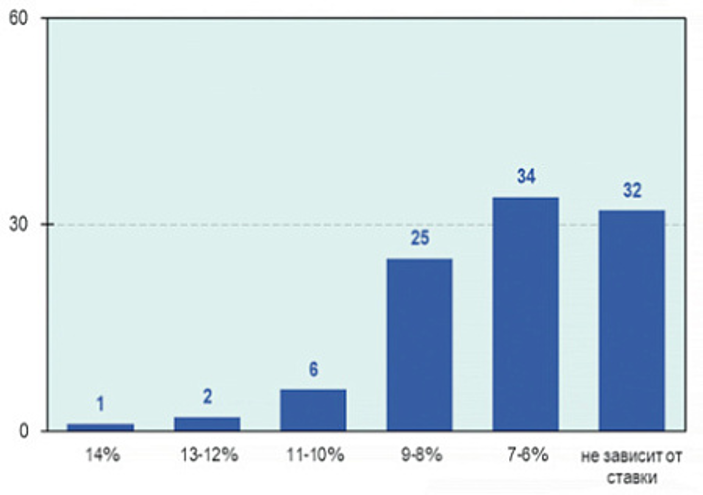
Share of enterprises planning to increase investment at different key-rate levels, % of respondents surveyed in September. Source: Institute of Economic Forecasting of the Russian Academy of Sciences (IEF RAS)
Most industrial companies are waiting for a clear-cut key-rate level: below 10%.
A September survey by the Institute of Economic Forecasting of the Russian Academy of Sciences found that 23% of enterprises believe demand will begin to recover when the key rate reaches 8–9%. Another 19% opted for 6–7%.
Production plans show a similar pattern. Almost one in four companies, or 24%, plan to increase output when the key rate reaches 8–9% per annum. One in five, or 19%, would do so at 6–7%.
Borrowing has a similar threshold: 24% of companies would seek credit at a key rate of 8–9%, while another 22% would do so at 6–7%.
Investment plans, however, are subject to stricter conditions. In this case, one in three enterprises links the start of investment growth specifically to a key rate of 6–7% per annum, while one in four expects it at 8–9%.
After the first eight months of the year, Russian industry as a whole, including mining, manufacturing, civilian production and defence-related industries, had slipped into stagnation. Compared with the same period of 2025, output showed zero growth
In August alone, industrial production in Russia fell 0.6% year on year, according to a review published on the Ministry of Economic Development’s website.
Speaking in the Federation Council late last week, Deputy Prime Minister Alexander Novak said manufacturing had grown 0.4% year on year in the first eight months. Some sectors, he added, were expanding much faster: the engineering sector had grown 6% since the beginning of the year, while pharmaceuticals were up 11.5%. Freight turnover excluding pipelines increased 3.1% over the first eight months and 8.4% in August
Presenting the government’s forecast for the next three years to senators, Novak said the task was to restore sustainable economic growth and ensure further gains in living standards
‘To achieve this, we plan to expand domestic production, improve the efficiency of resource use and create conditions for new investment,’ the deputy prime minister said.
The deputy prime minister also confirmed that after the high growth rates of 2023–24, the Russian economy had now shifted to more moderate growth
But this is an expected stage. Novak described it as ‘normalisation after overheating and, at the same time, a condition for reducing inflation’
GDP grew 0.6% year on year in the first eight months of 2026 and 0.8% in August, Novak added. Under the revised forecast, GDP growth for the whole of 2026 will also amount to 0.6%.
The government has begun work on launching a new investment cycle. Given limited resources, both for businesses and the state, the government will focus not on ‘new money’ but on making more efficient use of existing resources
‘The priorities are clearing accumulated debts and losses, including through pre-bankruptcy rehabilitation and restructuring; efficient use of idle capacity and infrastructure; clear priorities for investment support based on the taxonomy; improving the institutional conditions for doing business; and shortening the investment and construction cycle,’ Novak said.
He described the national model of targeted business conditions as the most important tool for improving the investment climate.
‘The goal for 2030 is to retain Russia’s position among the world’s 20 leading countries in terms of business conditions. The model covers 12 areas, including a new one, cultural heritage sites. A roadmap has been approved for each area. Of more than 260 measures, 56 have already been completed, 18 of them ahead of schedule. At the regional level, 24 key indicators have been established, and 85 regions have approved roadmaps,’ Novak said
Production will have to expand despite limited labour resources, making higher labour productivity one of the main conditions for economic growth, he added.
Sectoral ministries and businesses have jointly developed 17 sectoral productivity programmes, 11 in the real economy and six in the social sphere Their implementation will enable the economy to offset a labour shortfall of 3.3 mln workers by 2030
Such public reports, filled largely with what may appear from the outside to be bureaucratic indicators, completed measures, written roadmaps, sectoral programmes and newly approved targets, seem largely free of concern about the economic outlook. A great deal of work is being done, even if much of it is on paper. Ultimately, this too is important: standardising approaches to determine what needs to be monitored and why
But there may be another reason for relatively optimistic expectations despite tight financial conditions. The Russian economy is increasingly splitting into several distinct parts, or ‘business models’
For one of them, a key rate of 14% means that virtually all activity is grinding to a halt. For another, the key rate, whatever its level, makes no difference at all.
According to the IEF RAS survey, a substantial number of companies say the key rate has no bearing on their demand outlook, 43% of respondents; their plans to increase output, 45%; their borrowing plans, 46%; or even their investment plans. In the latter case, the share of such optimists is somewhat lower than in the previous examples, at 32%.
As Maxim Maksimov, an associate professor at Plekhanov Russian University of Economics, told Nezavisimaya Gazeta, the first and most significant reason for this divide is the sectoral and structural heterogeneity of the economy
‘A significant proportion of enterprises operate in segments where demand is determined not by market mechanisms but by government procurement, defence contracts or natural-monopoly positions,’ the economist said. ‘For such producers, the key-rate level is indeed not a determining factor, because their products are in demand regardless of the cost of credit.’
Other experts surveyed also identified this as an obvious factor. ‘Some producers may be focused on government procurement. For exporters, particularly those without rouble-denominated debt, dependence on the key rate is only indirect, through the rouble exchange rate,’ said Boris Kopeykin, chief economist at the Stolypin Institute for Growth Economics
In addition, Maksimov explained, for companies integrated into government support programmes, subsidised lending mechanisms or project-financing schemes, the market interest rate also has limited significance because the terms of their borrowing are regulated through other instruments
This may be evidence that existing support mechanisms are working and cover a significant share of industry, Maksimov believes. Experts identified another factor that may also apply to some companies.
‘Many enterprises have already gone through the adaptation stage and found internal reserves for development. If some companies have already adjusted their investment activity to the new reality, the current rate ceases to be a critical factor for them, which indicates the maturity of their financial strategies,’ Maksimov suggested.
The economy has been operating for several years under a double-digit key rate. ‘Moreover, the Central Bank’s baseline forecast assumes that the average annual key rate will not fall into single digits before 2028. It can be assumed that companies have partly adapted to this,’ agreed Olga Belenkaya, head of research at Finam.
The consequences of that adaptation, however, include stagnation in many civilian industries and a decline in fixed capital investment in 2025–26, the expert added.
Finally, as Oleg Nikolaev, a member of the general council of Delovaya Rossiya, told Nezavisimaya Gazeta, the key rate is not the only factor determining the parameters of the economy.
‘A low rate is needed to get the flywheel moving when the economy is sluggish and barely growing. If the economy is expanding on its own, it can absorb borrowing even at a higher interest rate because future profits will offset the cost. But the illusions of a rapid-growth outlook that prevailed in 2023–24 have faded,’ Nikolaev said. ‘Those entrepreneurs who believe the problem is not the rate are simply suggesting that we look at the situation more broadly and not turn a blind eye to the economy’s other problems.’
ORIGINAL: NG/Russian Economy Splits into Several Distinct Parts