The housing market is undergoing a structural shift, according to analysts at DOM.RF’s analytical centre. New-home supply is growing outside the country’s largest markets, while the launch of new projects is declining in the 10 regions with the largest construction volumes. Experts say demand is being redistributed. Construction activity in the regions has picked up thanks to the integrated area development (IAD) mechanism. In some Russian regions, IAD accounts for more than half of all housing under construction
By early October, the volume of housing under construction in Russia had reached a record 121.9 mln sq m, according to the centre’s data. In September alone, developers added 3.8 mln sq m of housing to the market, 42% more than a month earlier. Since the start of the year, the increase has amounted to 4.5%.
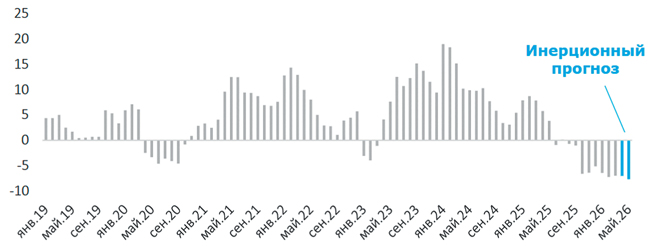
A total of 29.2 mln sq m of housing was launched in the first nine months of the year, 5% more than in the same period last year. All of the accumulated growth, however, came in the first quarter, when launches increased 35% year on year. In the second and third quarters, they fell 6% and 8% year on year respectively.
At the same time, new-home supply is growing outside the largest markets. Regions outside the top 10 by construction volume launched 16.2 mln sq m of housing, 11% more than a year earlier. That is almost a quarter more than the 13 mln sq m launched in the 10 largest regions, where the figure fell 2% year on year.
Experts say major developers began adjusting to changing demand in advance by reducing the volume of projects brought to market. As a result, the 10 companies with the largest construction portfolios launched 4.6 mln sq m of housing, 12% less than a year earlier. Other developers increased launches by 9% year on year, to 24.6 mln sq m. In Moscow, the volume of housing under construction fell 31%, to almost 2 mln sq m. In St Petersburg, it declined 1%, to 1.2 mln sq m.
Analysts highlight one particular feature: IAD projects accounted for 81% of the entire increase in new launches in September. Since the beginning of 2026, a total of 3.7 mln sq m of housing has been launched under the IAD mechanism, 41% more than a year earlier, according to DOM.RF
The IAD mechanism was introduced in Russia five years ago. Its aim is to transform urban areas by upgrading infrastructure, eliminating unsafe housing and creating a more comfortable living environment.
‘Integrated area development is a mechanism that directly improves the quality of the living environment. It makes it possible to create residential districts together with all the necessary social, engineering and transport infrastructure. In other words, it has become a driver bringing together a whole range of integrated programmes,’ Deputy Prime Minister Marat Khusnullin said in the spring
IAD is also actively used to resettle people from unsafe housing. It has been reported that roughly 500,000 sq m of dilapidated and unsafe housing has been eliminated over the past two to three years through IAD, with minimal budget involvement. As a result, 23,000 people in 35 regions moved into new flats. (See Nezavisimaya Gazeta, April 20, 2026)
According to the Ministry of Construction, more than 24 mln sq m of housing is currently being built under IAD projects across Russia. ‘Of the more than 200 mln sq m of potential, we already have more than 24 mln sq m directly under construction. These are projects with construction permits,’ Maria Sinichich, director of the IAD department at the Ministry of Construction, said late last week at the 100+ TechnoBuild International Construction Forum.
She said the number of IAD projects in Russia had now exceeded 1,500. IAD covers 81 Russian regions. The Ministry of Construction expects developers to complete 5.5 mln sq m of housing under IAD in 2026.
In terms of regional housing completions under integrated area development, the Moscow and Chelyabinsk regions are leading, Sinichich said.
‘In the Ural Federal District, the Tyumen region is one of the strongest in terms of housing completions under IAD. Yekaterinburg and the Khanty-Mansi Autonomous Area are also among them. Yekaterinburg ranks first in the country in terms of the volume of unsafe housing being resettled through IAD,’ she added.
According to Kirill Kholopik, head of the Unified Housing Developers Register, the Krasnodar region was the leader in 2026 in terms of the share of IAD projects among housing already brought to market. Here, 60% of new housing is being delivered under IAD. Experts say the region uses IAD as a way of binding developers to commitments to create social infrastructure. It is followed by the Novosibirsk region, with 44% of housing delivered under IAD, the Moscow region with 41.5%, the Perm region with 34% and Dagestan with 30%. Kholopik said IAD was growing faster than other ways of bringing land into development.
IAD projects are stimulating growth in housing completions in the regions, agrees Alexander Nevmerzhitsky, chief executive of developer Praktika. ‘Around 50 IAD agreements are currently being concluded in the Perm region. Their construction growth has increased by, I believe, 30%. So when a municipality or region begins working through IAD mechanisms, housing completions increase several-fold,’ he said
Oleg Gulevaty, chief executive of G Three Group, believes there is now a gradual redistribution of growth. ‘The largest agglomerations retain their leading role in housing construction, but high land costs, competition between projects and pressure on existing infrastructure limit further expansion of supply. At the same time, demand for modern housing is growing in the regions, while more affordable prices per square metre support demand,’ he said
The IAD mechanism makes it possible to address several objectives simultaneously: renewing outdated development, creating housing and social facilities, and upgrading engineering and transport infrastructure. As a result, developers gain a clear timeframe for developing an area, while municipalities gain the ability to manage its development comprehensively, the expert added.
Sinichich noted that Russia still has a substantial volume of unsafe housing and neighbourhoods with outdated infrastructure. One of the aims of IAD, she said, is to bring more such areas into integrated development.
The ministry expects the 2030 target for construction under the IAD mechanism, 10% of total housing completions, to be exceeded. Experts believe construction volumes could be several times higher. ‘We can safely set 30–40% as the target for housing completions under IAD, and the regions are demonstrating this,’ Nevmerzhitsky said. In his view, IAD is an indispensable tool for developing regions and cities. ‘At present, the IAD mechanism is not simply a driver of development for regions, cities and municipalities. Frankly, I see no alternative. It addresses so many of the needs of citizens,’ the developer said. Russian legislation governing IAD currently gives developers maximum flexibility, he added, making it important not to burden the mechanism with additional regulation.
The Ministry of Construction has also submitted to the State Duma a bill extending the validity of construction agreements under IAD. According to Sinichich, the measure would allow developers to be protected in light of market conditions and shield regions from breaches of deadlines for implementing such agreements
In addition, the ministry has prepared a broad package of amendments aimed at improving urban-planning and land legislation relating to IAD.
‘The bill, which contains around 40 amendments, provides for a number of important changes. In particular, it gives rights holders the opportunity to include undeveloped areas in IAD projects even if they are not adjacent to the main site. A simplified procedure for working with master plans and land-use and development rules is also proposed. We hope that once the new State Duma begins its work, we will be able to substantiate the need for these changes and secure their adoption,’ Maria Sinichich said.
ORIGINAL: NG/Integrated Area Development Becomes New Driver of Construction