One of the intriguing questions of 2026 is what status Russia will secure on the global agricultural market: net importer or net exporter of food. The gap between agricultural imports and exports currently stands at just USD 14.2 mln in favour of imports. The difference is so small by statistical standards that it disappears from Federal Customs Service tables when the figures are rounded. Experts are engaged in a battle of forecasts. The Gaidar Institute expects Russia to regain its net-exporter status after a disastrous 2025, but has also warned of negative scenarios caused by logistics constraints in the Azov-Black Sea basin. Experts surveyed by Nezavisimaya Gazeta, by contrast, point to the risk that Russia will remain a net food importer for a second consecutive year, putting the probability at between 55% and 80%.
Russia retains a significant position in global food markets, but its resilience is increasingly dependent on export logistics, the Gaidar Institute for Economic Policy warned in a new industry review obtained by Nezavisimaya Gazeta.
In the second half of 2026, Russian agricultural exports came close to the realisation of negative scenarios linked to logistics problems affecting the main export products, grain and sunflower oil,’ said Denis Ternovsky, an expert at the Gaidar Institute’s Foundation for Economic Policy and author of the review.
He added that ‘constraints in the Azov-Black Sea basin create a risk of slower deliveries and the loss of part of export revenues’.
‘The most pessimistic estimates envisage a one-third reduction in grain exports during the current agricultural season compared with their potential level,’ Ternovsky said in the review. ‘The expected decline in exports could offset the gains achieved in the first half of the year.’
On Thursday, October 1, Dmitry Rylko, director general of the Institute for Agricultural Market Studies (IKAR), said Russia risked failing to export 14–15 mln tonnes of wheat during the 2026/27 agricultural season because of logistics constraints in the Azov-Black Sea basin.
According to IKAR, Russia exported about 6.4 mln tonnes of wheat during the first three months of the current agricultural season. Rylko’s calculations show that, if exports remain at 2.5 mln tonnes a month for the rest of the season, total exports could reach 29 mln tonnes, against potential exports of 43–43.5 mln tonnes. ‘That leaves a gap of roughly 14–15 mln tonnes that Russia may fail to export,’ he said.
Rylko did, however, add a caveat: ‘We could be quite wrong, in either direction.’ Alternative export channels are currently operating at close to full capacity, he said. According to the IKAR director general, Baltic ports have become the main transshipment channel under the circumstances, while the Caspian route has also ‘increased significantly’.
Ternovsky added in his review that the domestic agricultural sector faces several other difficulties, including a widening discount on Russian wheat relative to global benchmarks and falling domestic prices. Both factors are putting additional pressure on farmers’ revenues and creating risks for winter sowing.
Despite this, the Gaidar Institute said Russia could regain its status as a net food exporter.
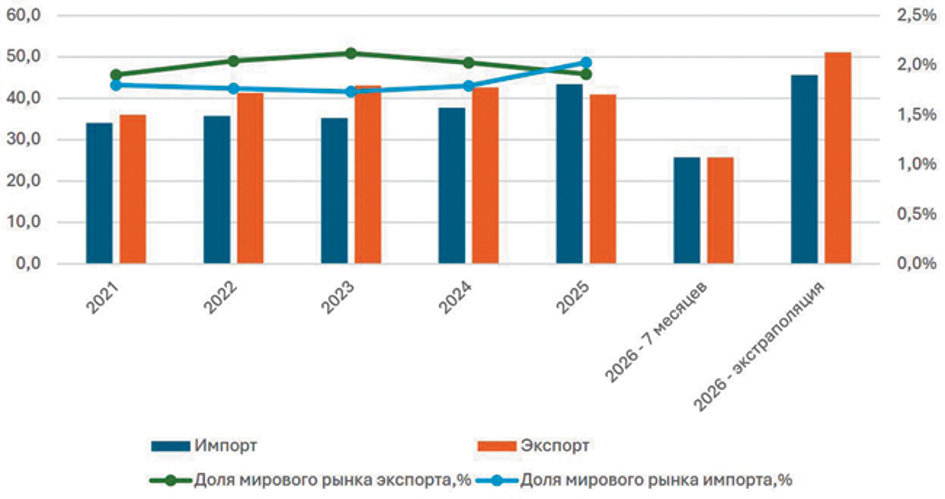
| 2026, seven months |
| 2026, extrapolation |
| Imports |
| Exports |
| Share of global export market, % |
| Share of global import market, % |
Exports and imports of food products and agricultural raw materials in Russia, USD bln (left-hand scale). For the full year 2026, a provisional estimate assuming January-July growth rates are maintained. Source: Gaidar Institute.
The basis for this expectation was customs data showing that Russian exports of agricultural products and food rose by almost 25% year on year in January-July, while agricultural imports increased much more slowly, by about 5%.
A country becomes a net exporter when it supplies more goods in a given category to foreign markets than it imports from abroad. When a country begins buying more from abroad than it supplies to external markets, it becomes a net importer.
The situation changed dramatically in 2025, however, when imports once again became dominant after a prolonged period in which exports had prevailed. The outlook for 2026 remains unclear.
According to Federal Customs Service data published on the agency’s official website, Russian exports of food products and agricultural raw materials, excluding textiles, were almost equal to imports in value terms in January-July this year, with both figures standing at about USD 25.7 bln
But these are rounded figures. A more detailed analysis of Federal Customs Service data shows that in January-July 2026, imports edged ahead of exports by a very small margin, with the difference in favour of imports amounting to USD 14.2 mln
The gap is tiny by statistical standards. But its existence could be a negative signal
Experts surveyed by Nezavisimaya Gazeta mostly believe Russia is finding it difficult to reverse the negative trends.
‘The dynamics of Russian food exports, one-third of which consists of grain, are largely determined by conditions in the grain market, from prices to logistics,’ said Anastasia Prikladova, an associate professor at Plekhanov Russian University of Economics. ‘I would put the probability of Russia remaining a net food importer in 2026 at about 55%, and the probability of returning to net-exporter status at 45%,’ Yaroslav Kabakov, director of strategy at Finam, told Nezavisimaya Gazeta. ‘The main risk for the second half of the year is related to grain and logistics in the Black and Azov seas.’
Prikladova said that although the market was gradually adapting to the new conditions by redirecting cargo flows, the sector risked being unable to make up the losses already incurred by the end of the year
She therefore estimates an 80% probability that Russia will remain a net food importer in 2026, albeit with a smaller negative balance than in 2025
Another question is how serious a problem this represents given the country’s objectives in food security and import substitution.
‘In the long term, this is a problem of political and trade stability,’ said Kirill Kononov, an economist at BCS World of Investments. In the short term, however, over a period of several years, no serious negative consequences should arise, according to his assessment. ‘It is more a psychological issue: we export more food than we import,’ Ternovsky, the author of the Gaidar Institute review, told Nezavisimaya Gazeta. ‘The commodity flows do not, however, intersect, and there are sufficient ways of covering food imports with foreign-exchange earnings from other goods.’
What food does Russia actively import? ‘For the most part, this is economically rational rather than forced import,’ Ternovsky said.
Major import categories include fruit and seasonal vegetables, which are cheaper to produce in warmer countries, dairy products from Belarus, their traditional producer, and alcoholic beverages, for which the country of origin is an integral part of consumers’ purchasing decisions.
The experts’ comments suggest that much depends on the specific reasons why food imports have begun to exceed exports.
‘The fact that food imports exceed exports is not in itself a problem. It may be caused by higher global prices for imported goods, such as meat, fruit, vegetables, coffee and cocoa, which we cannot influence. But there may also be another reason: constraints on the ability to realise export potential,’ Prikladova pointed out
In the latter case, she said, the relevant authorities should take prompt measures to support farmers and prevent the crisis in the sector from spreading
‘Net-importer status in itself does not mean a food shortage,’ Kabakov said. ‘But a sustained deficit in foreign food trade would be a worrying signal, as it would point to deteriorating price and export competitiveness in the agricultural sector.’
At the same time, experts noted that increasing agricultural exports is not an entirely benign practice either. When domestic supplies of a particular product are limited, focusing on exports can create risks of domestic prices rising in line with global prices, greater dependence on port infrastructure and other imbalances. In a critical situation, preventing such an outcome could also require the government to take special measures
ORIGINAL:NG/Agriculture Balances Between Net Exporter and Net Importer Status