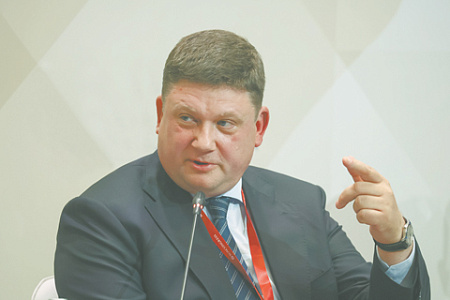
Attempts by the Russian government to meet defence needs amid economic stagnation and falling investment are a dead end. A chronic budget deficit and cuts in capital investment rule out the possibility of meaningful improvements in the country, according to Alexander Shirov, director of the Institute of Economic Forecasting of the Russian Academy of Sciences (INP RAS), who has published his assessment of Russia’s prospects. Economic growth should be at the very top of the hierarchy of economic policy goals, the economist argues. Without GDP growth, Russia will have neither a fully funded budget, nor defence, nor social spending, nor technological development.
As Russia’s economic growth slows, it is becoming increasingly difficult to finance national defence and social spending. The gap between budget revenues and expenditure has widened by more than 30% over the past year. Last year, the budget deficit stood at 2.6% of GDP, or RUB 5.645 tn, while this year, according to the Ministry of Finance, the shortfall will widen to 3.2% of GDP, or RUB 7.345 tn. This is despite exporters and the budget receiving a substantial, unplanned boost to revenues this year from a surge in global commodity prices. Had it not been for the US war against Iran, the budget situation would have been considerably worse and the deficit would have been closer to 4% of GDP.
The main reason for Russia’s budget problems is a policy of artificially cooling the economy, which is pushing the country towards a public-finance crisis while simultaneously ruling out opportunities for economic development.
The actual hierarchy of economic policy priorities looks as follows: the top priority is national security; the second is social policy, financed by a budget that relies on the fuel and energy sector; and the third concerns the development of the science and technology sector, Alexander Shirov, director of the INP RAS, says. His description of the hierarchy almost exactly echoes the government’s own wording when it approved the draft budget. Fulfilling social obligations, strengthening defence capabilities and developing the economy should be an unconditional priority for the federal budget over the next three years, Prime Minister Mikhail Mishustin said at the end of September.
‘The existing hierarchy of priorities and insufficient budget revenues directly indicate that high-quality economic growth is impossible without faster GDP growth, that is, without expanding the revenue base. Economic growth should therefore be at the very top of the hierarchy of economic policy goals. Otherwise, neither the problems of the budget system nor those of monetary policy can be resolved effectively,’ Shirov argues. In his view, the absence of significant structural shifts in the economy is leading to stagnation in the qualitative components of growth and a persistent increase in the costs of producing primary goods. Without high-quality economic growth, the risk of prolonged economic stagnation emerges, the economist says.
Although Russia’s fuel and energy sector is no longer posting high economic growth rates and is not a direct driver of growth, it still provides the revenue base on which the economy as a whole operates. As a result, fuel and energy companies can count on institutional and tax support. There is often not enough funding left for companies in the ‘third tier’ of priorities. ‘This means that even the national science and technology development projects currently being implemented are not always financed adequately or in full accordance with their stated objectives,’ the economist notes.
As for the rest of the economy, the overwhelming majority of businesses are forced to operate in a mode of compensation, relying on widely available mass resources.
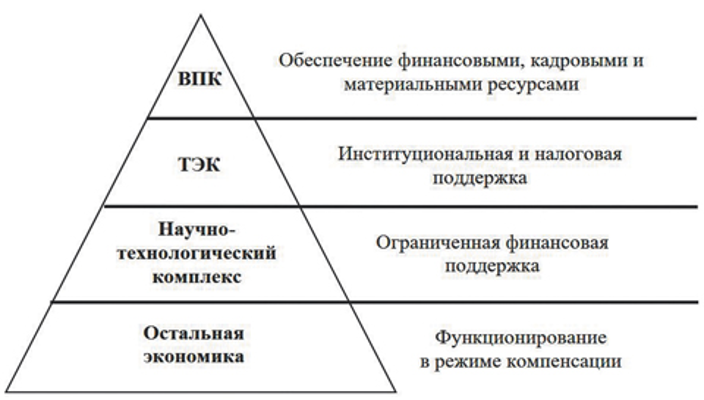
| ВПК | Defence industry |
| ТЭК | Fuel and energy sector |
| Научно-технологический комплекс | Science and technology sector |
| Остальная экономика | Rest of the economy |
| Обеспечение финансовыми, кадровыми и материальными ресурсами | Provision of financial, labour and material resources |
| Институциональная и налоговая поддержка | Institutional and tax support |
| Ограниченная финансовая поддержка | Limited financial support |
| Функционирование в режиме компенсации | Operation in compensation mode |
Support for sectors under Russia’s established economic policy priorities. Source: Institute of Economic Forecasting of the Russian Academy of Sciences
Compensation mechanisms have emerged both as a result of the Russian economy’s 30-year evolution and in response to newly emerging resource constraints. These mechanisms reflect the competitive advantages of the national economy and are used to varying degrees across all sectors. Russia has cheap and relatively accessible energy, substantial natural resources and significant construction capacity, the INP RAS director notes. Compensatory economic growth based on accelerated production of primary resources means that investment resources are allocated inefficiently, slowing the pace of modernisation in the productive sector of the Russian economy
Investment activity is a decisive factor affecting the quality of growth. ‘If most investment resources are directed towards capital-intensive projects to produce primary resources and into infrastructure, as often happens in Russia, the desired quality of growth is not achieved. A balance is needed between developing the commodity and infrastructure sectors, on the one hand, and improving the quality of the economy as a whole, on the other,’ the economist explains
Discussing investment activity and investment resources, the INP RAS director does not mention the fact that the economy has been in a prolonged investment downturn. In 2025, fixed capital investment in Russia fell 2.3%, following growth of 8.4% in 2024. In the first half of 2026, investment fell 9.9% year on year. The government says investment will decline by 5.4% over the full year. For next year, ministers have built investment growth of 0.2% into their forecasts under the baseline scenario. However, the government allows for the investment downturn to continue in 2027. Under the conservative forecast, capital investment will fall another 0.8% next year. Russia is therefore on a trajectory of prolonged investment decline. Notably, some officials are even trying to obscure the scale of the sharp fall in investment.
‘The investment cycle has not actually stopped… What we are talking about is that investment rose sharply from 2021 to 2024, and over the past two years it has remained close to the physical level reached at that point, while in nominal terms it continues to expand,’ Alexei Zabotkin, deputy governor of the Central Bank of Russia, said on October 1.
ORIGINAL:NG/Without GDP Growth, There Will Be No Defence, Social Spending or Technology