Russia’s small and medium-sized business sector is in a state of ‘polycrisis’. It has not itself fully grasped how it ended up in this position, which is the result not of temporary, local disruptions but of the cascading collapse of the foundations on which business models were built. Every new setback, let alone a serious problem, can now threaten a company’s survival. The list of challenges is growing: insufficient demand, labour shortages, inaccessible credit, a rising tax burden, displacement by Chinese suppliers, restrictions on online channels for promotion, fires at warehouses and accumulating costs, including fuel costs. The result is chains of non-payments and chronic cash-flow gaps.
Small and medium-sized businesses have faced a series of shocks. Experts at the Skolkovo Centre for Leadership Development described the ‘chronology’ in a new study as follows: the initial shock, the breakdown of the established order and adaptation in 2022; hope and growth in 2023; growth momentum and a plateau in 2024; and systemic challenges and extreme uncertainty in 2025–2026.
The study’s title is quite telling: ‘Life Without a Clear Future’. It is based on surveys, focus groups and in-depth interviews with representatives of small and medium-sized businesses across key sectors of the economy
The authors explained why they focused on small and medium-sized businesses: unlike large corporations, they have far fewer resources to sustain operations during periods of crisis. They are the first to stumble.
There is another argument: the social role of small and medium-sized businesses is difficult to overstate. The sector has become an important source of jobs in the economy. As Nezavisimaya Gazeta has reported, expert estimates suggest that almost 40% of Russia’s working-age population is employed in the small and medium-sized business sector in various forms. (See Nezavisimaya Gazeta, September 15, 2026) The sector also often provides goods and services that are indispensable to households and other businesses.
Experts at Skolkovo have described the current condition of Russia’s small and medium-sized businesses as a ‘polycrisis’.
This refers to an interlocking set of external and internal challenges hitting from several directions at once, affecting demand, margins, credit, supplies and management. According to the survey, almost 68% of respondents currently describe the negative impact of the crisis as ‘extreme’ or ‘very strong’
Each new problem only compounds the instability. This includes even what may appear, at least to an outside observer, to be a relatively minor disruption, such as restrictions on certain social networks in Russia’s internet space.
‘Entrepreneurs describe the current environment as “tense” and “extremely worrying”. Restrictions on the tools and platforms available to promote their products represent a major challenge for entrepreneurs,’ the researchers said.
What, then, can be said about the imbalances undermining economic activity on a national scale? The fuel crisis that erupted this summer became another dimension of the ‘polycrisis’ for small and medium-sized businesses, disrupting several processes at once: logistics, the operation of services, the ability to fulfil obligations and, as a result, companies’ cash cycles.
The same factor can be both helpful and, after a sharp change, harmful. Marketplaces, for example, have become an important sales channel for small and medium-sized businesses. From consumers’ perspective, a brand that is not present on a marketplace can often seem almost as if it does not exist at all.
At the same time, however, entrepreneurs complain about commissions and competition both from marketplaces themselves and from Chinese suppliers, which are gaining ground on Russian platforms
Fires at warehouses operated by major marketplaces have now added to these problems. According to the study, they have resulted in widespread losses of inventories, disruptions to operations, suspended sales, lower revenue and other financial and infrastructure problems.
The situation with large customers, including state-owned and state-affiliated companies, is no less contradictory. Government procurement, which ideally promises guaranteed demand and therefore a return on investment, has in practice become one of the most unstable factors
Cuts in government procurement, driven by budget deficits and problems of their own at large corporations, affect the entire business model of smaller companies that relied on such contracts. But even maintaining relationships with major customers carries risks because of the inefficiency of state-owned companies, according to the entrepreneurs surveyed.
There is another negative consequence of dependence on a major customer: non-payments being passed down the chain
Starting with government customers and moving down to large companies, non-payments ultimately become concentrated on small and medium-sized businesses, which may in turn pass them on either to other small businesses they deal with or, apparently, to their own employees by delaying wages or cutting staff.
It can be said that small businesses are effectively financing key sectors of the economy and large corporations. At current interest rates, delayed payment turns a government contract into a financially loss-making project,’ said Ellina Nikolayeva, chair of the government procurement committee of the Bashkortostan branch of Opora Rossii. (See Nezavisimaya Gazeta, May 11, 2026)
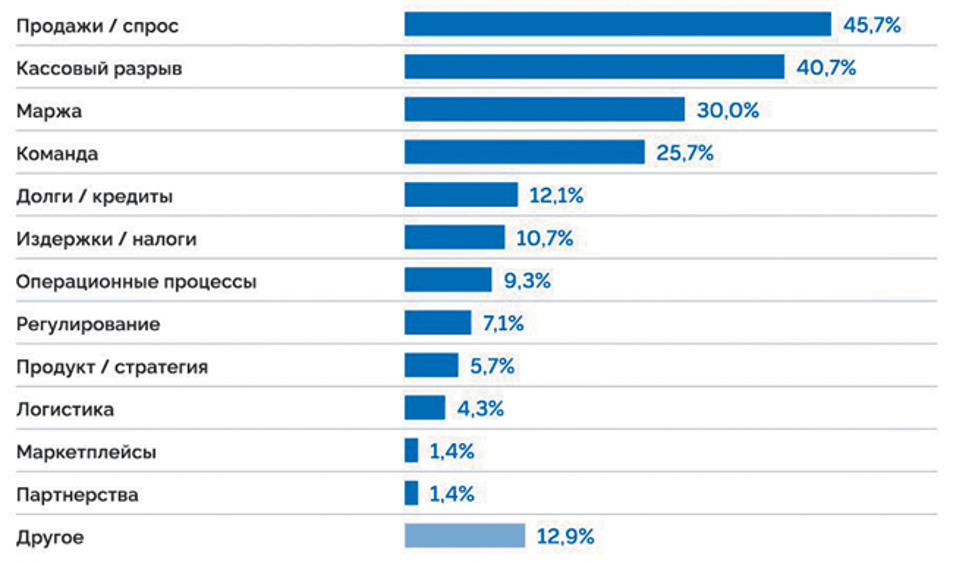
| Продажи / спрос | Sales / demand |
| Кассовый разрыв | Cash-flow gap |
| Маржа | Margin |
| Команда | Team |
| Долги / кредиты | Debt / credit |
| Издержки / налоги | Costs / taxes |
| Операционные процессы | Operational processes |
| Регулирование | Regulation |
| Продукт/стратегия | Product/strategy |
| Логистика | Logistics |
| Маркетплейсы | Marketplaces |
| Партнерства | Partnerships |
| Другое | Other |
Main problems (‘pain points’) reported by entrepreneurs, % of respondents. Respondents could select several answers. Source: Skolkovo Centre for Leadership Development study
Cash-flow gaps have become a recurring theme in business complaints. Many entrepreneurs already describe them as chronic: ‘cash-flow gaps one after another’, ‘we just plug the holes every time’.
Skolkovo experts, however, insist that despite the long chains of non-payments, a cash-flow gap is a consequence rather than the cause of the crisis, and above all a consequence of a business model that has stopped working.
Demand is falling, uncertainty is rising, interest rates are unaffordable, sources of revenue are not guaranteed, yet obligations remain at the same level or increase. Companies have to service existing loans, adapt to the tax burden, maintain staff and pay for rent, infrastructure and services provided by counterparties.
‘A loan can cover a temporary gap, but without recalculating the economics of the business model it increases the risk: the company buys time but does not eliminate the source of pressure,’ the researchers explained. In their view, the key management question now is not ‘Where can we get the money?’, but ‘Which part of the business model can no longer sustain its own economics?’
Notably, the study suggests that SMEs themselves did not always fully recognise that they were sliding into a state of ‘polycrisis’.
According to the surveys, about 78% of respondents took ‘strategic action’ a month or several months after recognising the crisis. A ‘management gap’ emerged between understanding the problem and taking action: businesses lost time and money, the trust of their teams and their negotiating position.
In some cases, matters reached the point of absurdity. This was certainly not widespread, but it did occur: in-depth interviews and focus groups found that some entrepreneurs avoided the word ‘crisis’ altogether because of superstitious beliefs and ‘magical thinking’, convinced that talking about a crisis could itself contribute to a worsening crisis.
Some business owners were also concerned about reputational risks that could arise if they acknowledged that their company was in deep crisis.
There were other reasons for this ‘blindness’: an unwillingness to take unpopular measures within the company until absolutely necessary, as well as an underestimation of the seriousness of the situation, with many negative signals interpreted by entrepreneurs merely as temporary phenomena
‘Our small business owners are not some uniquely far-sighted people. They are ordinary people just like everyone else, and easily susceptible to illusions,’ Oleg Nikolayev, an expert at the Stolypin Institute for Growth Economics and a member of the general council of Delovaya Rossiya, told Nezavisimaya Gazeta. One such illusion, judging from his comments, is an unquestioning belief in government support. ‘Government support certainly exists, but the policy of raising taxes is wiping out all its effects. That is the kind of time we are living through now: not an “economic” one, but something else. And that is the main conclusion you reach after letting go of your illusions,’ Nikolayev added.
In the conclusion to their study, the Skolkovo experts appear to have shifted the emphasis somewhat.
At the beginning of the study, they suggested that SMEs were in a more precarious position almost by definition. By the conclusion, however, they argued that the most vulnerable businesses are not necessarily the smallest or weakest, but those that were least willing to acknowledge the ineffectiveness of their previous decisions for the longest time.
Such decisions might include maintaining an expensive warehouse, an overinflated workforce, excessive debt, ineffective partnership agreements, unprofitable clients or an attempt to concentrate all business processes under a single owner.
ORIGINAL: NG/Small and Medium-Sized Businesses Face an Uncertain Future