At a government meeting on Wednesday, the Cabinet extended until 2030 a mechanism providing increased advance payments for government procurement of priority industrial products. It also expanded the list of products covered by the scheme. The government said the measure would strengthen the financial resilience of companies in the machine-tool industry, lifting and handling equipment and industrial robotics. The Cabinet also approved additional funding for fighting fires in remote forests.
The mechanism for increased advance payments on industrial procurement was introduced in late 2022 as a support measure for machine-tool manufacturers and was subsequently expanded to other industrial sectors. ‘This mechanism has demonstrated its effectiveness over several years and, importantly, strong demand. As a result, companies can operate without having to raise expensive borrowed funds,’ Prime Minister Mikhail Mishustin said at the meeting
On Wednesday, the Cabinet extended the mechanism for another four years. It also expanded the list of equipment covered by the scheme. The list now includes factory conveyors, lifting equipment, soldering and welding tools, machines and equipment for thermal spraying, 3D scanners, lasers, industrial robots, robotic devices and systems. Purchases of such equipment in 2026–2030 will be made with an 80% advance payment on the contract value
The next topic at the meeting was support for regions in fighting forest fires. ‘Our country has the largest forest areas in the world. This requires a rapid response to extreme natural events and measures to prevent their adverse consequences for residents and businesses, as well as effective protection, including against fires,’ Mishustin said.
He also noted that the government had established a systematic approach to tackling the issue.
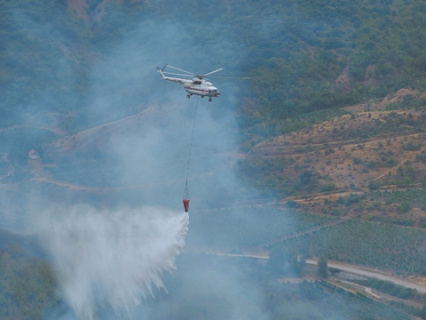
‘A unified digital forest register has been created, containing information on literally every plot. This allows the situation to be monitored continuously. When necessary, additional forces and equipment, including aircraft and helicopters, are deployed for reconnaissance and firefighting, as was the case this spring and summer when fires were tackled in remote and hard-to-reach forests across 10 regions of the country. We will allocate about RUB 4 bln to reimburse Russian regions for these costs,’ the prime minister said.
Earlier, Deputy Prime Minister Dmitry Patrushev said at a meeting on preparations for the fire season that a record amount of government funding, almost RUB 27 bln, had been allocated for forest-fire prevention and firefighting. The money would be used to establish and strengthen aviation units, upgrade their equipment and facilities, create firebreaks and conduct aerial patrols, he said.
The Federal Forestry Agency, Rosleskhoz, explained that the funds would go to regions reducing the areas in which forest fires remain outside active monitoring and response. In 2025, the Republic of Sakha (Yakutia), Zabaykalsky Krai and Krasnoyarsk Krai received an additional RUB 5.3 bln. The regions used the money to establish three new aviation units and recruit 570 specialists for airborne forest-fire brigades. In 2026, a further 19 regions received additional funding, with 11 new aviation units established in eight of them.
Officials have also reported a reduction in the area affected by forest fires. At the end of last year, Rosleskhoz head Ivan Sovetnikov reported significant progress in firefighting. Since the beginning of 2025, 6,800 forest fires had occurred on 4.3 mln hectares of forest land. Over the same period a year earlier, 8,900 fires had been recorded across 8.3 mln hectares.
In 2025, the area affected by forest fires fell by half compared with the previous year. We also remained within the limits set by the presidential decree and did not exceed the target for reducing the area affected by forest fires, which was 4.7 mln hectares that year. For us, this work is not simply about formally meeting regulatory targets, but about genuinely reducing the damage caused by forest fires,’ the agency head said.
At the same time, 4.1 mln hectares, or 95% of the total area affected by forest fires across the country, were concentrated in five Far Eastern regions. The most difficult situation was recorded in Zabaykalsky Krai and Buryatia, which accounted for 3.7 mln hectares, or 86%, of the area affected by fire.
‘A significant share of fires in Zabaykalsky Krai and Buryatia occurred in remote and hard-to-reach areas… It is practically impossible to reach the sites of fires by land. As a result, firefighting was carried out mainly from the air,’ Sovetnikov said.
In the spring of 2026, the area affected by forest fires in Russia also fell by more than half, with fires covering 1.15 mln hectares of forest, compared with 3.2 mln hectares a year earlier, Rosleskhoz reported. Yevgeny Pisarevsky, head of Rosleskhoz’s Forest Fire Protection Department, explained that the agency traditionally divides the fire season into three periods: spring, summer and autumn. In spring 2026, Russia recorded 2,200 fires covering 1.15 mln hectares of forest, compared with 2,800 fires and 3.2 mln hectares the previous year. Rosleskhoz attributed the decline to faster detection and more effective firefighting. According to Pisarevsky, the average area of a detected fire fell by almost half year on year, from 10.2 to 5.5 hectares. Rosleskhoz estimates direct annual losses to Russia from forest fires at RUB 10 bln.
Andrey Khoroshilov, chief executive of environmental service Sokhrani Les, said the government was deliberately expanding the area covered by active fire protection
‘Economically, this means that Russia has taken on the obligation to fight fires across a huge additional territory, which requires new aviation units, personnel and infrastructure. The seasonal trends show that the system is working. It cannot be attributed solely to increased funding: weather, geography and the causes of fires vary considerably. But it would also be wrong to dismiss investment in early detection and aviation,’ he said.
Digitalisation of the forestry sector is continuing. At an all-Russia meeting on the performance of the forestry sector in 2025, Rosleskhoz head Ivan Sovetnikov said 100% of information on forest compartments, subcompartments and title documents had been uploaded to the federal state information system for the forestry sector. However, completing the digitalisation process depends on the quality of the data. The agency has pledged to verify the information entered over a period of 18 months.
Russia’s total forest fund covers more than 1 bln hectares. This year, the state forest inventory will cover 62 mln hectares
The government also extended for another month a ban on producers exporting diesel and marine fuel and gasoil.
‘The decision was taken to maintain stability in the domestic fuel market, including amid increased demand for motor fuel during the harvesting season,’ the government said
Until now, the export ban on diesel for producers had been in place until September 30, 2026, while non-producers were subject to the ban until January 31, 2027. A ban on exports of jet fuel remains in force until November 30. In addition, a complete ban on petrol exports is in place until January 31, 2027. The authorities began imposing fuel export restrictions in the summer amid strikes on oil refineries and rising petrol prices.
The authorities continue to monitor the fuel market. On Tuesday, Deputy Prime Minister Alexander Novak held a meeting on the fuel market with representatives of the Energy Ministry, Agriculture Ministry, Federal Antimonopoly Service, Transport Ministry, State Duma, Federation Council, industry companies and regional governors. Novak stressed the need to take decisions and implement measures as quickly as possible to eliminate local shortages and stabilise domestic fuel prices. Among other things, government agencies were instructed to analyse fuel supplies in the Omsk and Tomsk regions and step up monitoring of pricing. The meeting also addressed supplies to the Irkutsk, Leningrad and Penza regions and the Republic of Sakha (Yakutia).
The extension of the diesel export ban comes amid a severe global diesel shortage. Citi estimates that the global supply-demand gap will reach about 1 mln barrels per day in 2026, while the cumulative drawdown in inventories will amount to 200-250 mln barrels. Analysts attribute this to two key factors: disruptions to supplies from the Middle East and falling Russian exports
Experts estimate the reduction in Russian supplies at 30,000–60,000 barrels per day and the decline in Middle Eastern supplies at 50,000–100,000 barrels per day. The total volume of lost supplies resulting from planned and unplanned refinery shutdowns worldwide has reached 3–4 mln barrels per day
In 2025, Russia exported 294 mln barrels of diesel, ranking second globally in terms of supply after the US. Continued restrictions amid the global shortage mean that the world market is losing one of its key suppliers, which analysts say will continue to push up diesel prices in Europe and Asia. (See Nezavisimaya Gazeta, September 27, 2026)
ORIGINAL: NG/Industrial Robotics to Be Shielded from High Borrowing Costs