Reports by the Russian central bank on regional economies allow the negative trend affecting the country as a whole to be obscured. After all, against a backdrop of a record decline in investment nationwide, it is always possible to find one or two regions where capital investment is rising. Nevertheless, the Bank of Russia’s latest report notes a decline in demand for domestic tourism services, while e-commerce volumes have fallen because of damage to warehouse infrastructure
According to official statistics, investment in Russia is currently declining at a rate of 9.9%. The government hopes to limit the decline to 5.4% for the year as a whole. Meanwhile, changes in Russian GDP are measured in tenths of a percentage point. Yet the Bank of Russia manages to find the mildest possible language to describe these disheartening figures.
‘In August and September, economic activity was broadly unchanged from June and July. Trends varied across industries and regions. In the Volga-Vyatka region, output continued to grow in industries serving investment demand, including demand from the public sector. In the Urals, sales of lorries and specialised vehicles increased, as did orders for equipment repairs. Companies in the North-West increased passenger car production; in the South, production facilities were modernised to expand chemical output; and Siberian coal companies continued to increase exports, after rerouting shipments through Far Eastern ports,’ the central bank says at the start of its latest report on regional economic conditions
However, more important figures can be found deeper in the 70-page report. According to the Bank of Russia’s business monitoring data, companies’ assessments of current investment activity edged down in the third quarter of 2026 compared with the second quarter. The main constraints on investment in the third quarter were economic uncertainty, a shortage of companies’ own funds to finance investment and insufficient demand for the goods and services offered by survey respondents
The central bank’s report contains no precise industry-by-industry estimates of the investment decline. Instead, it offers isolated examples of individual companies maintaining capital investment
Mining output fell by 1% in the first eight months of 2026 compared with the same period a year earlier. This was largely due to lower oil production as the capacity of oil refineries declined.
Companies continued to invest in developing their own production facilities. Investment activity remained particularly strong in the mining of non-ferrous metal ores. For example, a metallurgical company in the Urals is carrying out investment projects to expand its resource base in several Russian regions. The central bank attributes investment activity in this segment to strong demand from high-technology industries.
‘Despite a decline in physical production volumes, profits in the extractive sector rose by 35.9% in the first seven months of 2026 thanks to favourable prices. This provides a foundation for future investment in the industry,’ the central bank said.
Manufacturing output grew by just 0.4% year on year in the first eight months of 2026. Yet here too, the central bank finds positive examples.
‘Government orders and support measures continue to stimulate investment and business activity in manufacturing. For example, in early 2026, a major carmaker in the Volga-Vyatka region opened a new automotive components plant built with preferential financing,’ central bank officials report, as though the opening of a components plant in the Volga-Vyatka macroregion could change the overall picture of an investment slump of almost 10%.
Output and investment continue to grow in engineering companies focused on government orders, while demand for skilled workers remains high. ‘However, uncertainty about whether government contracts will be extended or the volumes supplied under them increased often constrains these companies’ ability to expand their investment programmes,’ the central bank report notes
The volume of construction work fell by 2.9% in the first eight months of 2026. ‘This may be linked to a decline in current investment in the construction of industrial and infrastructure facilities,’ central bank analysts suggest.
Retail turnover rose by 5.1% in the first eight months of 2026, while the volume of paid services to households increased by 2.4% year on year. The positive trend reflects continued growth in real household incomes.
‘Large retail chains across Russia’s regions continued investing in more self-checkout terminals to optimise labour costs. As delivery times on online marketplaces lengthened, retailers in various regions reported increased sales,’ the central bank says.
‘Consumer activity was moderate in August and September. Consumption generally declined across European Russia. Growth continued in the eastern part of the country, but at a slower pace. Domestic tourism continued to lose momentum in traditional holiday destinations. Damage to warehouse infrastructure and the resulting logistical difficulties faced by online marketplaces led to a slight decline in e-commerce turnover. Traditional retail did not fully offset this decline, although it did lead to a modest improvement in assessments of demand among bricks-and-mortar retailers,’ central bank officials explain.
The SberIndex laboratory provides quantitative estimates of this ‘moderate consumer activity’. Adjusted for inflation and seasonality, consumer spending in the third quarter of 2026 fell by 2.2% compared with the second quarter. The contributions to this change were: non-food goods, −1.6 percentage points; food, −1.1 percentage points; food service, −0.1 percentage points; and services, +0.5 percentage points
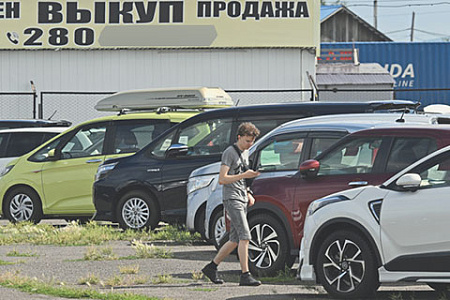
‘Overall, as wage growth slows, consumers are becoming more cautious and sales of expensive goods have begun to decline. Siberian manufacturers reported weaker demand for furniture. Passenger car sales fell in the Volga-Vyatka region. Retailers in the Far East reported a slight decline in demand for household cleaning products and cosmetics,’ central bank analysts said.
ORIGINAL: NG/Russian consumer spending falls 2% in a quarter