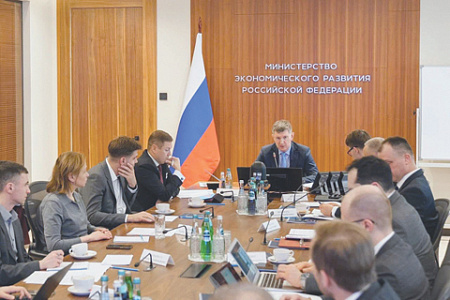
The Russian government responded to President Vladimir Putin’s inquiry about why macroeconomic indicators are still falling short of its own forecasts. In response, ministers revised their official forecasts downward to match the current stagnation, as well as the ongoing investment crisis and industrial downturns. The revised forecast cuts GDP growth expectations for the year from 1.3 % to 0.4 %. The government’s management of the economy is also reflected in the new Plan for Structural Changes in the Russian Economy for 2026, which projects investment growth instead of a decline. This growth will be overseen by Deputy Prime Minister Alexander Novak, who also announced the drop in capital investment in both the new and the previous government forecasts
In mid-April, President Vladimir Putin convened a significant meeting on economic matters, demanding explanations for ‘why the trajectory of macroeconomic indicators remains below expectations’ of both the government and the Central Bank of Russia. Despite the publication of unexpectedly positive data for March, the first quarter is still expected to show a decline in GDP compared to the same period last year (see Nezavisimaya Gazeta (NG) dated May 7, 2026). Moreover, meeting the government’s planned 1.3 % economic growth now appears virtually impossible. As a result, to avoid having the macroeconomic trajectory fall short of expectations, officials decided to downgrade their own forecast for the year.
Russia’s official GDP growth forecast for 2026 has been revised down to 0.4 %, Deputy Prime Minister Alexander Novak said in an interview with Vedomosti. The Ministry of Economic Development’s earlier forecast from September 2025 had projected 1.3 % growth for the year
Both the old and new forecasts reflect the continuation of the investment crisis. After a 2.3 % decline in investments last year, capital investment in Russia’s economy is expected to drop even further this year.
What’s surprising, however, is that the government’s Plan for Structural Changes in the Russian Economy until 2030 does not foresee a reduction in investment, but rather its growth. The plan designates Novak as responsible for ‘improving the quality of the investment climate’, which will be assessed ‘through the indicator of investment growth in fixed assets compared to the 2020 level’. According to the Plan for Structural Changes, investments were meant to steadily increase. The planned growth compared to the 2020 level was 36.6 %, 39 %, and 42.1 % for 2024, 2025, and 2026, respectively. Alongside Novak, the Ministry of Economic Development, headed by Maxim Reshetnikov, is also tasked with ensuring the continuous increase in investments under the Plan for Structural Changes.
The Central Bank’s policy of extremely high interest rates has rendered investments unfeasible across most sectors of the economy. At the end of last year, the supply of investment goods was only around 86 % of the average monthly level from mid-2024, and by February this year, it had dropped to about 84 %. ‘One of the main reasons for the investment downturn is the prolonged ultra-tight monetary policy,’ experts from the Centre for Macroeconomic Analysis and Short-Term Forecasting say (see NG dated April 27, 2026).
In the government’s latest forecast, investment decline for the year is projected to be 3.5 % in the conservative scenario or 1.5 % in the base case.
Beyond the prolonged investment slump, the government must also tackle growing budgetary issues. The government faces the challenge of balancing the budget amid declining revenues and rising expenditure needs, particularly in defense and security, said Deputy Prime Minister Alexander Novak.
‘The key task here is prioritising spending and focusing on the most effective areas that offer the greatest return, such as technological leadership projects,’ Novak explained.
However, the government’s budgetary decisions have yet to meet efficiency goals. In Russia, tax reform has had the opposite effect: as tax rates have increased, tax revenues from small and medium-sized businesses (SMEs) have dropped, according to experts from the Stolypin Institute for Economic Growth
Authorities expected that increasing VAT and tightening the rules for the simplified tax system (STS) would yield additional budget revenues. In practice, however, the fiscal maneuver led to microbusinesses shifting to individual entrepreneurship (IE), which resulted in lower tax revenues.
Total tax revenue for the consolidated budget fell by 8.2 %, amounting to about 8.3 trillion roubles. This decline was primarily driven by a drop in oil and gas revenues, according to experts from the Stolypin Institute. However, VAT receipts have only grown modestly—around 10 %, similar to the first quarter of 2025, when there was no VAT increase.
The combination of higher tax rates, increasing debt levels, and falling demand has had a serious impact on businesses. Surveys show that around 65 % of small and medium-sized enterprises (SMEs) reported no profits in the first quarter. By January, many businesses had switched to cash payments, with entrepreneurs, according to reports, offering discounts for customers who refuse card payments. Experts predict a rise in the shadow economy. In response, financial authorities have introduced a ‘tax amnesty’ for the hospitality industry, easing the exemption from VAT for some businesses. However, the first months have shown that the fiscal impact of higher taxes may be negligible or even negative, warn analysts.
While the tax hikes in Russia are leading to reduced revenue, tariff regulation is approaching a critical point
And while the public is currently absorbing the impact of higher tariffs, both government officials and monopolists are planning accelerated increases. For instance, authorities plan to raise electricity tariffs for households by 15.2 % this year and another 15.3 % next year. Last year, the tariff increase was 11.6 %.
The overall cost for citizens’ utility bills is set to rise by 9.9 % this year, with another 8.7 % increase expected next year.
ORIGINAL:NG/Russian Investment Could Fall Another 3.5 % This Year