At a government meeting on Thursday, the cabinet ordered the allocation of an additional RUB 5 bln to maintain existing stocks in the grain intervention fund. The Ministry of Agriculture had previously pledged to purchase another 3 mln tonnes of grain to support farmers struggling to sell their crops. Rising costs for agricultural producers could adversely affect the next planting season and next year’s harvest, the central bank warns
At Thursday’s government meeting, ministers also updated the list of strategically important medicines, which now contains 354 drugs. Prime Minister Mikhail Mishustin said the list includes medicines to treat diabetes, acute myocardial infarction, malignant tumours and other serious diseases and dangerous infections
‘It is important to continue increasing production and expanding the range of medicines made by Russian pharmaceutical companies so that our citizens have reliable access to quality domestically produced medicines, both in major cities and in smaller communities,’ the prime minister stressed. Support for farmers was the next item on the meeting’s agenda. ‘Harvesting has been completed on more than 90% of the sown area. It is already clear that the harvest will be no smaller than in previous years, although we have always been cautious in our forecasts. This will meet domestic demand, with a surplus in some product categories,’ Mishustin said on Thursday.
According to the Bank of Russia, by early October farmers had harvested grain from almost 90% of the area, collecting more than 126 mln tonnes of grain in bunker weight, including 93 mln tonnes of wheat. Harvesting progressed more slowly than last year, but average yields were higher. Food-grade wheat accounted for 78.4% of the total wheat harvest, above last year’s figure and close to the five-year average, according to the central bank’s regional economic report.
The Ministry of Agriculture estimates that the grain harvest could reach 140 mln tonnes this year, exceeding the five-year average and remaining close to last year’s level. Wheat output is expected to be in line with last year’s harvest of 91.1 mln tonnes. The report stresses that the expected grain harvest, together with stocks from previous years, will be sufficient to meet domestic consumption in full.
The Bank of Russia, headed by Elvira Nabiullina, also highlights declining grain producer prices.
‘Average grain producer prices declined year on year in August amid lower export shipments and rising stocks. This could have an additional disinflationary effect as the 2026 harvest reaches the market,’ the regulator said.
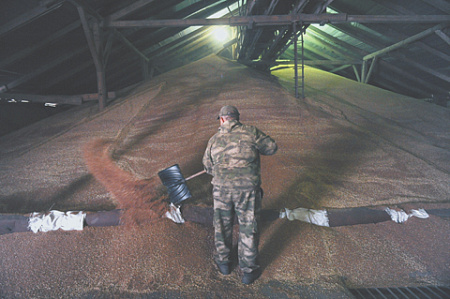
State purchases of grain for the intervention fund are planned to support agricultural producers.
Russia’s system of grain purchase interventions, in which the state buys grain, and commodity interventions, in which grain is sold from the state intervention fund, has operated since 2001. It is intended to stabilise grain market prices and support farmers. During grain purchase interventions, the state removes surplus grain from the market to halt price declines. When prices rise sharply, it sells grain from the fund to curb the increase. The most recent purchasing auctions took place in the first half of 2024, while sales from the fund ran from August 2024 to June 2025.
The state fund currently holds an estimated 3.7 mln tonnes of grain, with most stocks stored in Siberia and the Volga region. Other reserves are distributed across the Urals, Central and Southern federal districts. Food-grade wheat accounts for the bulk of the stock, at more than 3.6 mln tonnes. The grain is stored at 147 specialised facilities in 22 regions.
According to Mikhail Mishustin, the mechanism is designed to sustain farm profitability, strengthen food security, smooth price fluctuations and ensure that the country maintains sufficient reserves.
‘We will allocate more than RUB 5 bln to maintain the existing stocks of the agricultural intervention fund. Importantly, this will ensure that the grain already purchased is preserved,’ the Russian prime minister said on Thursday.
In late September, President Vladimir Putin backed grain purchases for the state intervention fund and instructed the government to proceed with the purchases. The decision followed difficulties farmers faced in selling grain during the current agricultural year because of logistical problems and damage to port infrastructure (see Nezavisimaya Gazeta, August 23 and October 7, 2026).
Agriculture Minister Oksana Lut previously said a new round of grain purchase interventions could begin in late October, with purchases totalling 3 mln tonnes. The United Grain Company, which will act as the intervention agent, has begun selecting operators to store state grain stocks on the instructions of the Ministry of Agriculture. The selection is taking place in 14 regions: Krasnodar and Stavropol territories and the Voronezh, Kursk, Lipetsk, Tambov, Ryazan, Volgograd, Rostov, Orenburg, Penza, Samara, Saratov and Ulyanovsk regions.
The grain market remains under pressure, with Russian wheat exports falling. According to the Institute for Agricultural Market Studies (IKAR), wheat exports exceeded 2.4 mln tonnes in September and totalled 6.4 mln tonnes from June to September. The Rusagrotrans analytical centre estimates that Russia exported almost 2.7 mln tonnes of wheat in September, while it estimated potential shipments between July and September at 6.6 mln tonnes. The Russian Grain Union (RGU) estimates that wheat exports in August amounted to 1.3 mln tonnes, approximately 74% lower than a year earlier. The union said this was the lowest level since 2017.
The main reason for the decline in exports is the suspension of operations at ports in the Azov–Black Sea basin and difficulties shipping grain along established routes.
According to Rosstat, agricultural enterprises sold 5.9 mln tonnes of wheat in September, 26.4% less than in the same month of 2025 (8.1 mln tonnes). Wheat sales rose by 6.7% to 33.3 mln tonnes in the first nine months of the year. Agricultural enterprises sold a total of 8.2 mln tonnes of grain and pulses in September, down 24.7% year on year. Sales over the first nine months rose by 6.7% to 48 mln tonnes.
In September, the governors of Stavropol Territory and Rostov Region asked the Ministry of Agriculture to increase grain purchases for the intervention fund to 10 mln tonnes at a price of RUB 15 per kg.
‘Together with Rostov Region Governor Yuri Borisovich Slyusar, we submitted a joint letter… We would very much like the state to approve a grain intervention of at least 10 mln tonnes. We asked for a purchase price of RUB 15 per kg because we fully understand that production costs are currently at least RUB 10 per kg, depending on yields,’ Stavropol Governor Vladimir Vladimirov said.
Regional authorities also proposed deferring principal and interest payments on loans for agricultural producers facing financial difficulties because of the current situation on the grain market.
Farmers’ costs have indeed risen, according to the central bank’s regional economic report.
‘Agricultural producers report substantial increases in the costs of fuel and lubricants, fertilisers, seeds and machinery maintenance. This could affect the next sowing campaign and next year’s harvest,’ the regulator noted. The central bank also pointed out that the Ministry of Agriculture had reduced its winter crop planting target for the 2027 harvest to 19 mln hectares, down from the previously planned 20 mln hectares.
ORIGINAL: NG/Russian farmers to get support through wheat purchases